


Most billing setups don't fail all at once. They fail in the gaps between systems. The invoice gets sent, the payment lands three days later in a different tool, the ledger doesn't get updated, and by month-end you're staring at a $600 discrepancy nobody can explain. Not because anyone made a big mistake — because the parts weren't designed to talk to each other cleanly.
If you've ever spent a Sunday reconciling Stripe against your accounting software line by line, you already know the problem isn't billing. It's the architecture of billing — the way invoicing, payments, the ledger, and notifications hand off data to one another. Get the handoffs right and reconciliation becomes boring. Get them wrong and every growth spurt makes the mess worse.
This is a systems piece, not a tips list. The goal is to give you a mental model for how a small business billing system architecture should be shaped, what breaks as you scale, and a few concrete data contracts and failure workarounds you can copy so payments and your books stop drifting apart.
The five components, and why people blur them together
Every billing system — whether it's a solo freelancer with three tools or a 12-person shop — is really five distinct components doing five distinct jobs:
-
Billing — deciding what a customer owes (rates, quantities, discounts, taxes).
-
Invoicing — turning that into a document with an ID, dates, and terms.
-
Payments — the money movement (Stripe, ACH, card, wire).
-
Ledger — the source of truth for what happened financially.
-
Notifications — reminders, receipts, dunning, internal alerts.
The reason so many setups break is that people treat these as one thing. "My billing system" usually means "the tool I make invoices in," and everything else is assumed to follow. It doesn't. The payment processor has its own record of reality. The accounting software has another. The invoice tool has a third. When those three disagree, you're the reconciliation engine.
Worth noting: the businesses with the cleanest books aren't the ones with the fanciest tools. They're the ones who decided early which component owns which fact. The ledger owns "was this paid." The billing logic owns "what was owed." The payment processor owns "how the money moved." When ownership is clear, conflicts get resolved by a rule instead of a guess.
What breaks at each stage of growth
The failure modes change depending on volume. What's harmless at 15 invoices a month becomes a genuine problem at 150.
Stop chasing payments and start automating your billing.
Billoly empowers you to create, send, and track invoices effortlessly while maintaining professional client relationships.
- Customizable invoice templates
- Automated payment reminders
- Real-time payment tracking
No credit card required
| Stage | Typical setup | Where it breaks | What it costs |
|---|---|---|---|
| Solo / ~10 invoices/mo | One invoice tool, manual payment entry | Forgetting to mark invoices paid; missed reminders | A few hours a month, occasional double-asks |
| Small team / 30–80/mo | Invoice tool + Stripe + accounting app | Payments landing but not syncing to ledger; partial payments untracked | Reconciliation drift of $200–$800/mo |
| Growing / 100–300/mo | Multiple channels, subscriptions, some automation | Duplicate charges, refund mismatches, tax rounding gaps | Real revenue leakage + audit risk |
| 10+ person | Semi-integrated stack, roles split | No single source of truth; blame ping-pong between people | Days of close time, trust erosion |
The jump that hurts most is usually the middle one. Around 30–80 invoices a month, manual reconciliation is still technically possible, so people keep doing it — right up until they don't have time, and then two months of drift pile up at once. In practice, this is often where a business discovers it's been under-collecting on partial payments without ever realizing it.
The core idea: design your data contracts first
Before touching any tool, decide what data every component must produce and consume. This is the part almost nobody does, and it's the part that determines whether you'll spend your weekends reconciling.
A data contract is just an agreement: when an invoice is created, it will always carry these fields, in this shape. When your invoicing tool and your ledger agree on the contract, the sync is straightforward. When they don't, you get orphaned records.
{ "invoiceid": "INV-2024-0417", "clientid": "CL-338", "issuedate": "2024-05-02", "duedate": "2024-05-17", "currency": "USD", "lineitems": [ { "description": "Design retainer - May", "qty": 1, "unitamount": 250000, "taxcode": "NONE" } ], "subtotal": 250000, "taxtotal": 0, "total": 250000, "status": "sent", "externalrefs": { "paymentintent": null, "ledger_entry": null } }
Two things to notice. First, amounts are in integer cents (250000 = $2,500.00), never floats. Float math is where those mystery one-cent rounding differences come from. Second, the externalrefs block — this is the connective tissue. When a payment lands, you fill in paymentintent. When it hits your books, you fill in ledger_entry. Now any record can be traced across all three systems.
{ "paymentid": "pay9fK2", "invoiceid": "INV-2024-0417", "amountreceived": 250000, "currency": "USD", "status": "succeeded", "receivedat": "2024-05-14T10:22:00Z", "method": "card", "processorfee": 7550 }
The single most important field here is invoice_id. If your payment event can't point back to a specific invoice, you end up matching by amount and date — and the moment two clients pay the same amount in the same week, that breaks. Carry the invoice reference into the payment. Stripe lets you do this with metadata; most processors have an equivalent. Use it every time.
Low-cost integration patterns that actually hold up
You don't need a middleware platform to connect these components. For most small businesses, three patterns cover almost everything.
Pattern 1 — The reference-carrying webhook. Your payment processor fires a webhook when money moves. That webhook carries the invoiceid from metadata. A small script or no-code automation catches it, updates the invoice status to paid, and writes the ledgerentry. Cheap, reliable, event-driven. The catch: webhooks can fail or fire twice, which brings us to failure modes below.
Pattern 2 — The nightly reconciliation sweep. Even with webhooks working, run a once-a-day job that pulls all payments from the processor and all open invoices, then flags anything that doesn't match. This is your safety net. Webhooks are for speed; the sweep is for truth. Businesses that run both almost never have surprise month-end drift.
Pattern 3 — The export-and-map bridge. For anything your tools genuinely can't connect, a clean CSV export with a fixed column mapping is far more reliable than a flaky integration. The field-mapping discipline matters more than the mechanism — the same thinking laid out in this walkthrough on integrating invoices with bookkeeping applies directly here.
A quick note on ordering these: start with the nightly sweep even before webhooks. A daily reconciliation catch-all buys you room to add real-time syncing later without fear. Most people do it backwards — they build the fancy webhook flow first and skip the boring safety net, then get burned when something silently misfires for two weeks.
The failure modes nobody warns you about
These are the specific gaps that cause reconciliation pain, and the workarounds you can copy.
-
Duplicate webhook delivery. Processors retry webhooks, so the same "payment succeeded" can arrive twice, marking an invoice paid twice or double-writing to the ledger. Workaround: make every write idempotent using the
paymentidas a key. Before writing, check whetherpay9fK2has already been processed. If yes, skip. This one fix prevents a whole category of phantom entries. -
Partial payments with no home. A client pays $1,500 on a $2,500 invoice. Many tools mark it "paid" or "unpaid" — neither is accurate. Workaround: your invoice contract needs an
amount_paidfield separate fromtotal, and status logic that supportspartial. Sum payments against the total; don't rely on a boolean. -
Refunds that never reverse in the ledger. The refund goes out through the processor, but nobody tells the books. Your revenue looks higher than it is. Workaround: treat refunds as first-class payment events with a negative amount and the same
invoice_id. If it moves money, it gets an event. -
Processor fees eaten silently. You invoiced $2,500, received $2,425 after fees, and recorded $2,500 as collected. Multiply that gap across a year and it's real money. Workaround: record
processor_feeon every payment event and book it as an expense, not as reduced revenue. -
Timezone-shifted dates. A payment at 11pm local looks like it happened the next day in UTC, landing in the wrong month for close. Workaround: store everything in UTC, convert only for display, and pick one timezone rule for period cutoffs and stick to it.
-
Currency rounding drift. On multi-currency invoices, converting each line separately then summing gives a different total than converting the sum. Workaround: round once, at the total, and store the FX rate used on the invoice so the number is reproducible later.
The theme across all of these: reconciliation problems are almost never about money being stolen — it's about money being mislabeled or double-counted because two systems disagreed and nobody arbitrated. A minimal, enforced schema is what does the arbitrating. Same principle behind treating your invoice data as governed data rather than something each tool defines on its own.
A concrete reconciliation workflow you can copy
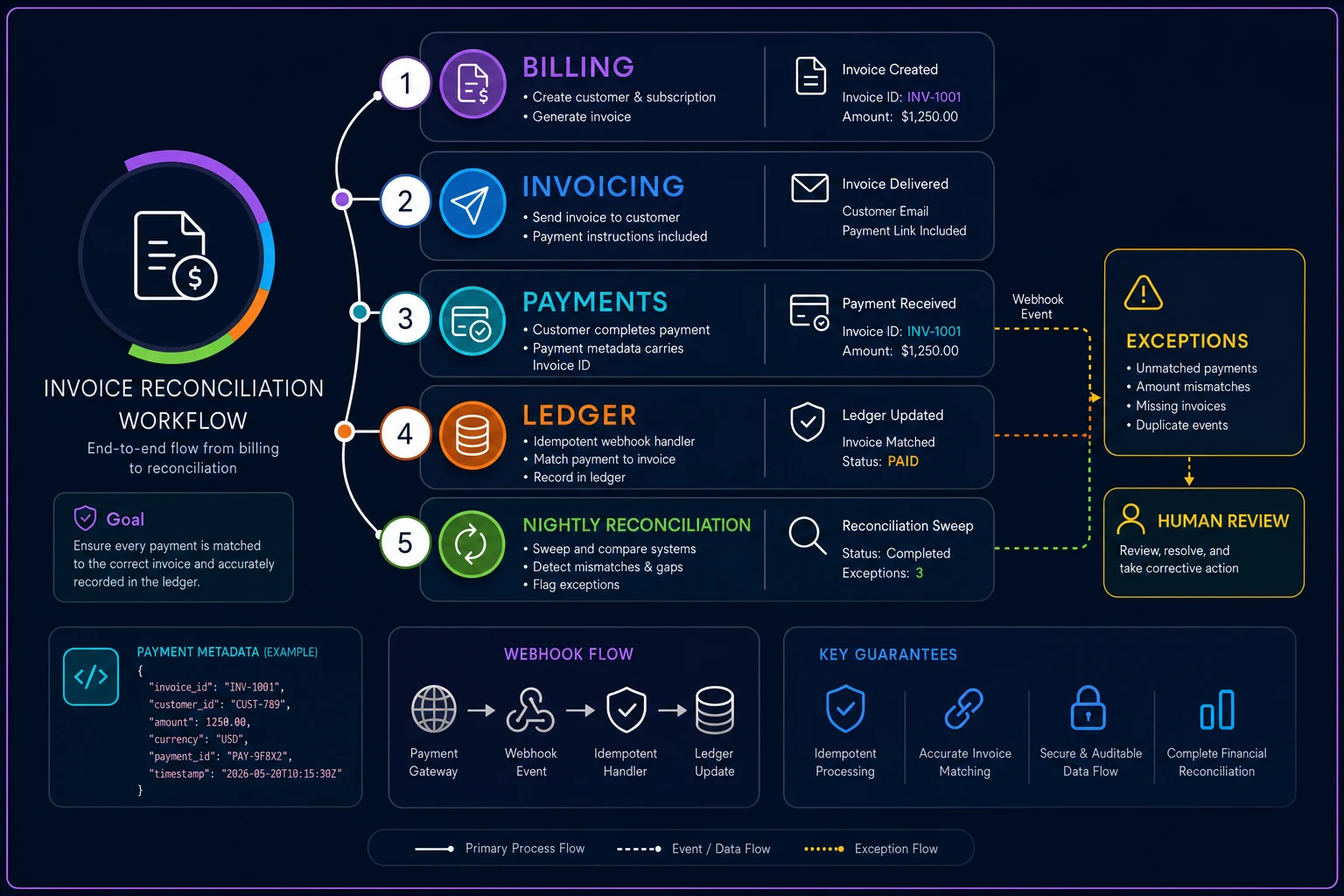
Here's the end-to-end flow a well-built small business billing system actually follows, in plain terms:
-
Billing logic calculates what's owed and produces an invoice record (integer cents, tax codes, currency).
-
Invoicing assigns the ID, dates, and terms, then sends it and sets status to
sent. -
The invoice ID is attached to the payment request as metadata before the customer ever pays.
-
Customer pays; the processor fires a webhook carrying that invoice ID.
-
An idempotent handler checks
paymentid, updatesamountpaid, sets status topaidorpartial, and writes a ledger entry with theexternal_reffilled in. -
Notifications fire — receipt to the client, internal confirmation.
-
Overnight, the reconciliation sweep pulls every processor transaction and every open invoice, matches on invoice ID, and flags mismatches into an exceptions list.
-
A human reviews only the exceptions — usually a handful, not the whole ledger.
Step 8 is the payoff. When the system is built this way, you stop reviewing everything and only touch what genuinely doesn't line up. That's the difference between a two-hour close and a two-day close. The process isn't glamorous, but it's the kind of thing that compounds quietly in your favor every single month.
Here's a quick visual summary of that flow.
Step 8 is the payoff. When the system is built this way, you stop reviewing everything and only touch what genuinely doesn't line up. That's the difference between a two-hour close and a two-day close. The process isn't glamorous, but it's the kind of thing that compounds quietly in your favor every single month.
When to build this vs. when not to bother
When it makes sense: You're above roughly 30–40 invoices a month, you take more than one payment method, or you've had even one month where the books didn't tie out and it took real effort to find why. That's the signal the manual approach has hit its ceiling.
When it's overkill: You're doing five or six invoices a month, all through one processor, all paid in full. Building idempotent webhook handlers for that is a waste of a weekend. Mark them paid by hand and move on. Architecture should match volume.
Who should be careful: Anyone tempted to wire up a chain of no-code automations without a reconciliation sweep. Automation that fires and forgets, with no daily truth-check, tends to create silent drift that's worse than manual work — because you trust it. Decide your automation scope deliberately; the framework in this piece on billing automation governance is worth reading before you connect anything to your ledger.
Real scenario: a small consultancy at the drift point
A four-person marketing consultancy running around 60–70 invoices a month — a mix of monthly retainers and one-off project fees, paid through both card and ACH. Their setup was an invoice tool, Stripe, and accounting software, loosely connected by "we'll check it later."
The problem showed up as a slow bleed. At month-end, their books and Stripe were consistently off by somewhere between $300 and $900. The causes were exactly the boring ones: a few partial payments marked as fully paid, processor fees recorded as if they'd collected the full amount, and two refunds that never made it back to the ledger. None of it was fraud. All of it was mislabeling.
They did two things. First, they moved everything to integer-cent amounts and added amountpaid and processorfee fields to their invoice records. Second, they set up a nightly sweep that matched Stripe transactions against open invoices by invoice ID and dumped mismatches into a short exceptions list.
Within a couple months, monthly reconciliation went from a half-day hunt to roughly 20–30 minutes of clearing exceptions. The recovered fee-and-refund gaps came out to a few hundred dollars a month they'd been quietly losing. Nothing dramatic changed in their tooling — they just stopped letting three systems disagree without a referee.
The takeaway that actually matters
Decide which component owns which fact, and make every record carry a reference to every other record. Invoice IDs on payments. Payment IDs on ledger entries. Amounts in cents. Fees and refunds as real events, not afterthoughts. A nightly sweep as your safety net.
None of this requires expensive software. It requires deciding, on purpose, how your billing components hand data to each other — and refusing to let any one of them define reality alone. The businesses that get this right scale from 30 to 300 invoices a month without their close time exploding. The ones that don't spend one weekend a month acting as the reconciliation engine their system should have been all along.
Decide which component owns which fact, and make every record carry a reference to every other record. Invoice IDs on payments. Payment IDs on ledger entries. Amounts in cents. Fees and refunds as real events, not afterthoughts. A nightly sweep as your safety net.
None of this requires expensive software. It requires deciding, on purpose, how your billing components hand data to each other — and refusing to let any one of them define reality alone. The businesses that get this right scale from 30 to 300 invoices a month without their close time exploding. The ones that don't spend one weekend a month acting as the reconciliation engine their system should have been all along.
Ready to streamline your billing process?
Join 5,000+ businesses using Billoly to reduce billing delays, automate payments, and grow revenue efficiently.