



Most service businesses think they have a sales problem or a collections problem. What they actually have is a seam problem.
The seams are where work passes from one person (or one tool) to another. Sales quotes a price in an email. Someone writes a contract that says something slightly different. Billing invoices off a third interpretation. Then collections chases a number nobody can fully explain, and bookkeeping tries to reconcile the whole mess at month-end. Every one of those handoffs is a place where money leaks or slows down.
The frustrating part is that each department usually does its job fine. The price was reasonable. The contract was signed. The invoice went out. But nobody owns the flow — pricing to contract to billing to collections to cash application — as one connected system. So the business runs on tribal knowledge and heroics, and revenue quietly leaks through the gaps.
This is a playbook for treating that whole chain as a single lean operating system. Not five separate functions bolted together, but one pipe with controlled handoffs, shared definitions, and the ability to catch and roll back mistakes before they cost you.
The core problem: every stage speaks a different language
This pattern shows up across service SMBs of almost every type — agencies, consultancies, trades, IT shops, bookkeeping firms.
Sales thinks in deals. "We landed the Henderson account at $6k a month."
Contracts think in terms. "Twelve-month agreement, net-15, 10% annual increase, scope limited to Schedule A."
Billing thinks in line items. "Monthly retainer $6,000, plus whatever overages came in."
Collections thinks in aging buckets. "The Henderson invoice is 40 days out."
Bookkeeping thinks in reconciled transactions. "A $5,850 deposit hit the account and I have no idea which invoice it maps to."
Notice what happened. The deal was $6k. The deposit was $5,850. Somewhere in that chain, a processing fee or a credit or a partial payment entered the picture, and because no two stages used the same reference numbers or definitions, reconciliation turns into detective work.
This usually happens because information gets re-typed at every stage instead of carried forward. Sales writes it in a CRM note. Contracts rewrite it in a Word doc. Billing rewrites it into the invoicing tool. Each re-typing is a chance to introduce drift.
What actually breaks, and where
Let me be specific about the failure points, because "communication could be better" is useless advice.
Stop chasing payments and start automating your billing.
Billoly empowers you to create, send, and track invoices effortlessly while maintaining professional client relationships.
- Customizable invoice templates
- Automated payment reminders
- Real-time payment tracking
No credit card required
The pricing-to-contract seam. Sales promises a discount or a flexible start date verbally, and it never makes it into the signed agreement — or worse, it makes it into the agreement but not into the billing setup. You end up honoring a price you can't find documented, or billing a price the client never agreed to.
The contract-to-billing seam. The contract says net-15 with a 1.5% monthly late fee. The invoice goes out net-30 with no late terms because that's the template default. Now your contract and your actual billing behavior disagree, which makes any late-fee enforcement legally shaky.
The billing-to-collections seam. An invoice goes out with a vague line item ("Consulting services — October"). The client's AP department can't match it to a PO, so it sits in their queue. Your collections person calls and can't answer "what was this for exactly?" because the detail lives in someone's head.
The collections-to-cash-application seam. Payment arrives short or batched across multiple invoices. Nobody can tell whether it's a partial payment, a disputed deduction, or a client paying two invoices with one transfer. The receivable stays "open" in your books even though cash is in the bank.
Each seam looks minor on its own. Stacked together, they're why a business doing roughly $900k in annual revenue can have $40k–$70k floating in "we're not sure" status at any given time.
The fix is a data contract, not a meeting
The instinct when things fall through the cracks is to add a meeting. "Let's do a weekly sync between sales and billing." That helps for about three weeks and then decays.
The durable fix is a data contract — a shared, minimal set of fields that every stage must fill in and carry forward. Think of it as the passport the deal carries from pricing all the way to cash application. Nothing moves to the next stage without it.
dealid: HEN-2024-0142 (never changes, follows the deal forever) clientlegalname: Henderson Retail LLC contractprice: 6000.00 billingfrequency: monthly paymentterms: net-15 latefeeterms: 1.5%/month after day 15 scopereference: Schedule A v2 porequired: yes ponumber: (filled at contract stage) startdate: 2024-11-01
The rule is simple: the deal_id is sacred and immutable. It appears on the contract, on every invoice, in the memo line of every payment request, and in your bookkeeping reference field. When a $5,850 deposit shows up, you don't play detective — you look at the memo, see HEN-2024-0142, and know exactly what it is and why it's short.
This is the same discipline behind good invoice data governance using a minimal schema — except here we're extending that schema backward into sales and contracts, not just forward into bookkeeping. The money problem usually starts upstream of the invoice.
Mapping contract fields to invoice controls
A contract is only useful if its terms actually control billing behavior. Most teams never connect the two, which is how you get contracts that say one thing and invoices that do another.
| Contract field | Invoice control it should trigger | Common failure if disconnected |
|---|---|---|
| Payment terms (net-15) | Due date auto-calculated from issue date | Invoice defaults to net-30, cash arrives two weeks late |
| Late fee clause | Late fee logic enabled on the account | Fees never charged, or charged with no contractual basis |
| PO required: yes | Invoice blocked until PO number entered | Invoice sits unmatched in client's AP queue |
| Scope reference | Line item description pulls scope ID | Vague descriptions, disputes, slow approvals |
| Annual increase % | Price change flagged at renewal date | You bill the old rate for months and lose the increase |
| Billing frequency | Recurring schedule set correctly | Missed cycles, double-bills |
Each contract term has a matching enforcement point at billing. When those two drift apart, revenue leaks. When they're locked together, the system enforces your own agreements for you.
Rollback gates: the part almost nobody builds
There's an idea borrowed from software deployment that service businesses almost never apply to money: recoverable rollback gates.
-
Pre-contract gate. Before a contract is generated, someone confirms the price, terms, and scope match what sales promised. If they don't match, it goes back to sales — not forward to the client.
-
Pre-invoice gate. Before an invoice sends, the system (or a person) checks it against the data contract. Wrong terms? PO missing? It doesn't send. This is the cheapest place to catch an error.
-
Pre-collections gate. Before collections contacts a client, someone confirms the invoice is actually correct and actually unpaid. Chasing a client for an invoice you botched destroys trust fast.
-
Pre-close gate. Before books close, every payment is applied to a specific deal_id. Anything unapplied gets flagged, not buried.
The key word is recoverable. A gate that just stops everything is a bottleneck. A good gate catches the problem, routes it back to the right owner, and lets everything else keep flowing. In practice, the pre-invoice gate alone eliminates most downstream reconciliation pain, because a clean invoice is a clean payment.
Keep the pre-invoice gate under 90 seconds to ensure it doesn't become a bottleneck.
A simple workflow diagram can make it obvious where to place each gate.
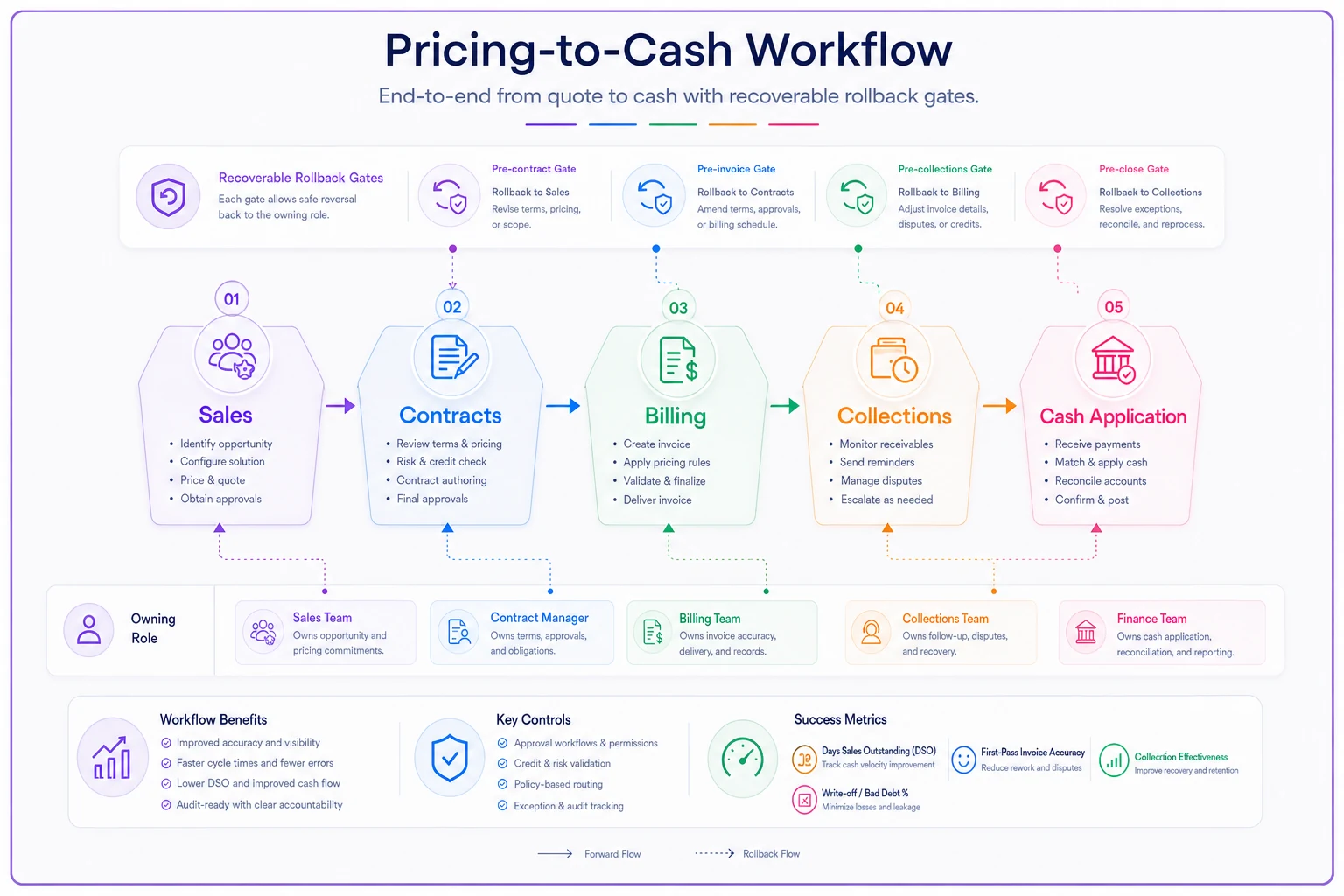
In practice, the pre-invoice gate alone eliminates most downstream reconciliation pain, because a clean invoice is a clean payment.
The weekly rhythm that keeps it running
Systems decay without rituals. But the ritual should be short and tied to the data — not a status meeting where everyone talks about how busy they are.
-
New deals in Does each have a deal_id and a complete data contract? Anything incomplete goes back to the owner today.
-
Contracts pending Which deals are signed but not yet set up in billing? These are your highest-risk items — money agreed, nothing flowing.
-
Invoices stuck at a gate What failed the pre-invoice check this week, and why? Repeated failures reveal a broken template or a bad handoff.
-
Payments unapplied Any cash in the bank not matched to a deal_id? Resolve before it ages.
-
Terms drift Any invoices that went out with terms different from the contract? Fix the template, not just the invoice.
This pairs naturally with an invoice-driven weekly cash flow model — once your pipe is clean end to end, your forecast actually becomes trustworthy, because the numbers upstream match the cash downstream.
Role handoffs: who owns what, and the exact checklist
The biggest source of leakage is the assumption that "someone" will handle the handoff. Define the owner at each stage, and give them a short checklist they actually complete before passing the baton.
Sales → Contracts handoff checklist:
-
- [ ] deal_id assigned
-
- [ ] Final price confirmed in writing (not just a verbal yes)
-
- [ ] Any promised discounts/exceptions documented
-
- [ ] Payment terms specified
-
- [ ] Scope reference attached
Contracts → Billing handoff checklist:
-
- [ ] Signed contract on file
-
- [ ] PO number captured (if required)
-
- [ ] Billing frequency and start date set
-
- [ ] Late fee and increase terms recorded against the account
-
- [ ] Data contract fields all populated
Billing → Collections handoff checklist:
-
- [ ] Invoice references deal_id and scope
-
- [ ] Due date matches contract terms
-
- [ ] Invoice confirmed delivered (not just sent)
-
- [ ] Any client-specific AP quirks noted
Collections → Cash application handoff checklist:
-
- [ ] Payment matched to deal_id
-
- [ ] Short/partial payments flagged with reason
-
- [ ] Disputes separated from slow-pays
If you want to go deeper on role structure as the team grows, the operational invoicing playbook covering roles, triggers and escalation extends these handoffs into full escalation ladders.
What changes as you scale
At solo or two-to-three person scale, this whole system can live in one spreadsheet and one person's discipline. The deal_id, the data contract, the gates — they fit in your head. You are the seam, so there's no handoff to lose anything in.
The trouble starts around 5–15 people, when roles specialize. Now sales, billing, and collections are different humans, and the information that used to live in one brain has to travel across people. This is exactly when leakage goes from "annoying" to "expensive," because the seams that didn't exist before are now real and nobody's been assigned to own them.
By the time you're at 20+ people, the data contract can't rely on human discipline anymore. There are too many deals and too many handoffs. This is where operational software earns its place — not because software is magic, but because it enforces the gates automatically. The pre-invoice check runs every time instead of when someone remembers. The deal_id gets carried forward instead of re-typed. AI-assisted workflow tools can flag terms drift, surface unapplied payments, and route failed gates back to the right owner without someone manually scanning a report.
The useful way to think about it: in a small shop, the system is a habit. At scale, it has to be built into the tooling, or it collapses back into heroics and tribal knowledge.
When this level of structure is overkill
Not every business needs the full apparatus. A freelancer with four long-term clients and predictable retainers doesn't need rollback gates — they need a clean invoice template and a reminder to send it. Building a five-stage operating system for that is just ceremony.
-
Multiple people touching the money chain
-
Variable pricing (overages, custom scopes, discounts)
-
Clients with AP departments and PO requirements
-
Recurring reconciliation headaches at month-end
-
A nagging sense that revenue is leaking but you can't point to where
If your invoices are simple, your clients pay fast, and your books reconcile cleanly, don't add structure you don't need. Complexity has a cost too.
A real scenario
A mid-size IT managed-services firm — around 14 people, somewhere near $1.4M in annual revenue — had a recurring problem: at any given time they had roughly $55k in receivables they couldn't cleanly explain. Payments came in batched (clients paid three invoices with one wire), overages got billed inconsistently, and their contracts said net-15 while invoices went out net-30 because of a template default nobody had fixed.
They didn't buy new software first. They started with the data contract and the deal_id discipline. Every deal got a permanent ID that followed it through contract, invoice, and payment memo. They added a pre-invoice gate — a 90-second check against contract terms before anything sent. They ran the 30-minute weekly review.
Within about two months, two things shifted. The net-15 terms actually started being honored, which pulled average days-to-pay down by roughly 9–11 days. And the "unexplained receivables" pile shrank to under $15k, because batched payments now carried deal_ids in the memo and cash application stopped being guesswork. Month-end close, which used to eat the better part of two days, dropped to a single morning.
Nothing dramatic. No big transformation. They just stopped letting the seams leak.
The takeaway
Pricing to cash for small business isn't five jobs — it's one pipe with five pressure points. Money doesn't usually get lost inside each stage. It gets lost in the gaps between them, where information gets re-typed, terms drift, and nobody owns the handoff.
Fix the seams and the rest mostly takes care of itself. Give the deal one immutable ID. Carry a small data contract from pricing all the way to the bank. Put recoverable gates where errors try to pass downstream. Run a short weekly check against the actual data. And as you grow, move those gates out of people's heads and into your tooling before the heroics stop scaling.
You don't need a bigger sales team or a tougher collections script to stop losing money. You need the stages to speak the same language — and a system that refuses to let a deal move forward until they do.
Ready to streamline your billing process?
Join 5,000+ businesses using Billoly to reduce billing delays, automate payments, and grow revenue efficiently.