

Most small businesses treat payment methods as a single decision: "We take cards." Then they wonder why processing fees quietly eat 2–3% of revenue every month, why cross-border invoices settle at weird rates, and why reconciliation turns into a Friday-afternoon puzzle.
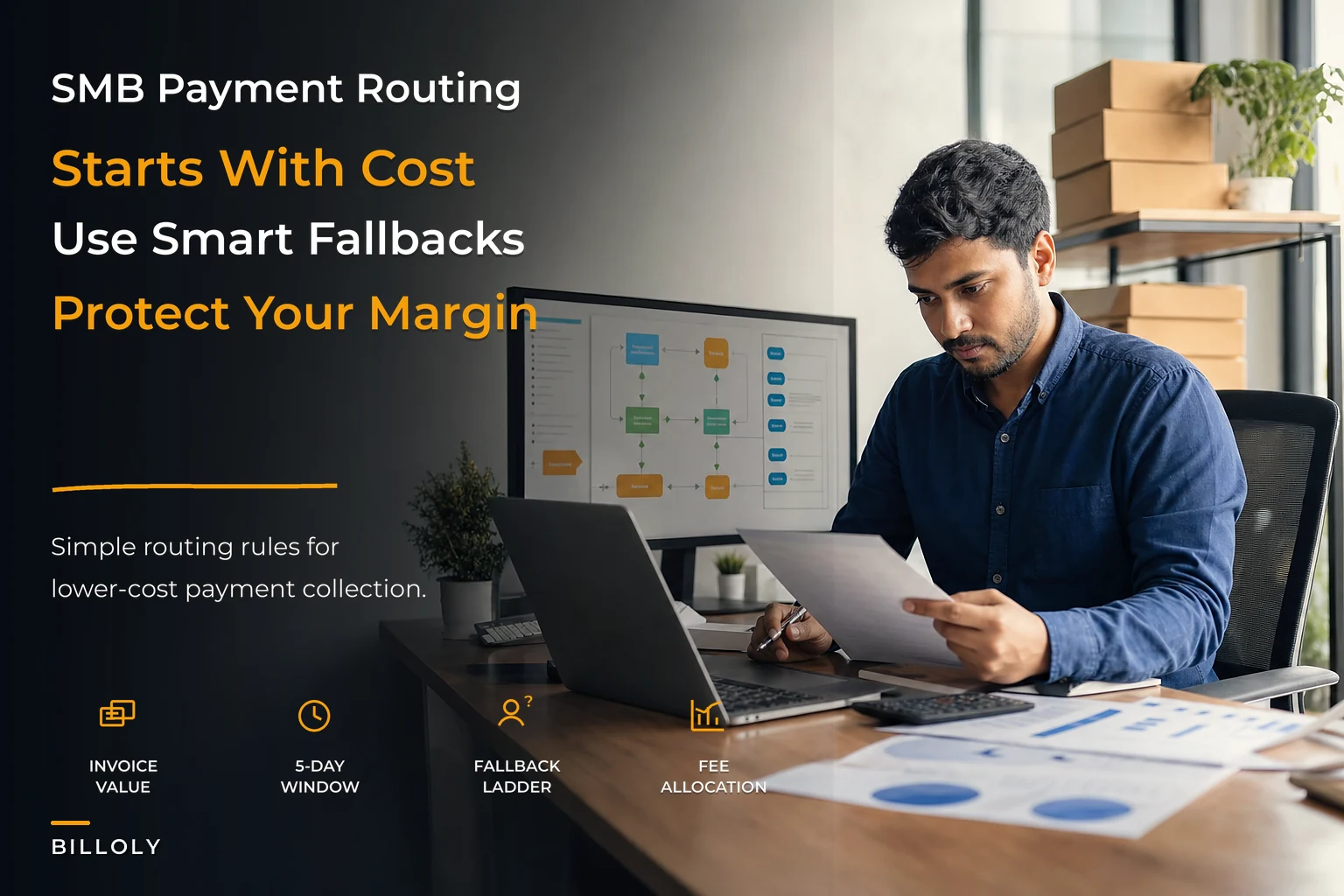
The businesses that actually keep more of their money don't do anything fancy. They route. They have a default method, a cheaper preferred method for certain situations, and a fallback ladder for when the preferred one fails. No orchestration platform. No engineering team. Just a set of rules that a bookkeeper or a solo founder can follow without thinking hard. This is a playbook for that — building a payment method strategy that leans on low-cost fallbacks by default, while staying simple enough that you'll actually stick to it.
Why "we just take cards" quietly bleeds money
Card processing is convenient and expensive. That's the whole tension. For a business doing $30k–$40k a month, a blended card rate of 2.9% means somewhere around $900–$1,200 a month in fees. Over a year, that's real payroll money.
The problem isn't that cards are bad. It's that most SMBs use them for everything, including situations where a card is the worst possible choice. A $12,000 project invoice paid by card costs you roughly $350 in fees. That same invoice paid by ACH costs a flat few dollars, or nothing. Nobody consciously made that choice — there just wasn't a rule telling the client (or the invoicing system) to prefer the cheaper rail for large amounts.
This usually happens because the payment method gets decided at the wrong moment: at checkout, by the customer, based on whatever's easiest for them. When you don't shape the default, the default shapes your margin.
There's also a hidden coordination cost. When every invoice can be paid five different ways with no logic behind it, reconciliation gets messier, dispute exposure goes up, and your accountant spends more time matching payments to invoices. The fee is the obvious cost. The operational drag is the one that compounds quietly.
The core idea: route first, fall back second
A workable strategy has two moving parts.
Stop chasing payments and start automating your billing.
Billoly empowers you to create, send, and track invoices effortlessly while maintaining professional client relationships.
- Customizable invoice templates
- Automated payment reminders
- Real-time payment tracking
No credit card required
Routing decides the preferred payment method for a given invoice before it goes out. You set this based on a couple of simple variables — usually invoice value and geography. High-value invoices get pushed toward low-cost rails. Small, fast transactions get cards because the fee is trivial and speed matters more.
The fallback ladder decides what happens when the preferred method doesn't work — the client can't do a bank transfer, the pay-link expires, the card gets declined. Instead of the payment stalling, it steps to the next option.
A diagram helps clarify the routing and fallback steps.
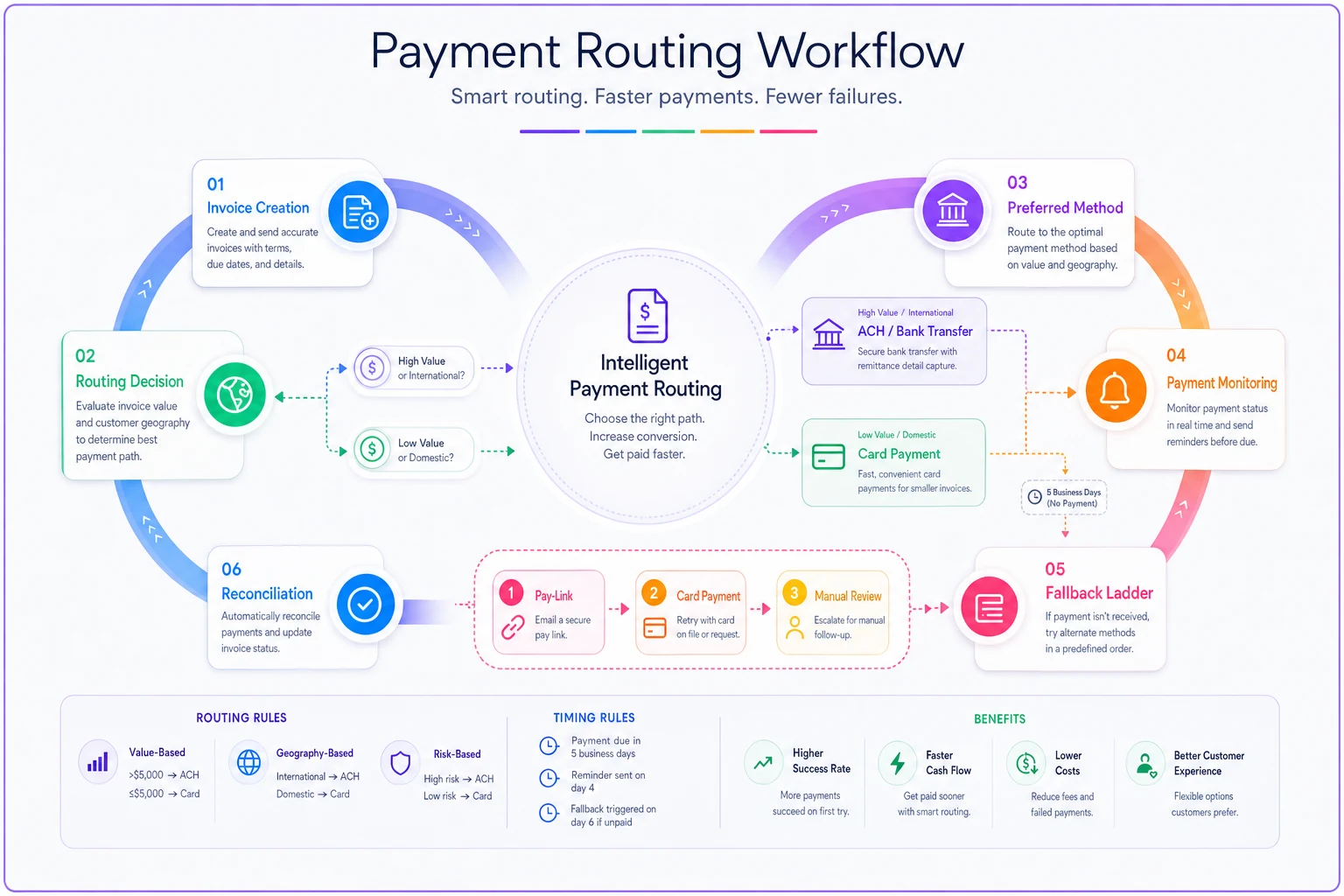
The mental model most SMBs get wrong: they think of payment methods as a menu where the customer picks. Better to think of it as a default with alternatives. You present the cheap option first, prominently, and keep the others available but secondary. Clients follow the path of least resistance almost every time. If the path you build is also the cheapest for you, you win by default.
Simple routing rules you can actually implement
You don't need branching logic or a rules engine. You need two variables and a small table. Here's a routing setup that covers most service and product SMBs:
| Invoice value | Domestic client | International client |
|---|---|---|
| Under $500 | Card / pay-link (fee is negligible, speed wins) | Card / pay-link |
| $500–$2,500 | Pay-link, ACH offered secondary | Card, with wire option noted |
| $2,500–$10,000 | ACH / bank transfer preferred | Wire preferred, card as fallback |
| Over $10,000 | Bank transfer, card explicitly discouraged | Wire only, confirm details before sending |
A few things worth noting. Below $500, chasing a cheaper rail is a waste of time — the fee difference might be a dollar or two, and slower payment costs you more in cash-flow terms. Above $2,500 is where routing starts paying for itself, and above $10k is where a single mis-routed card payment can cost you a few hundred dollars in one shot.
The geography split matters because international card payments carry cross-border and currency-conversion surcharges — often an extra 1–1.5% on top of the normal rate. For a large international invoice, that surcharge alone justifies a wire.
You can encode these as literal instructions on your invoice template. Something like: "For invoices over $2,500, please pay by bank transfer using the details below. Card payment available on request." That one sentence does most of the routing work, because most clients just do what the invoice tells them.
If you want the deeper structural side of how invoice fields and payment rails connect inside a billing system, the small-business billing system architecture and integration patterns breakdown covers how these pieces fit together without over-engineering.
The fallback ladder: card → pay-link → bank transfer (or the reverse)
A lot of businesses lose invoices entirely here. The preferred method fails and nothing catches the fall. A declined card, a pay-link that timed out, a wire the client "will get to next week" — and suddenly a ready-to-pay customer is stuck.
A fallback ladder is just a predefined order of what you offer next. The direction depends on the invoice.
For small invoices, fall down toward friction-free options:
-
Card on file (fastest, client already set up)
-
Fresh pay-link sent by email/SMS
-
Manual card entry over a secure link
For large invoices, the default is low-cost, and the fallback goes down toward convenience only if the transfer stalls:
-
Bank transfer / ACH (preferred, lowest cost)
-
Pay-link (if the client says transfers are a hassle)
-
Card (last resort — you eat the fee to close the payment)
The thing most people miss: the fallback ladder isn't just about getting paid, it's about not letting the payment go silent. A stalled bank transfer feels like progress ("they said they'd send it") but often becomes a 30-day-late invoice. Building a rule — "if bank transfer not received within 5 business days, send pay-link automatically" — keeps momentum without you babysitting it.
A typical example: a design studio invoices $6,800 and requests ACH. Client agrees, then goes quiet for two weeks because the transfer sat in an approval queue on their end. With a fallback rule in place, on day 5 the studio sends a pay-link. Client pays by card same day. Studio loses ~$200 in fees but recovers ten days of cash flow. Sometimes eating the fee is the right call — the ladder just makes it a decision instead of an accident.
Who pays the fee: allocation templates that don't feel sneaky
Fee allocation is where businesses either lose money silently or annoy their clients. There are really only three approaches, and each fits a different situation.
-
Absorb it. You eat the processing fee. Cleanest for the client, simplest to explain, right choice for small invoices and price-sensitive relationships.
-
Surcharge it. You add the fee as a line item when a client chooses a more expensive method. This nudges people toward cheaper rails — but surcharging cards is regulated or outright prohibited in some regions, so check before you do it.
-
Discount the cheap path. Instead of charging extra for cards, you offer a small discount for bank transfer (e.g., "2% off for ACH payment"). Same economic effect, friendlier framing, and usually cleaner from a compliance standpoint.
The discount framing wins more often than people expect. "Pay $9,800 by card or $9,600 by bank transfer" reads as a favor to the client. "Pay $9,600 by transfer or $9,800 including a card surcharge" reads as a penalty — even though the numbers are identical. Same money, very different response rate.
Before you roll out any surcharge model, it's worth reading through the small-business payments compliance mistakes to avoid, because fee-related rules trip up more SMBs than almost anything else in payments.
| Invoice value | Default fee approach |
|---|---|
| Under $500 | Absorb — not worth the friction |
| $500–$2,500 | Absorb, but offer ACH discount if margins are tight |
| $2,500–$10,000 | ACH discount (2%) to steer away from card |
| Over $10,000 | Bank transfer default; card only with fee agreement in writing |
Both tables above work as a starting point — adjust based on your margins and how rate-sensitive your clients actually are.
Reconciliation metadata: the part everyone skips
This is the least glamorous section and the one that saves the most Friday afternoons. Every payment should carry enough metadata to reconcile itself without a human playing detective.
-
Invoice number (the anchor — never rely on client name alone)
-
Payment method used (card, pay-link, ACH, wire)
-
Gross amount vs. net received (so fees are visible, not buried)
-
Fee amount and who absorbed it
-
Payment date vs. invoice date (for aging and cash-flow accuracy)
-
Client/entity ID (especially if one client has multiple projects)
-
Currency and conversion rate for anything cross-border
The failure pattern here is common and brutal: a business takes payments across three or four methods, each with its own payout timing and fee structure, and none of the records line up cleanly with the invoices. At $30k+/month in mixed payments, an hour or two of manual matching per week is normal — and errors slip through. A payment gets recorded as full when a fee was deducted, and suddenly your books are off by the exact amount of your processing costs.
The fix is to make the net amount and the fee explicit fields on every transaction, mapped to the originating invoice. When your accounting sees "$6,800 invoice, $6,603 net received, $197 card fee," reconciliation is straightforward. When it just sees "$6,603 deposited," someone has to go figure out where the missing $197 went.
A quick reconciliation mapping for accounting
Here's a sample field mapping most bookkeeping setups can handle:
-
Invoice total → Accounts Receivable (gross)
-
Net deposit → Bank / clearing account
-
Processing fee → Merchant fees expense account
-
Currency difference (if any) → FX gain/loss account
-
Payment method → memo/tag field for later filtering
Tagging by payment method matters more than it looks. At the end of the quarter, you can pull every card payment, total the fees, and know exactly what cards cost you. That number is what tells you whether your routing rules are actually working — or whether clients are still defaulting to cards on big invoices.
If your bookkeeping setup doesn't support these as separate fields yet, even a simple spreadsheet column per transaction type gets you most of the way there. The point is visibility. You can't fix a routing problem you can't measure.
When this whole approach makes sense — and when it doesn't
Routing and fallback ladders pay off when you have a mix of invoice sizes and at least some large transactions. If your average invoice is $80 and you do high volume, forget most of this — just take cards, keep it fast, and don't overthink fee allocation on small amounts.
It's also not worth over-engineering routing when almost all your invoices land in the same size bracket. One method, cleanly reconciled, beats a clever ladder you don't maintain.
And it's genuinely not worth it if your client base won't tolerate friction. Some industries expect one-click card payment, period. Pushing a bank transfer on a client who wanted to pay in 30 seconds can cost you the sale — the fee you saved is nothing next to a lost customer or a delayed payment.
The businesses that benefit most: service firms, agencies, consultants, contractors, and B2B sellers with invoices ranging from a few hundred to five figures. That spread is exactly where routing turns a 2.9% blended rate into something closer to 1% without anyone feeling squeezed.
A real scenario
A small marketing agency, three people, running roughly $45k/month across a mix of retainers and project invoices. Everything was card, blended rate around 2.9%. Monthly processing fees hovered near $1,300.
They made two changes. Invoices over $2,500 defaulted to bank transfer with a 2% ACH discount offered. And they added a fallback rule: if a transfer wasn't received in five business days, a pay-link went out automatically.
Nothing dramatic happened overnight. Over the next quarter, the share of large invoices paid by card dropped from most of them to under a third. Processing fees settled somewhere around $650–$750 a month — roughly half of what they'd been paying. The fallback rule caught a handful of stalled transfers each month, so cash flow actually got steadier, not slower. No new software, no orchestration platform. Just a routing table on the invoice template and one automated reminder.
Tie it back to your terms
Payment method routing doesn't live in isolation — it works best when it lines up with your payment terms. If you're offering an ACH discount, your terms should say so. If large invoices go to bank transfer, set that expectation upfront so nobody's surprised at payment time. The decision matrix for choosing payment terms that protect cash flow pairs naturally with a routing setup, because terms and methods are really two halves of the same conversation with your client.
Getting one right without thinking about the other usually means leaving something on the table.
The takeaway
A payment method strategy for a small business isn't about collecting every possible option and hoping clients pick the cheap one. It's about shaping the default toward low-cost rails, having a fallback ladder so payments don't go silent, being deliberate about who eats the fee, and carrying enough metadata that reconciliation doesn't require a Friday afternoon.
You can build the entire thing with a routing table, one sentence on your invoice template, and a single fallback reminder. Start with your largest invoices — that's where the money is hiding — and let the smaller stuff stay simple. The goal isn't sophistication. It's keeping more of what you already earned, without making anyone's payment harder than it needs to be.
A payment method strategy for a small business isn't about collecting every possible option and hoping clients pick the cheap one. It's about shaping the default toward low-cost rails, having a fallback ladder so payments don't go silent, being deliberate about who eats the fee, and carrying enough metadata that reconciliation doesn't require a Friday afternoon.
Ready to streamline your billing process?
Join 5,000+ businesses using Billoly to reduce billing delays, automate payments, and grow revenue efficiently.