


Most small businesses don't fail a compliance requirement because they broke a rule they understood. They fail because they built a workflow that quietly touched card data, or stored customer info they never needed, or set up billing that a bank could later flag — and nobody noticed until a processor sent a scary email or an audit form showed up.
Payments compliance isn't really a legal problem for operators. It's a systems problem. The rules matter, but what actually determines your risk is how money and data move through your business day to day. Where does a card number enter your process? Who touches it? What gets stored, and for how long? Who has access to the export?
This guide walks through the parts of payments compliance that actually bite small businesses — mapped to your operations, not to a legal textbook. The goal isn't to turn you into a PCI DSS expert. It's to help you set up your payment flow so most of the risk simply never enters your business in the first place.
The core mistake: treating compliance as paperwork instead of plumbing
The most expensive misunderstanding is thinking compliance is a checklist you fill out once. In real operations, compliance risk lives in the plumbing — the actual path a payment takes from a customer's card to your bank account, and every place data pools along the way.
A pattern that keeps showing up: a business starts small, takes payment through one clean processor, and has almost zero exposure. Then it grows. Someone starts taking card numbers over the phone and writing them on a sticky note. Someone else sets up a spreadsheet of "saved" client cards to make rebilling easier. A contractor emails an invoice with full account details. None of these felt like compliance decisions at the time. They felt like getting work done faster.
That's the trap. Every shortcut that touches card data expands what's called your PCI scope — the portion of your business that has to meet the payment card security standard. And scope is the single biggest cost driver in payments compliance. A business that never stores, processes, or transmits raw card data has almost nothing to prove. A business that does has an entire universe of requirements attached to it.
The first mental shift: your job isn't to comply with everything. Your job is to shrink the surface area that requires compliance in the first place.
Cutting PCI scope without spending real money
PCI scope reduction sounds technical, but for a small business it comes down to a few concrete operational choices. The theme is always the same — don't let raw card data live inside your systems.
Stop chasing payments and start automating your billing.
Billoly empowers you to create, send, and track invoices effortlessly while maintaining professional client relationships.
- Customizable invoice templates
- Automated payment reminders
- Real-time payment tracking
No credit card required
The cleanest way to do this is to make sure card data goes directly from the customer to your payment processor, never passing through your own tools, staff, or storage. When you use a hosted checkout page or a processor-provided payment form — the kind where the card fields are technically served by Stripe, Square, PayPal, Adyen, or whoever you use — the card number never actually enters your environment. That single design choice can drop you into the simplest possible compliance category.
Here's what low-cost scope reduction looks like in practice:
-
Never take card numbers by phone, email, or text. If a client wants to pay, send them a payment link. Handwritten card numbers and emailed card details are the two most common scope disasters in small businesses.
-
Don't store card numbers anywhere yourself — not in a CRM note, not in a spreadsheet, not in a "saved for later" doc. Let your processor tokenize and store the card. You reference a token, never the number.
-
Use hosted or embedded payment fields rather than building your own payment form. If your web person built a custom checkout that captures card fields into your server, you just took on serious scope.
-
Limit who can log into the payment dashboard. Fewer people with access means fewer people to train, fewer credentials to leak, fewer mistakes.
-
Turn off card-on-file features you don't actually use. Every stored card is a liability. If you rebill monthly, fine — the processor holds the token. But don't save cards "just in case."
A useful way to think about it:
| Where card data lives | Your PCI burden | Typical small-biz cost |
|---|---|---|
| Only inside the processor (hosted checkout, tokens) | Minimal — simplest self-assessment | Basically $0 extra |
| Passing through your website/server briefly | Moderate — more requirements, possible scanning | Ongoing time + tooling |
| Stored by you (spreadsheets, notes, saved files) | Heavy — full obligations, real audit risk | High, plus breach exposure |
The biggest lever costs nothing: stop letting card data touch your business. Most scope-reduction "projects" are really just cleanup projects — finding and killing the places where raw card data leaked into your normal tools.
When paid help actually makes sense here
If you take payments only through a hosted processor and store nothing, you almost certainly don't need to hire a compliance consultant. You need to fill out a short self-assessment and keep your processor account tidy.
You should get paid help when you're building custom payment infrastructure, integrating card data into your own software, processing high volume across multiple channels, or when your processor specifically tells you a formal assessment is required. Paying a QSA (qualified security assessor) before you've actually complicated your setup is usually money spent on a problem you don't have yet.
KYC for B2B billing: enough, but not too much
Know-Your-Customer requirements get talked about like they only apply to banks. But if you invoice other businesses, run a marketplace, hold funds, or use certain payment platforms, some version of customer verification lands on you too — usually pushed down from your processor's own obligations.
For most B2B service businesses, the mistake tends to go in one of two opposite directions. Some businesses collect nothing and then can't prove who they billed when a dispute or fraud flag hits. Others collect everything — copies of IDs, bank statements, tax documents they didn't need — and now they're sitting on a pile of sensitive data that becomes its own liability.
-
Legal business name and trading name (they're often different).
-
Business address — the real operating one, not just a billing zip.
-
A verified contact — name, role, email, and a phone number that actually reaches someone.
-
Tax/registration identifier where relevant to your invoicing (this also matters for cross-border work — see the note below).
-
The authorized signer or PO reference for larger accounts, so you can prove the engagement was approved.
That's usually enough to satisfy a processor, defend a chargeback, and reconcile your books. Notice what's not on that list: personal IDs, bank login details, or anything you'd hate to see leak.
For anyone billing across borders, verification overlaps heavily with your tax handling. Getting the right registration numbers and jurisdiction details captured up front saves a mess later — the mechanics of that are covered in international invoicing essentials: VAT/GST fields, multi-currency notes and cross-border mistakes to avoid. Treat KYC data collection and tax-field collection as one onboarding step, not two separate ones. Clients hate being asked for the same info twice, and split collection is where records go inconsistent.
The pattern worth internalizing: collect the minimum that lets you prove the relationship, and no more. Every extra field you demand at onboarding is friction that slows your first payment, and every sensitive document you store is something you now have to protect.
Data retention: the risk nobody schedules
In year one, you have a handful of clients and everything fits in your head. By year three, you've got transaction records, customer details, invoices, payment metadata, and export files scattered across a payment dashboard, an accounting tool, an email inbox, and three people's laptops. Nobody ever decided to keep all of it. It just accumulated.
Data retention is where "we'll deal with it later" turns into real exposure. The two opposing pressures are straightforward:
-
Keep records long enough to satisfy tax rules, defend disputes, and reconcile your books.
-
Don't keep sensitive data longer than you need it, because everything you hold is something that can leak, get subpoenaed, or become a compliance headache.
The trick is separating what you keep from how sensitive it is. Financial records — invoices, amounts, dates, who paid what — generally need to be retained for years, and you want them for audit and reconciliation. The sensitive stuff — anything close to card data, personal identifiers, or documents you only needed once for verification — should have the shortest life possible.
-
Transaction and invoice records keep for the full period your tax jurisdiction requires (commonly several years). These are low-sensitivity and high-value to you.
-
Card data ideally you store none. If your processor holds tokens, that's their retention problem, not yours.
-
KYC/onboarding documents keep the structured fields (name, address, tax ID) as long as the account is active plus a reasonable buffer; delete any sensitive attachments once verification is done.
-
Payment metadata and logs keep enough to investigate disputes and reconcile, then age it out on a schedule.
-
Dead accounts when a client relationship ends, run a cleanup — archive what you must legally keep, purge the sensitive extras.
Make deleting old sensitive data a recurring calendar task owned by a specific person.
The operational point most people miss: retention has to be a schedule, not a vibe. If deleting old sensitive data isn't a recurring task somebody owns, it never happens, and your risk quietly grows every month. This connects directly to keeping clean, exportable records for audits — the retention and export side of that is covered in make invoices audit-ready: retention, export and record-keeping checklist for small businesses.
How this breaks at scale
At one or two people, all of this feels invisible. The founder takes every payment, knows every client, and holds the whole system in their head. Compliance risk exists but rarely materializes because the surface area is tiny.
The breaks happen at three predictable points.
First hire who touches money. The moment someone other than the owner sends invoices or takes payments, informal habits become invisible risks. That new person doesn't know your unwritten rule about never writing down card numbers, because it was never written down. This is where most scope leaks originate — not from malice, from onboarding gaps.
First integration. When you connect your billing to a CRM, a bookkeeping tool, or a custom app, data starts flowing into places you didn't map. Suddenly customer and payment data lives in four systems and nobody's sure which one is the source of truth. This is also where retention goes sideways — the same record now exists in multiple tools, each with its own deletion behavior.
First real volume. More transactions mean more disputes, more fraud flags, and more attention from your processor. Volume is what triggers KYC requests, reserve holds, and formal assessment thresholds. A business quietly cruising under the radar at low volume can get a compliance wake-up call the month it grows past a threshold it didn't know existed.
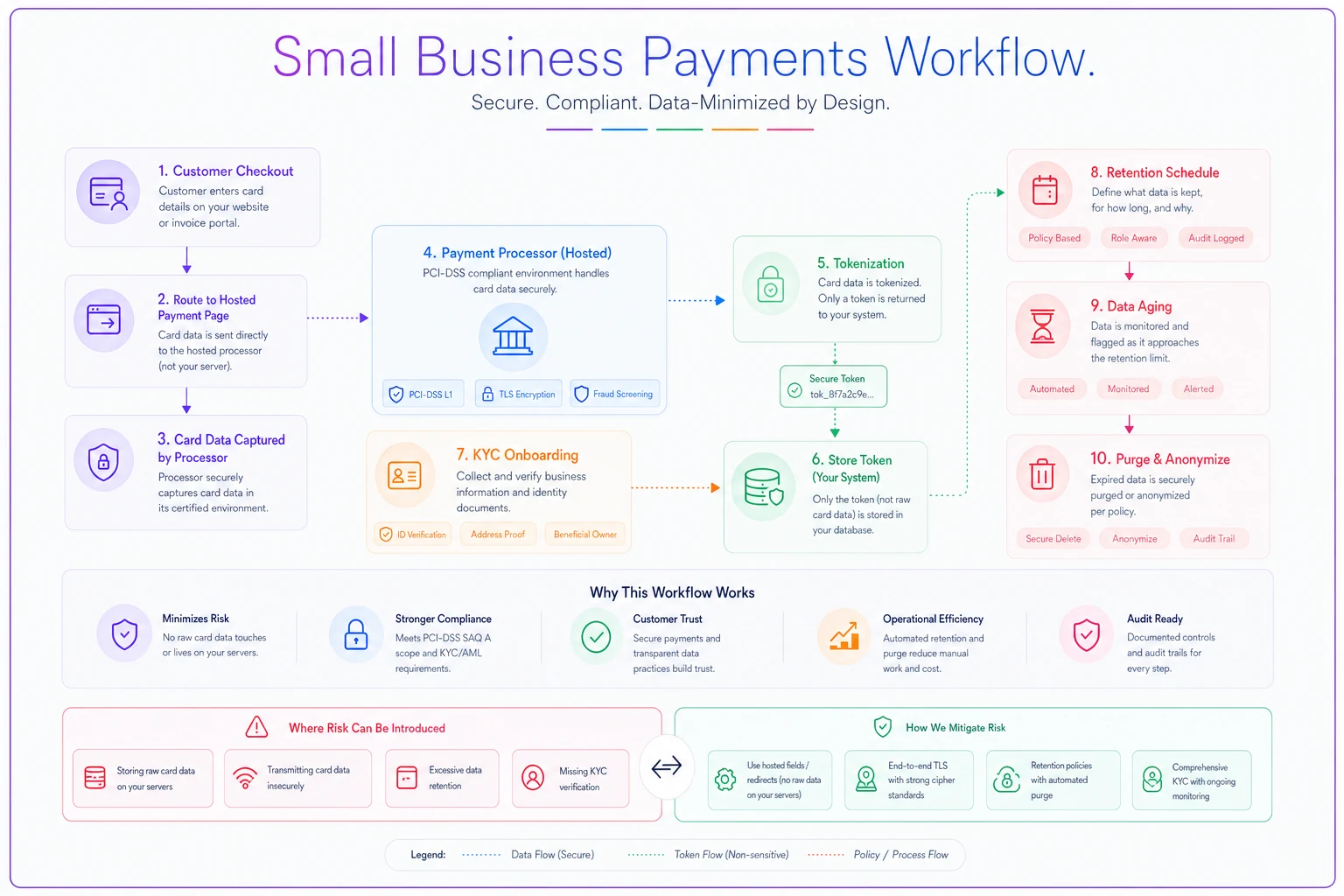
The businesses that handle this well aren't the ones with the fanciest tools. They're the ones who wrote down the payment workflow — where card data enters, who's allowed to touch it, what gets stored, and when things get deleted — before they scaled. A one-page written flow beats a spreadsheet of policies nobody reads.
A real scenario
Take a small B2B design studio, four people, billing somewhere around $40k–$50k a month across a mix of retainer and project clients. Their setup had grown organically: a couple of clients paid by ACH, a few paid card over the phone (numbers jotted on a notepad, then keyed into the dashboard), and their office manager kept a spreadsheet of "client cards on file" to make monthly retainer billing faster.
None of it felt reckless. It felt efficient. Then their processor flagged a chargeback, asked for documentation on the client relationship, and the studio realized they had inconsistent records — solid card data they shouldn't have had, and missing verification info they actually needed.
The fix took about a week of focused cleanup and cost them essentially nothing beyond time:
-
They killed the card-on-file spreadsheet entirely and moved recurring clients onto tokenized card-on-file inside the processor.
-
Phone payments got replaced with emailed payment links.
-
They built a simple onboarding step capturing business name, address, contact, and tax ID for every client.
-
They set a quarterly reminder to purge onboarding attachments and age out old metadata.
The outcome wasn't dramatic revenue growth — it was risk that mostly disappeared. Their PCI scope dropped to the simplest self-assessment tier, chargeback documentation became easy to pull, and the anxiety around what happens if the notepad walks out the door went away. Roughly a week of work to remove a whole category of problems permanently.
When to bring in paid help — clear criteria
Most of what's covered above, a competent operator can handle themselves. The signal that you actually need paid expertise is specific, not vague. Get help when:
-
You're building or buying custom software that handles card data rather than using a hosted processor.
-
Your processor formally requests an assessment, questionnaire beyond the basics, or documentation you don't understand.
-
You've hit volume thresholds that change your compliance level or trigger reserves and enhanced KYC.
-
You operate across multiple countries with genuinely conflicting requirements you can't reconcile yourself.
-
You've had an actual incident — a breach, a serious fraud pattern, a regulator or bank inquiry.
Be honest about when not to spend: if you use a mainstream hosted processor, store no card data, and run modest volume, hiring a compliance consultant is usually premature. Solve the plumbing first. Most small businesses pay for advice when what they really needed was to stop letting card numbers into their workflow — a fix that's free.
The system that keeps you out of trouble
Strip everything down and safe small-business payments come from four connected habits, not four separate compliance projects:
-
Route card data straight to the processor so it never enters your business — this kills most of your PCI scope for free.
-
Collect just enough B2B verification to prove the relationship, folded into onboarding alongside your tax fields.
-
Retain financial records long, sensitive data short, on an actual schedule someone owns.
-
Write the workflow down so new hires and new integrations don't quietly reopen risks you already closed.
A visual sketch of this workflow helps teams see where risk enters and what to change.
Payments compliance stops being scary the moment you see it as workflow design rather than legal homework. The rules aren't the hard part — the hard part is making sure your own convenience habits don't drag risk back into the business.
Build the plumbing right, keep the surface area small, and most of the compliance burden simply never shows up at your door.
Payments compliance stops being scary the moment you see it as workflow design rather than legal homework. The rules aren't the hard part — the hard part is making sure your own convenience habits don't drag risk back into the business.
Build the plumbing right, keep the surface area small, and most of the compliance burden simply never shows up at your door.
Ready to streamline your billing process?
Join 5,000+ businesses using Billoly to reduce billing delays, automate payments, and grow revenue efficiently.