
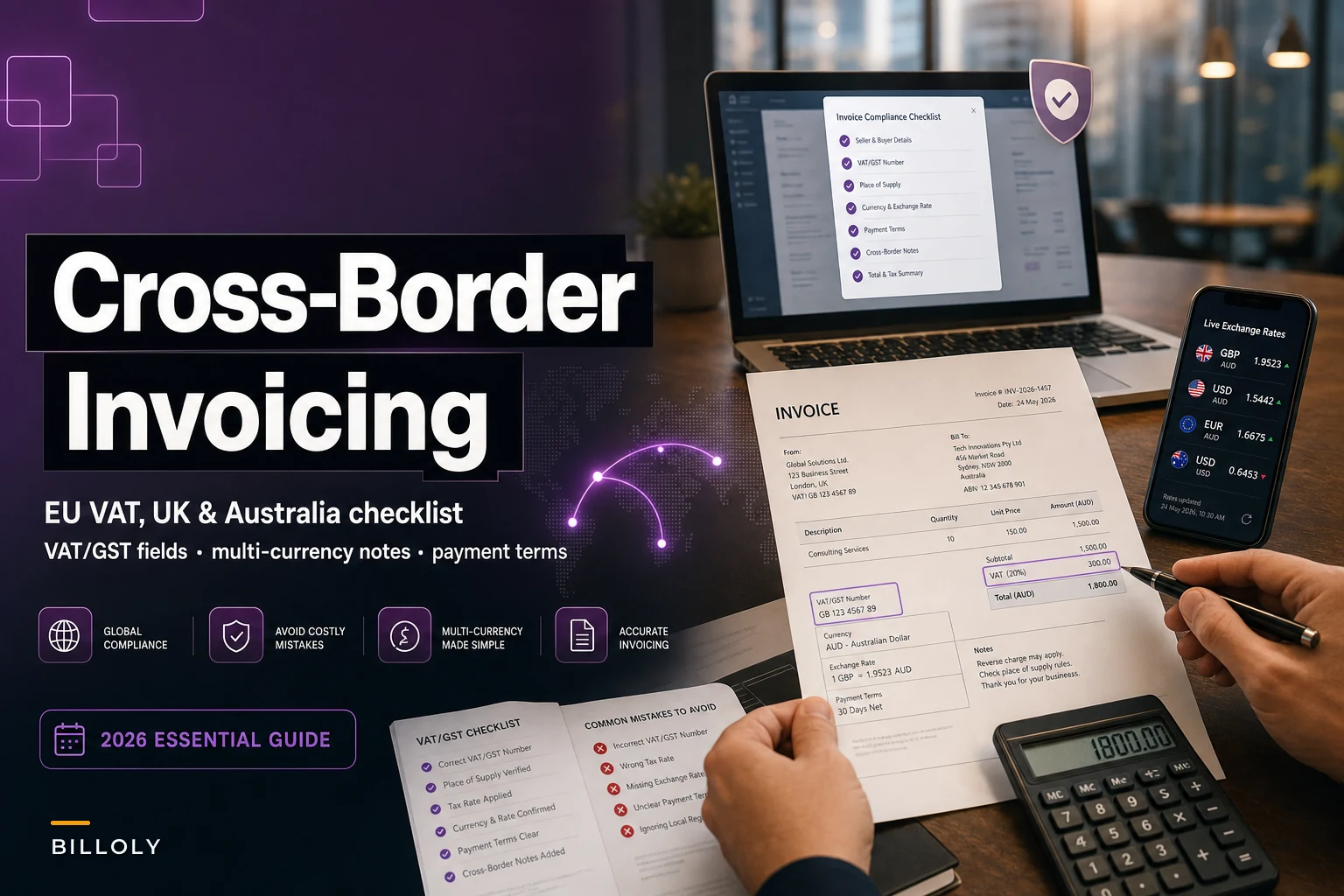

The moment your first international client says yes, your invoice stops being a formality. A domestic invoice that's technically wrong usually gets paid anyway. A cross-border invoice missing the right VAT wording, or showing the wrong currency for tax purposes, can get bounced by the client's accounts team, delayed for weeks, or worse — leave you exposed when their tax authority starts asking questions.
Most of the pain isn't complicated tax law. It's small formatting and wording decisions that go wrong once and then repeat on every invoice until someone catches it. Below are the three regions where small businesses trip most often — EU VAT, UK, and Australia — broken down as specific scenarios, with the exact fields and phrasing that keep invoices clean.
Scenario 1: You're a UK freelancer billing an EU business client
You design brand assets. A client in Germany hires you. You send your normal invoice with 20% UK VAT on it because that's what your template does.
That's the mistake. When you sell most services to a VAT-registered business in another EU country, the place of supply shifts to the customer's country, and the transaction falls under the reverse charge. You don't add UK VAT. The German client accounts for the VAT on their end.
But you can't just silently drop the VAT line — that's where people get it wrong the other direction. The invoice needs to show what's happening.
What the invoice must include for a B2B EU reverse-charge supply:
-
Your VAT number (if you're VAT-registered)
-
The client's VAT number (validated — more on this below)
-
A clear note stating the reverse charge applies
-
The net amount with no VAT charged
> "Reverse charge: VAT to be accounted for by the recipient under Article 196 of Council Directive 2006/112/EC."
Where this quietly goes wrong: freelancers who aren't VAT-registered assume none of this applies to them. Partly true — you don't charge VAT either way. But if you cross the registration threshold and don't notice, you've been invoicing incorrectly for months. And the reverse charge only applies if the client is genuinely a business with a valid VAT number — which brings us to the single most common failure point.
The VAT number validation step almost everyone skips
You cannot take the client's VAT number on faith. If you apply the reverse charge to a client whose VAT number turns out to be invalid, you can end up liable for the VAT you didn't charge.
Stop chasing payments and start automating your billing.
Billoly empowers you to create, send, and track invoices effortlessly while maintaining professional client relationships.
- Customizable invoice templates
- Automated payment reminders
- Real-time payment tracking
No credit card required
Run the VIES check at onboarding, save a screenshot and note the date so you can prove you validated the number.
The fix takes about 30 seconds: run the number through the EU's VIES system before you send the first invoice. It tells you whether the number is valid and active. Do it once at onboarding, save a screenshot or confirmation, and note the date on file. Validate at onboarding, not at invoicing. By the time you're sending the invoice you want to be moving fast, and a failed VAT check at that moment is exactly when people shrug and send it anyway.
Scenario 2: You're an Australian business selling to overseas customers (or the reverse)
Australia uses GST at 10%, and the logic for exports works differently. Broadly, if you're an Australian business and the sale is a genuine export — services consumed outside Australia, or goods shipped overseas — the supply is usually GST-free. That doesn't mean you ignore GST on the invoice; it means you show it as GST-free rather than taxable.
The invoice error here is pretty common: an Australian consultant bills a US client, adds 10% GST out of habit, and now the US client is being charged an Australian tax that shouldn't apply. The client's finance team notices, disputes it, and the invoice sits unpaid while you sort it out.
For a valid Australian tax invoice, you generally need:
-
The words "Tax invoice"
-
Your business name and ABN
-
The date
-
A description of what was sold
-
The GST amount, or a statement that the sale is GST-free
-
The buyer's identity or ABN for sales over the relevant threshold
For GST-free exports, the cleanest presentation is a line that reads "GST-free export — GST $0.00" rather than simply omitting GST, so the client's accountant sees an intentional decision, not a missing field.
The reverse direction: if you're a non-Australian business selling digital services or low-value goods to Australian consumers, you may fall under Australia's GST rules for imported services and need to register. Small overseas sellers regularly miss this because nothing about a single sale feels like it should trigger a tax obligation in another country.
The currency mistake that shows up at reconciliation
Multi-currency invoicing has one trap that's almost invisible until your bookkeeper hits it: the tax amount and the invoice currency don't line up with what the tax authority expects.
For EU and UK invoices, you can invoice in a foreign currency, but the VAT amount typically needs to be shown in the local currency — GBP for UK, or the relevant EU member state's currency — using an accepted exchange rate on the supply date. An invoice in USD with a VAT figure only in USD and no local-currency equivalent is a common rejection reason.
A typical example: a UK studio invoices a UK-based client in USD because the project was quoted that way. The invoice shows VAT in USD only. The client's accountant kicks it back because they need the GBP VAT figure to file. Two weeks lost on a $4k invoice, purely over a missing conversion line.
How to present multi-currency cleanly:
-
State the invoice currency clearly at the top
-
Show the exchange rate used and the date it's based on
-
Show the tax amount in both the invoice currency and the required local currency
-
Note who bears currency conversion or bank fees
That last point saves real money. When it's not stated, cross-border bank fees quietly eat into the payment — you invoice for the equivalent of £1,000 and receive £972 after intermediary charges. Over a year of international invoices, that gap adds up to a meaningful amount you never agreed to absorb.
Region-by-region field comparison
Here's the quick reference for what has to appear, by region and situation:
| Field / requirement | UK (B2B to EU) | EU intra-community B2B | Australia (export) |
|---|---|---|---|
| Your tax ID | VAT number | VAT number | ABN |
| Client tax ID | Client's VAT no. (validate) | Client's VAT no. (validate) | Buyer ABN if over threshold |
| Tax charged | None (reverse charge) | None (reverse charge) | GST-free ($0.00 shown) |
| Required legal note | Reverse charge wording | Reverse charge wording | "Tax invoice" + GST-free note |
| Currency of tax figure | GBP equivalent required | Local currency equivalent | AUD |
| Doc must say | — | — | "Tax invoice" |
The table looks tidy, but the real risk is that your invoice template was built for domestic work and none of these fields exist on it yet. Adding them once per client type is the whole job.
A pre-send checklist for cross-border invoices
Run this before the first invoice to any new international client. After the first one is clean, the rest usually follow the same template.
-
Confirmed whether the client is a business (B2B) or consumer (B2C) — this changes everything
-
Validated the client's VAT/tax number and saved proof with the date
-
Determined the correct place of supply for the type of service or goods
-
Applied the right treatment
reverse charge, GST-free export, or standard rate
-
Included the correct legal wording for that treatment
-
Showed the tax amount in the required local currency, not just the invoice currency
-
Stated the exchange rate and the date it's based on
-
Included both tax IDs and all mandatory document fields for the region
-
Specified who covers bank/currency conversion fees
-
Set payment terms that account for slower international bank transfers
A visual workflow can help teams follow the checklist consistently.
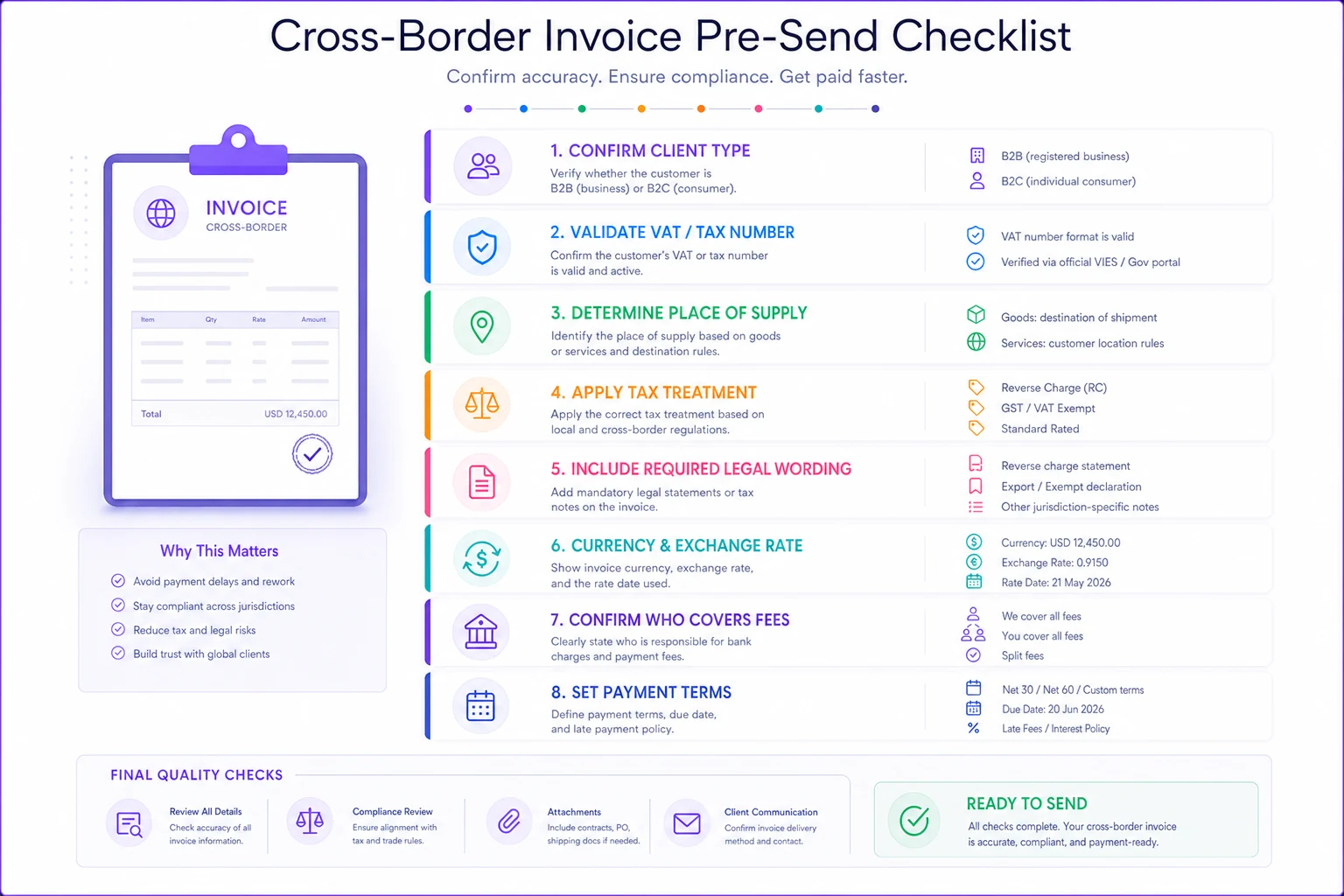
After the first one is clean, the rest usually follow the same template.
Three invoice presentation snippets you can copy
EU B2B reverse charge (services):
Subtotal (net): EUR 2,400.00 VAT: Reverse charge (0.00) Note: VAT to be accounted for by the recipient under Article 196 of Council Directive 2006/112/EC. Supplier VAT: [your VAT no.] Client VAT: [client VAT no., validated DD/MM/YYYY]
UK invoice issued in USD to a UK client:
Invoice currency: USD Subtotal: USD 4,000.00 VAT (20%): USD 800.00 (GBP 632.00) Total: USD 4,800.00 Exchange rate: 1 GBP = 1.266 USD (rate as of DD/MM/YYYY)
Australian GST-free export:
TAX INVOICE [Business name] ABN: [your ABN] Description: Consulting services (delivered to overseas client) Amount: AUD 3,500.00 GST: GST-free export — AUD 0.00 Total: AUD 3,500.00
When to just get an accountant involved
Some situations are worth a professional's ten minutes rather than a guess.
When this makes sense to handle yourself: straightforward B2B service work to a validated business client, using the reverse charge, invoiced in a currency you can convert cleanly. Once the first invoice is right, you're mostly repeating a template.
When to check with an accountant first: you're selling goods across borders, selling digital products to consumers in another country, approaching a VAT/GST registration threshold in your own or a foreign country, or dealing with a mix of taxable and exempt items on one invoice. These are the situations where a wrong assumption compounds silently across dozens of invoices.
Who should not wing it: anyone crossing into B2C sales in the EU or Australia. Consumer sales frequently require you to charge the destination country's tax rate and register there — which is a genuinely different regime from B2B. Getting it wrong means undercollecting tax you're personally on the hook for.
A short real scenario
A small UK web development shop — two people — started taking on EU agency clients. Their template applied 20% VAT to everything. On B2B EU work that was wrong; those invoices should have carried the reverse charge. Three invoices went out incorrectly before a German client's finance team flagged it.
The cost wasn't just the correction. Each disputed invoice sat unpaid an extra 15–20 days while it was reissued, and on a monthly cash cycle of roughly £18k–£22k, having several thousand pounds stuck at any given time made payroll timing genuinely stressful. Once they built one template per client type — domestic, EU B2B reverse charge, and non-EU — and moved VAT number validation to onboarding, the reissue problem stopped. New international clients got a clean first invoice, and average time-to-payment on EU work tightened by close to a week.
The change wasn't tax expertise. It was building the right template once and validating tax numbers at the start instead of at the finish.
Closing thought
Cross-border invoicing rewards setup over cleverness. The businesses that struggle are the ones running every international invoice through a template designed for their home market and hoping the differences don't matter. The ones that don't struggle build a small set of region-specific templates, validate tax numbers before the work starts, and always show the tax figure in the currency the client's accountant needs to file.
Get those three habits in place and the errors in this article mostly stop happening — not because the rules got simpler, but because you stopped meeting them for the first time on the invoice that's already out the door.
Cross-border invoicing rewards setup over cleverness. The businesses that struggle are the ones running every international invoice through a template designed for their home market and hoping the differences don't matter. The ones that don't struggle build a small set of region-specific templates, validate tax numbers before the work starts, and always show the tax figure in the currency the client's accountant needs to file.
Get those three habits in place and the errors in this article mostly stop happening — not because the rules got simpler, but because you stopped meeting them for the first time on the invoice that's already out the door.
Ready to streamline your billing process?
Join 5,000+ businesses using Billoly to reduce billing delays, automate payments, and grow revenue efficiently.