


Most small businesses pick their payment terms once, early on, usually by copying whatever they saw on someone else's invoice. Net 30 shows up everywhere, so it becomes the default. Then it just stays. Same terms for the enterprise client with a 45-day AP cycle and the same terms for the guy who ghosts you the moment work is done.
That's the actual problem. Not that Net 30 is bad — it's that using one set of terms for every client means you're either too soft on the risky ones or unnecessarily rigid with the safe ones. Both cost you. The soft version costs cash flow. The rigid version costs deals.
What follows is a way to decide terms by matching them to the client in front of you, using three inputs you already have a gut read on: how risky the client is, what's normal in their industry, and how much pricing power you hold in the relationship.
The three inputs that should actually drive your terms
Before the matrix, you need a quick honest read on three things. Not a spreadsheet exercise — just a fast internal rating.
Client risk. This is your read on whether they'll pay, and pay on time. Signals: how they found you, whether they haggled hard on price, how organized their business seems, whether they have a real AP process or the owner pays personally from their phone. A slow-paying-but-reliable Fortune 500 subsidiary is low risk even if they pay in 60 days. A brand-new business that negotiated aggressively and wants to start immediately is high risk regardless of how friendly they are.
Industry norms. Certain industries have payment cultures you can't fight without losing work. Construction pays slow and expects retainage. Agencies and marketing shops are used to deposits. Government and healthcare have fixed AP cycles that ignore your terms entirely. Fighting the norm makes you look difficult; working within it makes you look like you know their world.
Your pricing power. This is the one people ignore. If you're the only person who can do the thing, or the client came to you specifically, you can ask for deposits and milestones without blinking. If you're one of four vendors bidding and they have leverage, aggressive terms cost you the job. Pricing power isn't about being good — it's about how replaceable you are in this specific deal.
One pattern worth noting: people consistently overestimate their pricing power with big clients and underestimate it with small ones. The big client feels prestigious so you cave on terms. The small client feels needy so you skip the deposit — even though the small one is where you actually hold all the leverage and all the risk.
The decision matrix
Rate each client Low / Medium / High on risk, then cross it against your pricing power. Industry norms adjust the output — they set the ceiling on how aggressive you can get without walking away from the work.
Stop chasing payments and start automating your billing.
Billoly empowers you to create, send, and track invoices effortlessly while maintaining professional client relationships.
- Customizable invoice templates
- Automated payment reminders
- Real-time payment tracking
No credit card required
| Client Risk | Your Pricing Power | Recommended Terms | Deposit | Milestones |
|---|---|---|---|---|
| Low | High | Net 15–30, early-pay discount optional | 0–15% | Not needed for short work |
| Low | Low | Net 30–45 (match their AP cycle) | 0% | Optional on large scope |
| Medium | High | Net 15 + 25–40% deposit | 25–40% | Yes on anything 4+ weeks |
| Medium | Low | Net 30, 20% deposit, staged billing | 15–20% | Yes, tied to deliverables |
| High | High | 50% deposit, milestone billing, Net 7 on final | 50% | Mandatory |
| High | Low | Prepay or half-up-front, or decline | 50%+ | Mandatory or walk |
A note on the bottom-right box: high risk plus low pricing power is the danger zone. You want the work, they have leverage, and they might not pay. The honest move is often to require prepayment rather than discount your way in. If they won't prepay and you have no leverage, that's usually a client to pass on — the ones who fight prepayment when they're high-risk are exactly the ones who don't pay.
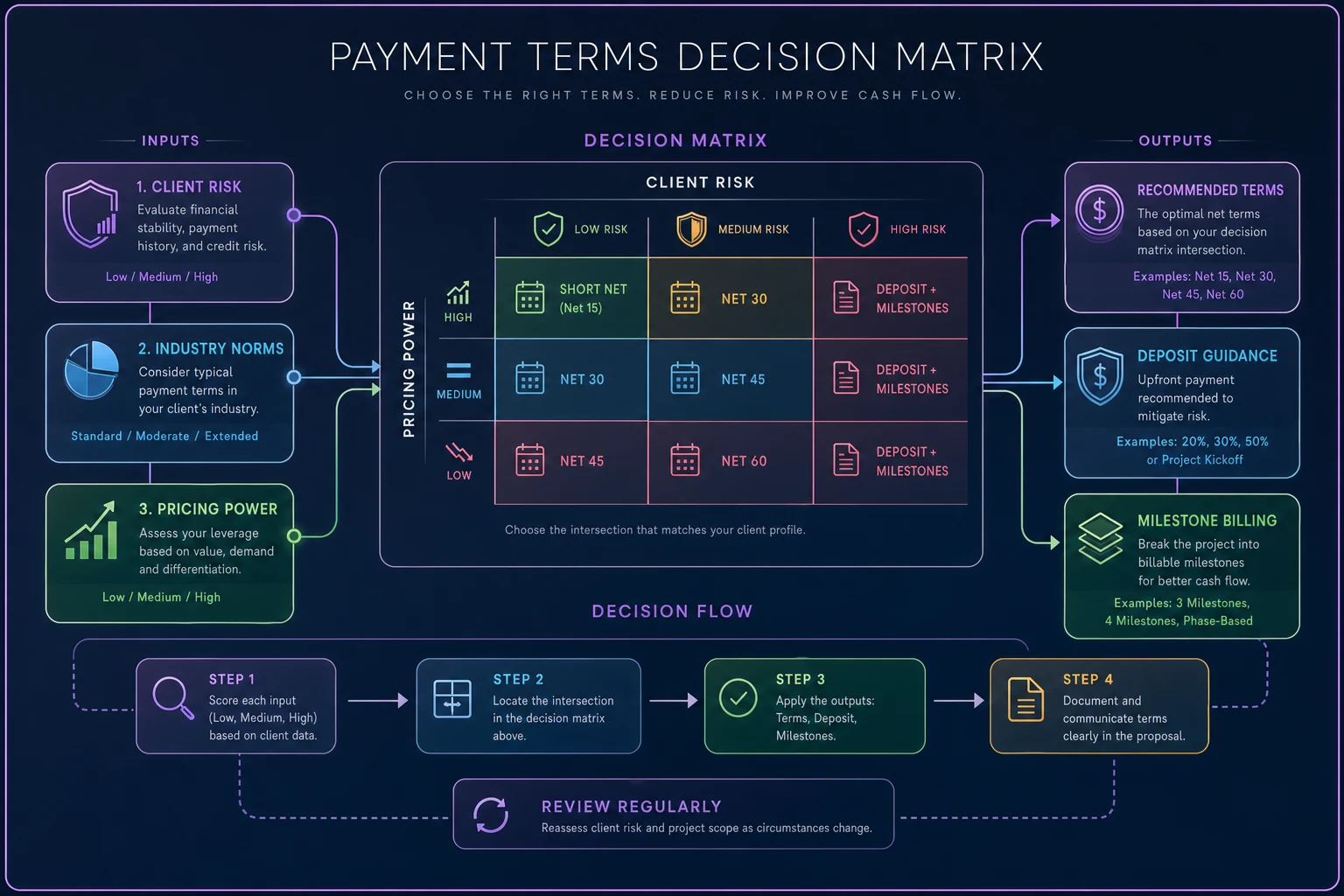
A quick visual of how the inputs feed the matrix.
Example policies you can lift directly
Terms only work if they're specific enough to enforce. Vague ones ("payment due promptly") invite delay. Here are concrete policies mapped to the matrix outputs.
Early-payment discount (for Low risk / High power): 2% off if paid within 7 days, full amount at Net 30. Written as "2/7 Net 30" on the invoice. This works when your margins can absorb 2% and you'd rather have cash now. It does not work if your margins are already thin — you'd be paying to accelerate money you were going to get anyway.
Deposit policy (Medium risk): "A 25% deposit is due to reserve your project start date. Work begins upon receipt. Remaining balance billed per the milestone schedule below." Tying the deposit to the start date rather than to "beginning work" gives you a cleaner reason it's non-negotiable — you're holding a slot.
Milestone billing (High risk or long projects): Break the project into 3–4 payable checkpoints, each tied to a deliverable the client can see. Something like: 40% deposit, 30% at first draft/prototype delivery, 30% on final acceptance. The key is that each milestone releases before the next chunk of work, so you're never more than one milestone ahead of your money.
Late-payment terms (all boxes): "Invoices unpaid after the due date accrue a 1.5% monthly late fee." Whether you enforce it every time is your call, but having it in writing changes the conversation. Clients treat "there's a fee" invoices differently than "please pay when you can" invoices.
When to break your own matrix
The matrix is a default, not a law. A few situations where you override it:
-
A long-term relationship going through a rough patch. A reliable 3-year client suddenly paying slow is probably a cash crunch on their end, not a risk shift. Loosening terms temporarily buys loyalty. Tightening them looks like you're panicking.
-
A strategic client worth more than the invoice. If landing them opens a category or a referral pipeline, softer terms can be a deliberate investment. Just decide that consciously, not by accident.
-
First job with a client you want to keep. Sometimes running the first small project on easy terms, watching how they pay, then setting real terms on project two is smarter than front-loading friction.
The mistake isn't breaking the matrix. It's breaking it without noticing — which is how "just this once" becomes your actual policy.
Negotiation scripts that hold the line without killing the deal
The terms are easy. Holding them in a live conversation is where most people fold. A few scripts that work because they frame terms as normal process, not as distrust.
Asking for a deposit (Medium/High risk): > "The way I run projects, I take a 25% deposit to lock in your start date, then bill the rest at each milestone. Keeps everything predictable on both sides. I'll send the deposit invoice today and we can get going as soon as it clears."
Client pushes back on the deposit: > "Totally get it. The deposit reserves the time I'd otherwise book for another client, so it's how I make sure your dates are actually yours. If cash flow timing is the concern, I can split it — half now, half at the first milestone."
Client asks for Net 60 when you quoted Net 15: > "I can do Net 30 as a middle ground. For Net 60 I'd need to build the extended terms into the rate, since it changes my cash flow on the project. Which works better for you?"
Reinforcing the early-pay discount: > "One thing worth mentioning — I offer 2% off if the invoice clears within a week. A lot of clients take it since it's free money on their end. No pressure either way."
A real scenario
A freelance brand designer — solo, doing logo and identity work — was running everything on flat Net 30 with no deposits. Roughly $6k–$8k projects, a handful going at once. The problem showed up in two places: a couple of new clients disappeared after receiving deliverables, and even the reliable ones stretched Net 30 to 45–50 days, so she was constantly floating her own costs.
She reworked terms using the matrix. New clients (medium-to-high risk, and she had solid pricing power because they'd sought her out specifically): 40% deposit, milestone billing on the rest. Established repeat clients (low risk): kept at Net 30 but added a 2% early-pay discount.
Within a few months the ghosting problem basically vanished — clients who would've disappeared self-selected out at the deposit stage, which is exactly what you want. Her average time-to-payment on established clients dropped by around a week and a half as a chunk of them started taking the discount. Nothing dramatic on the revenue line, but her cash timing got noticeably steadier, which for a solo operator is the whole game.
The interesting part wasn't the money. It was that requiring deposits didn't cost her a single client she actually wanted. The two who pushed back hardest were the two she'd have chased for payment later anyway.
Where terms usually break down in practice
Even with the right terms chosen, they leak in execution. Three common failure points:
-
Terms live in the contract but not on the invoice. If your invoice doesn't restate the due date, deposit status, and late fee, the client's AP department works off the invoice alone and defaults to their own cycle. Put the terms on the document that actually gets paid.
-
No trigger for the deposit invoice. People agree to a deposit, then start work before it clears because they're eager. Now you've lost the leverage the deposit was supposed to give you. Deposit clears first, always.
-
Milestones with no defined deliverable. "Payment at 50% completion" is unenforceable — completion is subjective. Tie each milestone to something the client can point at: draft delivered, files handed off, staging site live.
The fix for all three is making sure the moment a client agrees to terms, the right invoice goes out on the right trigger with the terms printed on it.
Send the deposit invoice before booking the start date so you keep leverage and avoid starting work unpaid.
Whether that's a checklist you follow or an invoicing system that fires the deposit request automatically the day a project is confirmed, the point is removing the gap between "they agreed" and "the invoice exists." That gap is where good terms quietly turn into Net-whenever.
Bottom line
There's no correct set of payment terms — there's only correct matching.
The client's risk, their industry's payment culture, and your leverage in the specific deal should decide whether you ask for 50% up front or offer a discount to be paid a week early. Run every new client through the matrix once, pick the terms that fit that box, and hold them with scripts that treat terms as process rather than as a favor you're asking for. Do that and cash flow stops being a monthly surprise and starts being something you actually set on purpose.
There's no correct set of payment terms — there's only correct matching. The client's risk, their industry's payment culture, and your leverage in the specific deal should decide whether you ask for 50% up front or offer a discount to be paid a week early. Run every new client through the matrix once, pick the terms that fit that box, and hold them with scripts that treat terms as process rather than as a favor you're asking for. Do that and cash flow stops being a monthly surprise and starts being something you actually set on purpose.
Ready to streamline your billing process?
Join 5,000+ businesses using Billoly to reduce billing delays, automate payments, and grow revenue efficiently.