



Most small businesses don't have an accounts receivable problem. They have an accounts receivable ambiguity problem. Nobody's quite sure who sends the invoice, who follows up on day 15, who decides when to stop being polite, and what happens when the person who normally handles all of that is on vacation or buried in client work.
When you're one person, that ambiguity is invisible — you're every role at once. But the moment you add a second or third person, even a part-time bookkeeper or a VA, the cracks show up fast. Invoices go out late. Two people email the same client. Nobody escalates. Cash that should've landed in week two shows up in week seven, if at all.
An accounts receivable operating model for small business isn't a template you fill out once. It's the wiring that decides how money moves from "work delivered" to "cash in the bank" — and more importantly, what happens when that path gets blocked. This is the blueprint for building that wiring at 1, 3, 5, and 10 people, without pretending you have a finance department.
Why AR quietly breaks as you add people
The strange thing about receivables is that a solo operator often has cleaner AR than a five-person shop. Not because the solo person is more disciplined — they usually aren't — but because there's zero coordination cost. One brain holds the whole picture. They know client X always pays late, that client Y needs a nudge before the due date, and that the March invoice is still sitting open.
Then you hire. Now that knowledge lives in one head but the work is split across three people. The founder assumes the bookkeeper is chasing overdue invoices. The bookkeeper assumes the founder handles anything relationship-sensitive. The VA sends invoices but doesn't know the payment terms differ by client. Nobody owns the middle.
What shows up consistently across small teams is that AR failures are almost never about effort. They're about undefined handoffs. The invoice gets created but sits in draft because it's unclear who approves it. A payment comes in but isn't marked received, so a reminder goes out anyway and annoys a client who already paid. The overdue account crosses 45 days and everyone thinks someone else is on it.
The pattern worth internalizing: as headcount grows, the number of possible handoff failures grows faster than the headcount itself. Two people have one handoff between them. Five people have ten possible pairs. The system doesn't need more effort — it needs defined ownership and clear triggers.
Roles: what actually needs an owner at each size
You don't need job titles. You need to know which functions exist and who's responsible for each. In a small team, one person often wears several hats — that's fine, as long as it's written down and not just assumed.
Stop chasing payments and start automating your billing.
Billoly empowers you to create, send, and track invoices effortlessly while maintaining professional client relationships.
- Customizable invoice templates
- Automated payment reminders
- Real-time payment tracking
No credit card required
Here's how the core AR functions typically map as a business grows:
| AR Function | 1 person | 2–3 people | 4–6 people | 7–10 people |
|---|---|---|---|---|
| Invoice creation | Founder | VA / admin | Admin | Ops coordinator |
| Invoice approval | Founder | Founder | Founder / lead | Ops lead |
| Sending & delivery confirmation | Founder | VA | Admin | Ops coordinator |
| Payment tracking / matching | Founder | Bookkeeper | Bookkeeper | Bookkeeper |
| Routine reminders (pre-escalation) | Founder | VA | Admin | Ops coordinator |
| Escalation & difficult conversations | Founder | Founder | Founder / lead | Account owner |
| Dispute resolution | Founder | Founder | Lead | Lead + founder |
| Reporting / cash visibility | Founder | Founder | Bookkeeper | Ops lead |
The insight most people miss: approval and escalation should almost never sit with the same person who creates invoices. When the invoice creator also decides when to escalate, escalation gets skipped — because that person has an emotional stake in the client relationship and a natural bias toward "let's give them a little more time." Separating creation from escalation, even loosely, keeps overdue accounts from quietly drifting.
A common mistake at the 4–6 person stage is spreading AR across too many people to "share the load." That usually backfires. Payment tracking and reporting should stay with one person — typically the bookkeeper — because fragmented tracking is exactly how you end up sending reminders for invoices that were already paid.
The SLA matrix: turning "we'll get to it" into deadlines
A service-level agreement in AR isn't a legal document. It's an internal commitment about how fast each step happens. Without it, every step floats. "Send the invoice soon" becomes three days. "Follow up when it's overdue" becomes whenever someone remembers.
The point of an SLA matrix is to define the maximum allowable time between each stage of the receivables lifecycle. Here's a realistic version for a small team:
| Stage | Trigger | SLA (max time) | Owner |
|---|---|---|---|
| Work delivered → invoice drafted | Project/milestone marked complete | 1 business day | Invoice creator |
| Draft → approved | Invoice sitting in draft | Same day | Approver |
| Approved → sent | Approval given | Same day | Sender |
| Sent → delivery confirmed | Invoice sent | 1 business day | Sender |
| Due date → first reminder | Invoice hits due date, unpaid | 1 business day | Reminder owner |
| First reminder → second reminder | No response | 5–7 days | Reminder owner |
| Overdue 30 days → escalation | Still unpaid | Immediate | Escalation owner |
| Payment received → marked paid | Funds land | Same day | Payment tracker |
The single highest-leverage SLA on this list is the first one: delivered to invoiced. In real operations, the biggest source of slow cash isn't clients paying late — it's businesses invoicing late. Deliver work on the 3rd, invoice on the 20th on net-30 terms, and you've quietly turned a 30-day cycle into a 47-day one. The client did nothing wrong.
Track your "delivered-to-invoiced" gap for a month. If it's averaging more than a couple of days, that's free cash-flow improvement sitting right there — and it costs nothing but a bit of discipline.
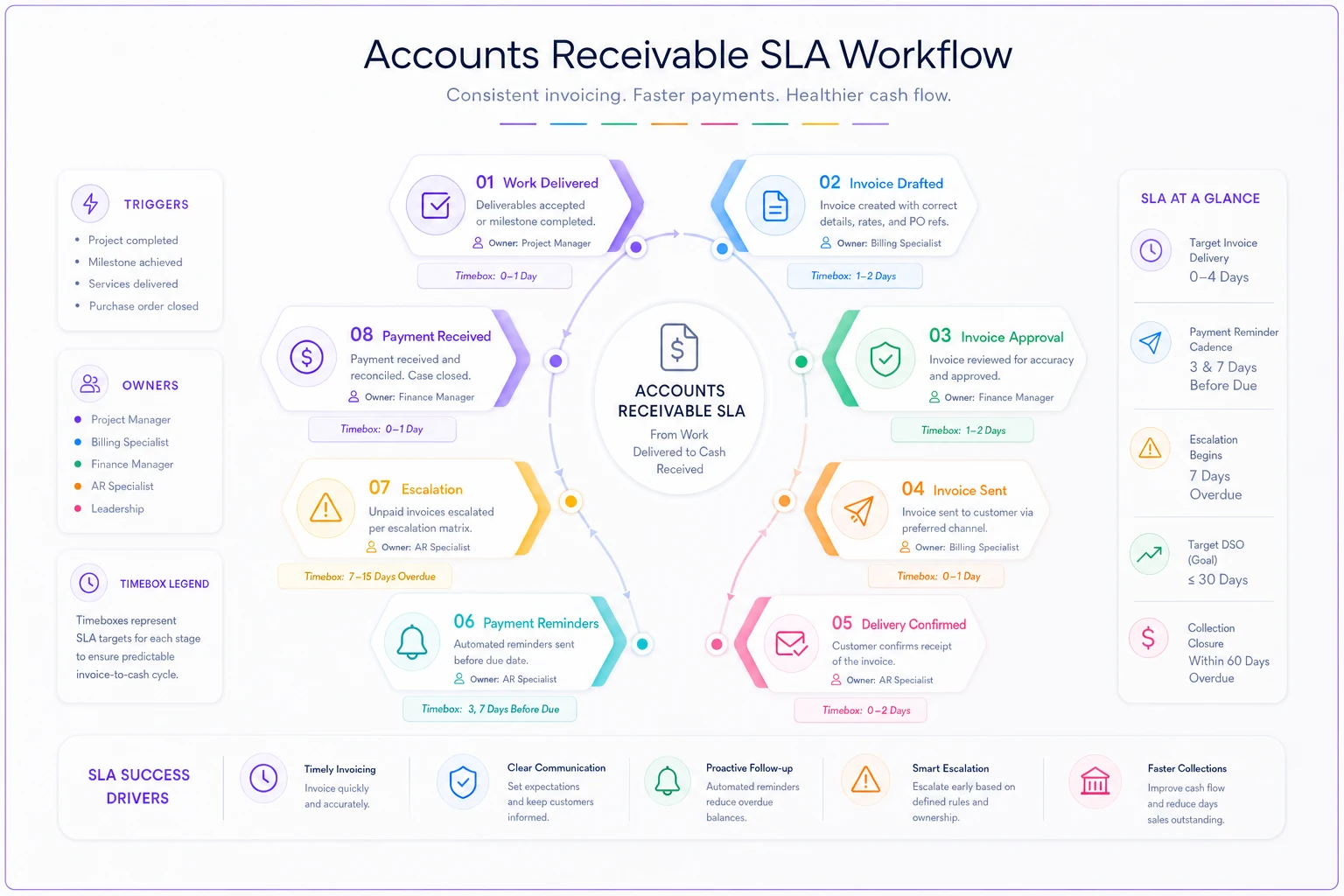
Below is a simple visual of the SLA workflow.
Weekly rituals that keep the system alive
An operating model dies without rhythm. SLAs and roles look great on paper, but they only hold if there are recurring moments where the whole picture gets checked. For small teams, this doesn't mean adding more meetings — it means short, predictable routines.
-
Monday — AR snapshot (10 minutes). Pull the open invoice list. What's outstanding, what's approaching due, what's overdue. This is a visibility ritual, not a problem-solving one. Just make sure everyone's looking at the same numbers.
-
Wednesday — reminder sweep. Whoever owns reminders confirms every due-and-unpaid invoice has had its scheduled nudge. Anything that slipped gets caught here.
-
Friday — escalation review. Look at anything past 30 days. Decide: keep chasing, offer a payment plan, or escalate. This is where a decision gets made rather than deferred.
-
Month-end — close and match. Confirm every payment received is matched to an invoice and marked paid. This is what prevents the "reminder sent to a client who already paid" embarrassment.
The Friday escalation review matters more than the others, and it's the one most teams skip. Without a fixed time to decide what to do about aging invoices, those invoices don't get decisions — they get avoided. A recurring slot forces the call. You'll be surprised how many "we're not sure what to do" invoices resolve the moment someone is required to pick an action.
For teams that want the reminder side to run more consistently, structured sequences help — the timing and tone of those nudges genuinely affect recovery rates, and we broke that down in detail in our guide on automated reminder sequences that increase recovery. The weekly sweep above is what keeps those sequences from quietly falling out of sync.
The escalation ladder: knowing when to stop being nice
Most small teams don't have an escalation ladder. They have a "reminder loop" that repeats the same polite email indefinitely, getting quieter and less effective each time. An escalation ladder replaces that with defined steps that increase in seriousness, each tied to a time threshold and an owner.
-
Day 1 overdue — Friendly automated reminder. Owned by the reminder owner. Assume it's an oversight, because usually it is.
-
Day 7 overdue — Second reminder, slightly firmer, still warm. Same owner.
-
Day 14 overdue — Personal outreach. A real human email or call from someone who knows the client. This is the point where a template stops being enough.
-
Day 30 overdue — Escalation owner takes over. Payment options offered: partial payment, a short plan, or a firm request with a clear deadline.
-
Day 45 overdue — Work-pause consideration. If services are ongoing, this is where you decide whether to hold future work until the balance clears.
-
Day 60+ overdue — Formal collections process or final demand. Founder involvement mandatory.
The critical design choice: each rung changes who's involved and how personal it gets. Early rungs are automated and impersonal on purpose — you don't want to spend relationship capital on a client who simply forgot to pay. Later rungs escalate human involvement precisely because the situation warrants it.
One mistake worth naming: escalating based on emotion instead of time. A frustrated founder who escalates hard at day 8 because they're annoyed can damage a relationship that a basic day-1 reminder would've fixed. The ladder exists to remove emotion from the timing. The days decide, not your mood.
The full script-and-timing side of this — what to actually say at each rung — connects closely to the escalation logic we cover in our operational invoicing playbook for small teams, which pairs well with the role structure here.
A real scenario: the three-person design studio
A small branding studio — founder, a designer, and a part-time bookkeeper. Combined billings somewhere around $28k–$34k a month across roughly 12–15 active clients.
Their AR was technically "handled." The founder created invoices when projects wrapped, the bookkeeper watched the bank account, and reminders went out when the founder remembered. The problem showed up in the numbers: average days-to-payment was sitting around 52 days on net-30 terms. Somewhere between $40k and $50k was consistently tied up in receivables — for a studio that size, that's a genuine cash-flow squeeze.
When they mapped it out, the real issue wasn't clients. It was internal. The founder was invoicing an average of 8–9 days after delivery because invoicing always lost out to client work. Reminders were inconsistent — some clients got chased on day 3, others never got chased at all. And nobody owned escalation, so anything past 30 days just sat there.
They made three changes. The bookkeeper took over invoice sending and reminders, with a hard SLA: invoices out within one business day of the designer marking a project complete. They added a Friday escalation review. And they built a simple ladder so overdue accounts had defined steps instead of gut feelings.
Within about two months, days-to-payment dropped to the mid-30s. Not because clients suddenly loved paying — because the delivered-to-invoiced gap collapsed from over a week to one day, and reminders became reliable. Money tied up in AR fell by roughly a third. No new clients, no rate changes, no software overhaul. Just defined ownership and a consistent rhythm.
When this level of structure makes sense — and when it doesn't
When it makes sense
-
You have more than one person touching invoices or payments
-
You've had at least one "I thought you were handling that" moment
-
Cash flow feels tighter than your revenue suggests it should
-
Days-to-payment is creeping up and you can't pinpoint why
-
You're about to hire and don't want AR chaos to scale with headcount
When it's overkill
If you're a true solo operator with a handful of reliable clients who pay on time, a full SLA matrix and escalation ladder is more structure than you need. Write down one simple rule — invoice same-day, remind at day 1 overdue — and move on. Don't build a coordination system for a team of one. The whole point of this model is managing handoffs, and you don't have any yet.
Who should be careful
Teams that adopt the documentation without the rituals usually fail. A detailed SLA matrix sitting in a shared doc that nobody looks at does nothing. If you can't commit to the weekly rhythm — even a 10-minute version — start there before building out the full model. The rituals are what keep the system alive.
Keeping the whole thing coordinated as you grow
The reason AR gets messy isn't complexity — it's that information ends up scattered. Invoice status lives in someone's email, payment status lives in the bank, reminder history lives in someone's head, and escalation decisions live nowhere. When those things exist in separate places, no amount of ritual can fully fix it because everyone's working from a different version of reality.
A shared operational system earns its place here — not as a magic fix, but as the single surface where invoice status, payment matching, reminder history, and aging all sit together. When the Monday snapshot pulls from one source everyone trusts, the rituals get faster and the "did we already remind them?" confusion goes away. Tools that automate the routine reminder rungs also free your team to spend actual human attention only on accounts that need it — the day-14-and-beyond conversations where judgment matters.
Keep one source of truth for invoice status so the Monday snapshot is fast and unambiguous.
Whatever you use to run it, keep your records clean enough that any handoff or audit is painless. The retention and export side of that is worth setting up early, and we walked through it in our checklist on making invoices audit-ready. A tidy record trail is what makes the escalation ladder defensible if a dispute ever goes formal.
An accounts receivable operating model isn't about having more rules. It's about removing ambiguity from the path between finished work and collected cash. Define who owns each function. Set a maximum time for each stage. Build a weekly rhythm so nothing floats. Create an escalation ladder so overdue accounts get decisions instead of avoidance.
Do that, and AR stops being the thing you dread at month-end and starts being a system that mostly runs itself — one where the second, fifth, and tenth person you hire strengthens it instead of breaking it. The businesses that stay cash-healthy as they grow aren't the ones with the best clients. They're the ones whose money-collection wiring was built to survive more than one set of hands.
Ready to streamline your billing process?
Join 5,000+ businesses using Billoly to reduce billing delays, automate payments, and grow revenue efficiently.