


Most small businesses don't lose money to sophisticated fraud rings. They lose it to boring stuff — a vendor email that got spoofed, a payee record that quietly changed last Tuesday, a refund that went to a card that was never used to pay. The fraud that actually drains SMB bank accounts is usually mundane, slow, and completely preventable if you're watching the right signals.
Fraud prevention gets talked about like it's a security project. It's not. It's an operations problem. It lives in the same workflow as your invoicing, your vendor onboarding, your refund approvals, and your bank reconciliation. If those workflows have gaps, fraud slips through them — not because you lack a firewall, but because nobody owns the moment when a payee's bank details change.
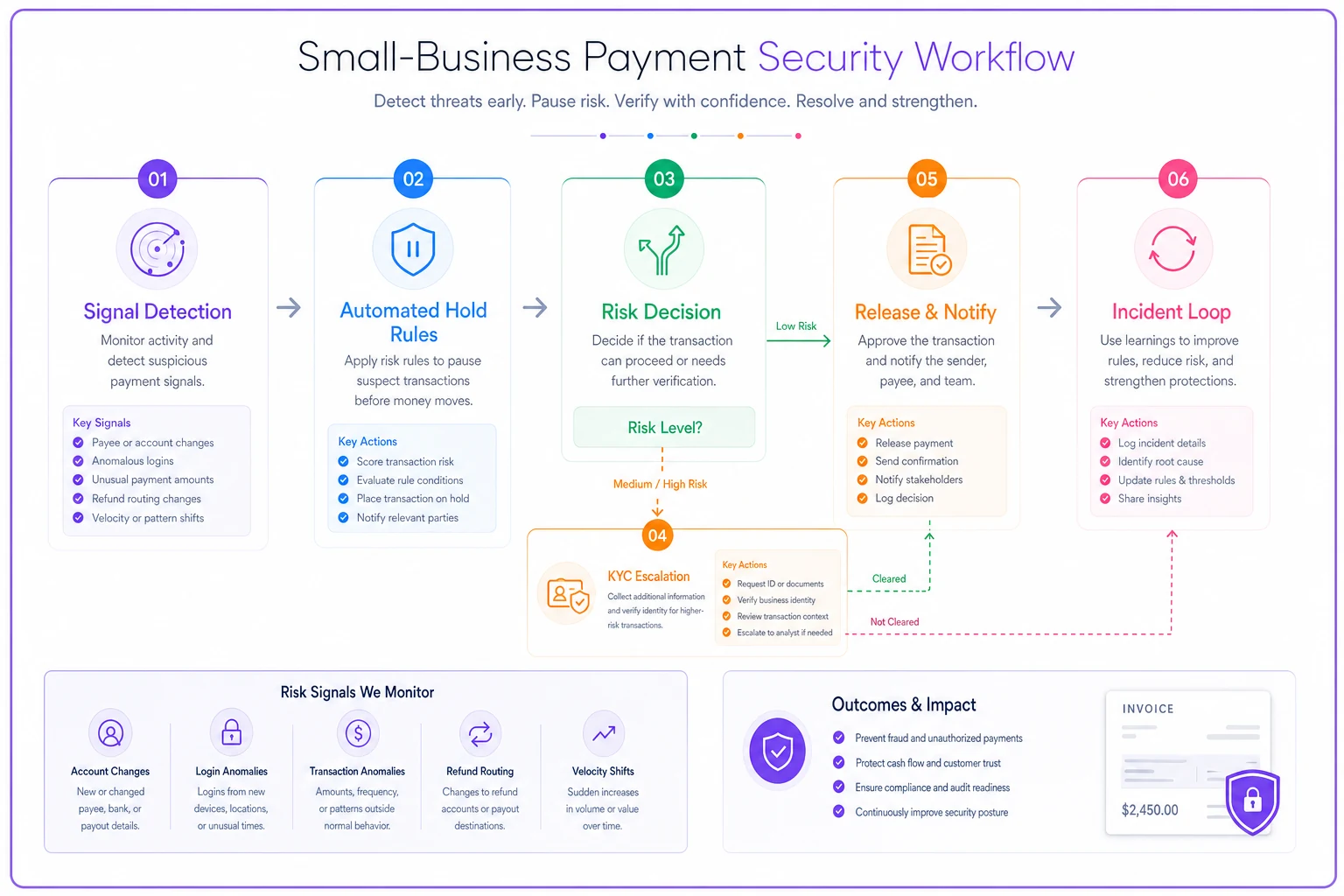
This piece is about building a lightweight system: a catalog of signals worth watching, hold rules that pause risky payments automatically, KYC thresholds that scale with transaction size, and an incident-response playbook you can run without a security team. The goal isn't to make you paranoid. It's to make the risky moments visible so a human looks before money moves.
Why fraud slips through SMB operations specifically
Big companies have dedicated fraud teams and layered controls. Small businesses have one person doing accounts payable between client calls. That's the real vulnerability — not technical sophistication, but the absence of a second set of eyes at the exact moment that matters.
A few patterns show up again and again across small operations:
Everything runs on trust and memory. The owner knows which vendors are legit, so no formal verification exists. That works until the owner is on vacation and a convincing email asks to "update our bank details for this month's payment." The person covering has no baseline to compare against.
Approval and execution live in the same hands. When the same person approves an invoice and pays it, there's no natural checkpoint. Fraud thrives wherever one person controls the whole chain.
Changes aren't treated as events. A new invoice gets scrutiny. A changed payee bank account often doesn't — it just looks like an edit to an existing, trusted record. That's the single most exploited gap in small-business payments.
Speed is rewarded. Fast payment is good for relationships and cash flow, so teams optimize for it. Fraudsters exploit urgency ("the wire needs to go out today or we lose the contract"). The faster your process, the more you need friction in the right places.
What breaks as volume scales is coordination. When you're paying 10 invoices a month, you notice anomalies by instinct. At 200 a month across multiple approvers, instinct stops working. You need the system to flag what a human can no longer track by memory — which is exactly where an operations-first signal catalog earns its keep.
The signal catalog: what's actually worth watching
Forget the enterprise threat models. For an SMB, a handful of signals catch the overwhelming majority of real incidents. The trick is defining each one concretely enough that software — or a checklist — can detect it without judgment calls.
Stop chasing payments and start automating your billing.
Billoly empowers you to create, send, and track invoices effortlessly while maintaining professional client relationships.
- Customizable invoice templates
- Automated payment reminders
- Real-time payment tracking
No credit card required
| Signal | What it looks like | Why it matters | Typical response |
|---|---|---|---|
| Mismatched bank details | Payee's account/routing differs from last paid invoice | #1 vector for payment redirection | Auto-hold + out-of-band verification |
| Duplicate payee | Same name, new vendor ID, or same bank account under two names | Shell vendor or accidental double-pay | Hold + manual review |
| Anomalous IP / login | Login or invoice submission from unexpected country or new device | Account takeover in progress | Force re-auth + alert owner |
| Round-number wire requests | Unusual request like a flat $9,800 (just under reporting thresholds) | Classic structuring behavior | Hold + KYC escalation |
| Email domain mismatch | Invoice from vendor-billing.com vs. usual vendor.com | Spoofed vendor / BEC | Hold + verify via known phone |
| New payee + high first payment | Vendor created this week, first invoice over threshold | No track record to validate against | KYC + staged payment |
| Refund to non-origin method | Refund routed to a card/account that never paid | Refund fraud | Block; refund only to original method |
| Off-hours activity spike | Multiple payments queued at 2 a.m. local time | Compromised credentials | Alert + hold batch |
Writing these down isn't really about the list itself — it's that each signal becomes a rule instead of a gut feeling. A gut feeling doesn't work when you're busy. A rule works whether you're paying attention or not.
One thing worth sitting with: the most dangerous signal on that table isn't anomalous IPs or exotic login patterns. It's the quiet bank-detail change. It generates no alarm because it looks like normal maintenance. Treat every change to a payee's banking information as a security event — not a routine edit — and you've closed the door most fraud walks through.
Automated hold rules: friction in the right places
A hold rule is simple: when a payment matches a defined risk condition, it doesn't execute — it waits for a human. The art is tuning the thresholds so you're not holding every payment (that just trains people to click "approve" without looking) and not letting the dangerous ones slip through.
Here are sample hold rules you can adapt. The numbers are starting points — calibrate them to your actual payment volume.
Rule 1 — Bank detail change hold
> IF a payee's bank account or routing number differs from the last successful payment → HOLD → require verification via a phone number on file before the change (not one supplied in the request).
Rule 2 — New payee first-payment cap
> IF payee was created within the last 7 days AND payment exceeds $1,500 → HOLD → require secondary approver.
Rule 3 — Threshold-adjacent amounts
> IF wire request falls between $9,000 and $9,999 → HOLD → KYC review. (Amounts hugging a round reporting number deserve a second look.)
Rule 4 — Duplicate bank account
> IF two different payee records share the same bank account number → HOLD both → manual reconciliation.
Rule 5 — Velocity / off-hours
> IF more than 5 payments are queued within 10 minutes OR any payment is initiated outside business hours → HOLD the batch → notify owner.
Rule 6 — Refund routing
> IF refund destination ≠ original payment method → BLOCK. No hold, no override. Refunds go back the way the money came in, period.
A good hold rule has three parts: a clear trigger, a clear action, and a clear path to release. If any of those three is fuzzy, the rule will either get ignored or quietly disabled the first time it's inconvenient.
Where you draw the line between fully automated and human-in-the-loop is its own design decision, and it's worth being deliberate about. The tradeoffs are covered well in this breakdown of billing automation governance and human-in-the-loop rules. Short version: automate detection and holding, keep release in human hands for anything above your comfort threshold.
KYC thresholds that scale with risk, not bureaucracy
Full KYC on every vendor is overkill for a two-person shop and will quietly get skipped. The better approach is tiered — the amount of verification rises with the amount of money and the newness of the relationship.
A practical three-tier model:
-
1. Light tier (under ~$1,000, existing payee) Match payee details to prior payments. No new verification needed. This is the bulk of your volume and shouldn't have friction.
-
2. Standard tier ($1,000–$10,000, or any new payee) Confirm legal name, confirm bank details via an out-of-band channel (call a known number, not one on the invoice), and keep a record of who verified and when.
-
3. Enhanced tier (over ~$10,000, or any held transaction) Collect formal documentation — business registration, a voided check or bank letter for account confirmation, and a second internal approval. Stage the first large payment if possible.
The part most SMBs miss: KYC isn't a one-time gate at onboarding. The riskiest moment isn't when a vendor is created — it's when something about them changes. A vendor onboarded cleanly two years ago whose bank details change today should drop straight back into enhanced verification. Static onboarding checks give a false sense of safety.
This ties directly into broader payment hygiene, and a lot of the foundational mistakes here overlap with the ones covered in this guide to small-business payments compliance mistakes to avoid — worth reading alongside this if you're setting up controls from scratch.
A real scenario: the Tuesday bank-detail switch
A small design studio — three people, maybe 40–50 vendor payments a month — had a long-standing contractor they'd paid for over a year. One Tuesday, an email came in from what looked like the contractor's address: new invoice, same formatting, plus a note that they'd "switched banks, please update for this payment."
The person handling payments that week wasn't the usual owner. The invoice looked normal, the amount was in range (around $4,200), so the bank details got updated and the payment went out. Two weeks later the real contractor called asking where their money was.
The loss was roughly $4,200 — not catastrophic, but painful for a studio that size, and genuinely hard to recover once a wire clears. The email came from a near-identical spoofed domain nobody thought to check.
After the incident they added exactly one rule: any change to a payee's bank details triggers a hold and a callback to the old phone number on file before money moves. No new software, no consultant. Over the following months two more "bank change" requests came in — both flagged, both confirmed fraudulent on the callback. One rule paid for itself several times over.
The lesson isn't "be careful." Everyone thinks they're careful. The problem is that careful doesn't survive a busy week with a substitute at the keyboard. A rule does.
The evidence checklist: what to capture before money moves
When a payment gets held, the person reviewing it needs the right evidence in front of them to make a fast, correct decision. Scrambling for context is how good holds get released badly. Keep this checklist attached to every flagged transaction:
-
[ ] Prior payment history — have we paid this exact payee + bank account before?
-
[ ] Source of the change request — email header, sender domain, exact address (not just the display name)
-
[ ] Out-of-band verification record — who was called, at what number, what was confirmed
-
[ ] Invoice metadata — submission IP/location, timestamp, device if available
-
[ ] Amount context — does this fit the vendor's normal range?
-
[ ] Approver trail — who created the payee, who approved, who's releasing
-
[ ] Supporting docs — PO, contract, or prior invoice for comparison
-
[ ] Decision log — approve/hold/block, by whom, with a one-line reason
Capturing evidence before resolution isn't just diligence — half your fraud attempts die at the evidence-gathering step. The moment you say "let me call the number we already have on file to confirm," a spoofed request falls apart. The act of collecting evidence is the control.
The incident-response playbook
When a payment does go wrong — or you catch one mid-flight — speed matters more than almost anything. Fraudulent wires can sometimes be recalled in the first few hours and almost never after a couple of days.
-
1. Freeze first, investigate second. The moment something looks wrong, hold all related and queued payments to that payee. Don't wait to be sure.
-
2. Call your bank immediately. Report suspected fraud and ask about a recall or reversal. For wires, minutes matter. Have the transaction reference ready.
-
3. Lock down access. If account takeover is possible, reset credentials on your payment and email accounts, enable or re-check MFA, and review recent login activity for the anomalous-IP signal.
-
4. Preserve evidence. Save the original emails with full headers, screenshots of the changed records, and timestamps. You'll need these for the bank, insurance, and any report.
-
5. Verify through a known-good channel. Contact the real vendor using a number you already had — not anything from the suspicious message — to confirm what's legitimate.
-
6. Contain the blast radius. Check whether the same attacker touched other payees, whether any other records changed recently, and whether the compromised email sent anything else.
-
7. Report it. File with your bank's fraud unit and the relevant authorities. For the US, that's the FBI's IC3 for business email compromise. Reporting improves recovery odds and is often required for insurance.
-
8. Debrief and patch the gap. Within a week, identify the exact rule that would have caught it and add it. Every incident should produce one concrete change to your signal catalog or hold rules.
Step 8 is the one most teams skip, and it's the only one that compounds. An incident you learn nothing from is just a loss. An incident that produces a new rule is tuition.
When heavy controls are a bad idea
More control isn't automatically better. Friction has a cost, and misapplied it creates its own risks.
When this makes sense: You're processing enough payment volume that memory no longer catches anomalies, you have multiple people touching payments, or you run wires and ACH where reversals are hard. The more irreversible your payment methods, the more upfront controls earn their keep.
When it's overkill: If you're a solo freelancer paying two vendors a month on credit cards with strong dispute protection, a full signal catalog and tiered KYC is wasted effort. Enable MFA, watch for bank-detail changes, and move on.
Who should NOT over-engineer this: Anyone whose controls would slow legitimate payments so much that staff start building workarounds. A hold rule everyone bypasses is worse than no rule — it creates a false sense of safety while the actual control is dead. If you add friction, add it only where the loss would genuinely hurt.
The goal is a system where the normal path stays fast and only the risky moments slow down. Get that balance wrong in either direction and the controls either fail to protect you or get quietly dismantled by the people they inconvenience.
Pulling it together as a system
Fraud prevention for a small business isn't a product you buy or a one-time audit. It's a layer woven into how payments already flow: signals that make risk visible, hold rules that pause the dangerous moments, KYC thresholds that scale with exposure, and a playbook for the day something slips through anyway.
The connective tissue across all of it is the same principle — separate the moment of change from the moment of trust. A new invoice, a changed bank account, a refund going somewhere new, a login from an unfamiliar place: each of these is a moment where a small amount of friction, applied automatically, buys you a lot of protection.
The businesses that get burned aren't the ones without firewalls. They're the ones where a risky change looked identical to a routine one, and nobody was positioned to tell the difference.
Start with one rule — the bank-detail hold — because it closes the gap behind most real losses. Add the signal catalog as your volume grows past what memory can track. Write the playbook before you need it, because you won't have time to think clearly in the first hour of a live incident. Done right, none of this slows your business down. It just makes sure that when money moves, someone — or something — looked first.
Ready to streamline your billing process?
Join 5,000+ businesses using Billoly to reduce billing delays, automate payments, and grow revenue efficiently.