


Most small businesses don't outsource collections because they ran the numbers. They outsource because one month got ugly. A big client went 90 days late, the owner spent two weeks chasing it instead of doing billable work, and in a moment of frustration they Googled "collections agency" and signed whatever showed up first.
That's not a decision framework. That's surrender dressed up as a strategy.
What almost nobody tells you is that outsourcing collections is a coordination problem, not a procurement problem. The agency isn't a vending machine where you drop in bad debt and recovered cash falls out. It's a second set of hands operating on the same customer relationships, pulling from the same data, and making calls that reflect on your brand. If the handoff is sloppy, if the data is wrong, if nobody's watching the KPIs — you don't just lose money, you lose customers and spend weeks untangling disputes the agency created.
So treat it like what it actually is: a system you're plugging an external party into. That means thresholds, contracts, clean handoff points, and a dashboard that tells you whether the thing is working before it's too late to fix.
First question: are you even at the threshold yet?
Before anything else — most small businesses that think they need an agency actually have an internal process problem, not a collections problem. They've got $40k sitting in 60–90 day aging and assume that's a recovery failure. Half the time it's just that nobody sent the second and third reminder, or the invoices had the wrong PO number and got stuck in the client's AP queue.
If your internal follow-up sequence isn't tight, outsourcing just hands a broken process to someone who charges 25–40% of whatever they recover. You're paying a premium to skip a step you could've handled yourself.
Here's a rough gut-check on when outsourcing actually makes sense:
| Signal | DIY still works | Time to consider outsourcing |
|---|---|---|
| Monthly overdue volume | Under ~$5k–$8k | Consistently above $10k–$15k |
| Age of worst accounts | Mostly under 90 days | Multiple accounts past 120 days |
| Your time spent chasing | A few hours a month | Days per month, pulling you off billable work |
| Internal process maturity | You have reminder sequences + escalation rules | You're chasing ad-hoc with no system |
| Account type | Active, ongoing clients | Dead relationships you've written off emotionally |
That last row matters more than people expect. Outsourcing works best on accounts where the relationship is already over — the client ghosted, moved on, or became genuinely delinquent. Those are safe to hand to a third party because there's nothing left to damage.
What breaks businesses is sending active clients to collections — the ones you still invoice monthly. An agency doesn't know Mrs. Delgado is your best referral source. They just see an aging balance and start making calls. Suddenly you've recovered $900 and lost a $14k-a-year account.
If you don't have a solid internal escalation ladder yet, build that first. Our dispute and collections playbook for small portfolios walks through the timing and scripts, and the accounts receivable operating model for 1–10 person businesses covers the escalation ladders you should exhaust before an external party ever touches a customer.
Who should NOT outsource (yet)
A few situations where an agency is the wrong move, full stop:
Stop chasing payments and start automating your billing.
Billoly empowers you to create, send, and track invoices effortlessly while maintaining professional client relationships.
- Customizable invoice templates
- Automated payment reminders
- Real-time payment tracking
No credit card required
-
You bill the same clients repeatedly. Recurring revenue businesses almost never want third-party collectors near active accounts. The lifetime value loss dwarfs the recovery.
-
Your invoices are disputed, not just late. If a chunk of your overdue balance is clients saying "that's not what we agreed to," you have a billing clarity problem. An agency can't collect on a disagreement — they'll just escalate the fight.
-
You don't have clean records. If you can't produce the signed agreement, the delivery confirmation, and the invoice history in under five minutes per account, you're not ready. Agencies need documentation, and so do you if anything goes to legal.
-
The amounts are tiny. Sending a $300 invoice to a contingency agency that keeps 40% means you net $180 on a good day. The admin overhead isn't worth it.
Fix those first. Outsourcing amplifies whatever system you already have — good or bad.
The vendor-selection thresholds that actually matter
Once you're genuinely at the point where handing off makes sense, the selection process is where most small businesses get burned. They compare agencies on recovery rate and nothing else. That's like hiring a contractor based only on price.
-
Contingency structure and rate tiers. Good agencies charge on a sliding scale — lower percentage for fresher, higher-balance accounts; higher for old or small ones. Be suspicious of a flat 50% across the board. That usually means they only win if you lose big.
-
Specialization in your account size. An agency that chases six-figure commercial debt will treat your $2k invoices as an afterthought. You want someone whose typical client looks like you — small balances, SMB portfolios.
-
Licensing and compliance posture. They must be licensed in the states where your debtors are, and operating under FDCPA (and any state equivalents). Ask directly. A vague answer here is a red flag you cannot ignore — their compliance failures become your legal exposure.
-
Data handling and reporting cadence. How do they receive accounts? How do they report back? If the answer is "email us a spreadsheet and we'll call you monthly," walk away. You need structured updates you can actually monitor.
-
Their communication tone. Ask to hear a sample call or read their script templates. You're letting these people speak as your business to your customers. If their default posture is aggressive, that tone lands on your brand.
Worth naming one pattern here: the agencies that are easiest to sign with are often the worst to work with. Fast onboarding with no paperwork usually means no process. The good ones ask you a lot of questions upfront — about your documentation, your dispute history, your relationship status with each account. That friction is a feature.
Contract clauses and red flags
The contract is where the relationship lives or dies. A few clauses to insist on, and a few to run from.
Clauses you want in writing:
-
Tiered contingency rates spelled out by account age and balance, not "to be determined."
-
A placement cap or no-collection-no-fee guarantee — you shouldn't pay a monthly retainer and a contingency fee on a small portfolio.
-
Mandatory dispute escalation back to you. If a customer disputes the debt, the agency must pause and notify you before proceeding. This single clause prevents most relationship damage.
-
A recall right. You can pull an account back at any time — critical if a "dead" client suddenly reactivates or you realize there was a billing error on your end.
-
Clear data-return terms. When the engagement ends, they return or destroy your customer data on a defined timeline, and they can't sell or reuse it.
-
Reporting SLA. Defined frequency and format for status updates. Weekly or biweekly, structured, not "when there's news."
Red flags that should kill the deal:
-
They keep a percentage of future payments the client makes directly to you after placement. Some contracts quietly claim a cut of anything the debtor pays, even if they pay you months later without the agency lifting a finger.
-
No clause requiring them to pause on disputes.
-
Vague or missing compliance/licensing language.
-
Auto-renewing exclusivity that locks all your overdue accounts to them for a year.
-
They won't share call recordings or scripts.
-
Penalties for recalling an account. If pulling your own customer back costs you a fee, they're betting on your mistakes.
One more subtle one: watch how recovered amounts get reported. A few agencies report gross recovery and invoice their fee, but net out their percentage from a client's payment in ways that are hard to reconcile. You want every recovered dollar traceable to a specific account and a specific payment date.
The data contract: what you hand over and how
This is the part small businesses skip, and it's the part that causes the most downstream mess. You're not just "sending accounts." You're establishing a data exchange between two systems that need to stay in sync.
If any payment that lands in your account doesn't immediately flag the agency to stop calling, you will — guaranteed — have a customer who paid you directly get a collections call three days later. That's the single most common way these engagements blow up.
Minimum fields to transfer per account:
-
Unique invoice ID / account reference (yours, so you can reconcile later)
-
Customer legal name + billing contact
-
Original invoice date, due date, and current age
-
Original amount, amount paid, current balance
-
Last contact date and summary of your prior attempts
-
Dispute status (clean / partially disputed / disputed)
-
Any payment arrangement already in place
The sync mechanism — this is non-negotiable:
-
Webhook from your billing system to the agency's intake — a payment event fires and the account is auto-flagged as paid. Cleanest option, but requires an agency that can actually receive it.
-
A shared status portal both sides update. Workable, but relies on humans remembering to log in.
-
Daily reconciliation email/file. The floor. Better than nothing, but there's a lag where overlap calls happen.
Here's a simple workflow for syncing payments and pausing calls.
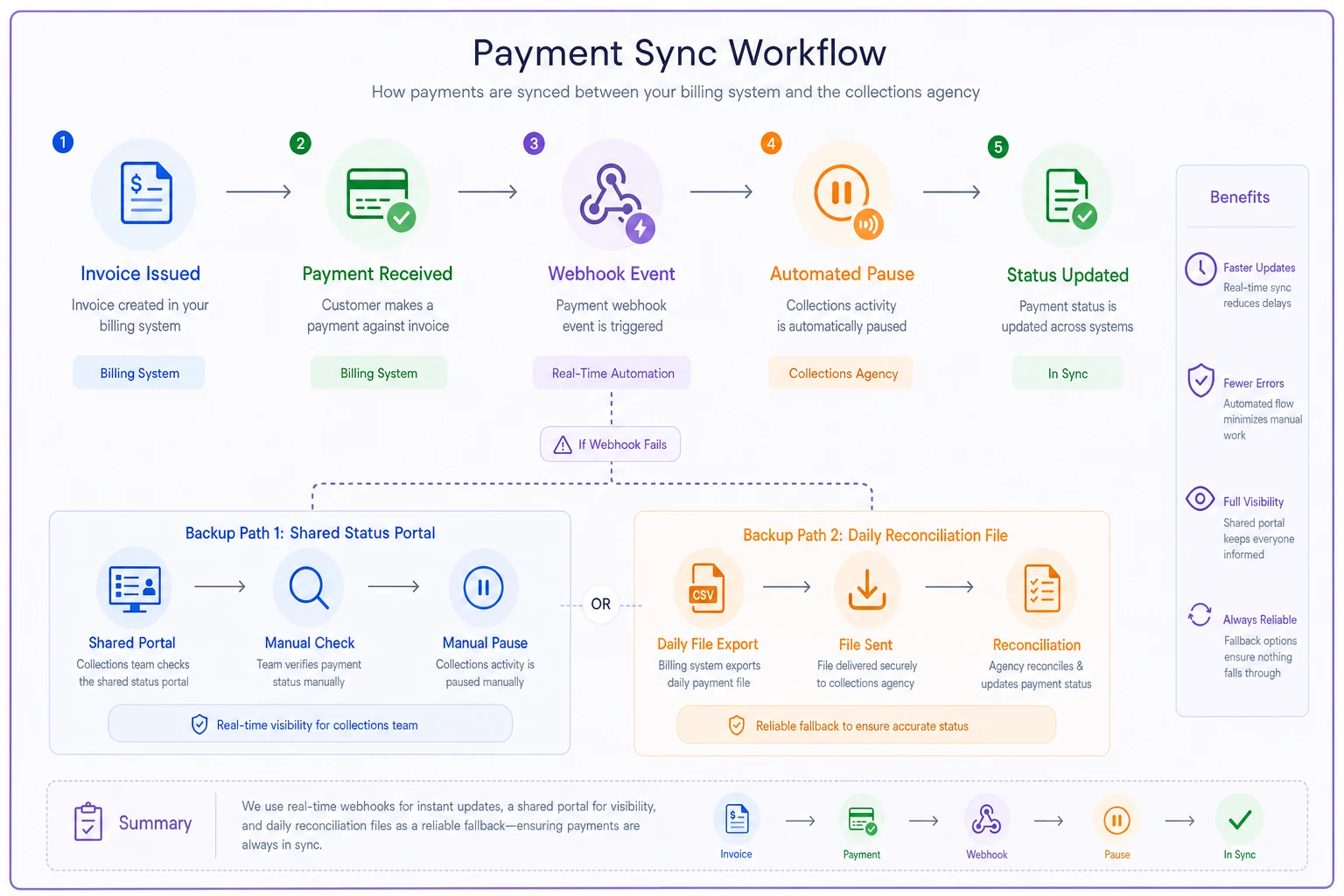
The businesses that avoid the "paid customer gets harassed" nightmare are the ones that automated the payment-to-pause signal. If a payment hits your account and something automatically tells the agency to stop, you've eliminated most of the embarrassment. If that step depends on you remembering to send an email on a Friday afternoon, it will fail eventually.
This is where having your billing data organized actually pays off. If every invoice carries a stable ID and a current status field, pushing clean data to an agency — and syncing payments back — is a non-event. If your records live half in a spreadsheet and half in your head, the handoff becomes a manual reconciliation project every single week.
Handoff points: where the baton actually changes hands
Think of the collections lifecycle as a relay. There are specific points where responsibility moves, and each one needs a clear rule so nothing falls through the gap.
Handoff 1 — Internal to placement. You've exhausted your reminder sequence and escalation ladder. The account crosses your threshold (say, 90 days + no response to final notice). Before placement: last documentation check, confirm the relationship is truly dead, flag any dispute history.
Handoff 2 — Placement to active collection. The agency acknowledges receipt and begins. Rule: they confirm the data is complete and flag any missing documentation back to you within a set window — 3–5 business days. No silent black holes.
Handoff 3 — Dispute pause. Customer disputes the debt. The agency stops and kicks it back to you. You resolve the billing question, then either re-place or recall. This handoff protects relationships, so it needs to be airtight.
Handoff 4 — Direct payment. Customer pays you instead of the agency. The pause signal fires, the agency stops, and you reconcile the fee owed (if any) per the contract.
Handoff 5 — Resolution or return. Account is recovered, settled, or deemed uncollectable. The agency closes it out, returns the data, and the final accounting happens.
The gaps between these handoffs are where money and goodwill leak. A missing rule at Handoff 3 means disputes turn into fights. A missing signal at Handoff 4 means harassed customers. A fuzzy Handoff 5 means accounts sit in limbo for months with no one owning them.
A real scenario
A small commercial cleaning company — about eight recurring contracts plus a steady stream of one-off deep-clean jobs — had roughly $28k in aging, most of it from one-off customers who'd disappeared after the work was done. The owner was spending maybe two full days a month chasing people who were never going to call back.
They almost signed with the first agency that quoted them, which wanted a flat 45% and had no dispute-pause clause. Instead they slowed down, screened three agencies, and picked one specializing in sub-$5k SMB accounts at a tiered rate (28% on fresher accounts, up to 40% on the oldest). They insisted on a recall right, a dispute-pause clause, and a daily payment reconciliation file.
Over the following couple of quarters, the agency recovered somewhere around $11k–$13k of the old balance. Net of fees, the owner cleared maybe $8k they'd basically written off. More importantly, those two days a month went back into selling new contracts. And because they'd separated the recurring clients out — those never went near the agency — they didn't torch a single active relationship.
The recovery number wasn't dramatic. The operational win was.
The monitoring dashboard: KPIs you actually watch
The mistake: businesses sign the agency, feel relief, and stop paying attention. Six months later they can't tell you whether it worked. You need a small, boring dashboard you glance at every couple of weeks.
Automate an alert for overlap incidents so you know the instant a paid customer was contacted.
Keep it tight — these are the metrics that tell the real story:
-
Net recovery rate — recovered dollars after fees, as a percentage of placed balance. Gross recovery is a vanity number.
-
Average days to first contact after placement — how fast the agency actually starts. Slow starts predict poor results.
-
Average days to resolution — how long accounts sit before closing one way or another.
-
Dispute rate on placed accounts — if this spikes, the agency is placing pressure on accounts that shouldn't have gone out, or your documentation is weak.
-
Overlap incidents — number of times a customer who paid you got contacted anyway. This should be near zero. If it's not, your sync is broken.
-
Recall rate — how often you pull accounts back. High recall rates mean your placement criteria are wrong.
-
Complaint count — any customer who complained about agency conduct. Even one aggressive call that reaches your inbox is a signal.
Watch two of these together especially: net recovery rate against dispute rate. An agency that posts great recovery numbers while generating a pile of disputes isn't winning — it's borrowing against your future. The quiet, steady agency with a lower recovery rate and almost no complaints is usually the better long-term partner.
Set a simple review cadence. Every two weeks, five minutes: did overlap incidents stay at zero, did disputes stay flat, is net recovery tracking where you expected. If any of those drift, address it before it compounds.
When this whole thing is a bad idea
Outsourcing collections can quietly make a business worse in a couple of specific situations, and it's worth being honest about them.
If most of your overdue balance is clients who are confused rather than delinquent — wrong PO numbers, invoices stuck in approval, unclear line items — an agency does nothing but add aggression to a misunderstanding. The fix there is clearer invoices and tighter internal follow-up, not a third party.
And if you haven't separated active clients from dead ones, outsourcing is actively dangerous. The agency can't tell the difference, and the contract rarely requires them to ask. That segmentation has to happen on your end, before a single account leaves the building.
Bringing it together
Outsourcing collections isn't a rescue button. It's a system you bolt onto an existing one, and it only works if the existing one is already decent. Tight thresholds so you only hand off what's genuinely dead. A contract that forces the agency to pause on disputes and return accounts on demand. A data contract where payments-to-you instantly signal stop-calling. Clean handoff points so nothing falls into a gap. And a small dashboard that tells you the truth every two weeks.
Get those five pieces right and the agency becomes a genuine extension of your operation — recovering money you'd written off while keeping your real relationships untouched. Skip them, and you've paid someone 40% to damage your reputation. The difference isn't which agency you pick. It's the system you plug them into.
Ready to streamline your billing process?
Join 5,000+ businesses using Billoly to reduce billing delays, automate payments, and grow revenue efficiently.