



Most billing integrations don't fail loudly. They fail quietly. A webhook times out at 2am, a payment gets recorded in Stripe but never in your books, and nobody notices until month-end when the numbers don't tie out. By then you're reconstructing what happened across three systems with incomplete logs.
The gap between "the integration works in testing" and "the integration survives real traffic" is enormous. That gap is where small businesses lose money — not through fraud or disputes, but through boring plumbing failures that nobody tested for. A duplicate charge here, a missing invoice there, a sync that skipped 14 records because of a malformed timestamp.
This is a test plan, not a feature wishlist. It's built around the specific ways billing integrations break when real customers, real cards, and real edge cases hit them. If you're wiring up a payment processor, a bookkeeping sync, or a data export, this is the checklist of things to actually test before you trust it with your revenue.
Why billing integrations break in ways other integrations don't
Billing sits at the intersection of at least three systems that each think they're the source of truth. Your invoicing tool thinks it owns the invoice. Your payment processor thinks it owns the transaction. Your bookkeeping software thinks it owns the ledger. When these disagree, there's no automatic referee.
What makes billing integrations uniquely dangerous is that errors are often financially asymmetric. A dropped event in a marketing tool means a slightly late email. A dropped event in a billing flow means a payment that happened in reality but doesn't exist in your records — or worse, a customer charged twice for the same invoice.
A lot of small-business setups "work" during the demo because the demo only tests the happy path: one invoice, one payment, immediate success. Nobody tests what happens when the webhook arrives twice, or when the processor is down for 90 seconds, or when a customer's card declines on retry attempt three. Those are the paths that actually lose money.
Before going further, it helps to have a clear picture of how the pieces fit together. If you haven't mapped your own flow yet, the breakdown in small-business billing system architecture and integration patterns is a good place to ground the rest of this.
The events you must actually handle
Every billing integration revolves around a small set of lifecycle events. The mistake isn't failing to handle them — it's handling the common ones and ignoring the rare ones, because the rare ones are exactly where money leaks.
Stop chasing payments and start automating your billing.
Billoly empowers you to create, send, and track invoices effortlessly while maintaining professional client relationships.
- Customizable invoice templates
- Automated payment reminders
- Real-time payment tracking
No credit card required
Here's the minimum set of events your integration needs to receive, record, and react to:
| Event | What it means | What breaks if you miss it |
|---|---|---|
invoice.created | An invoice was issued | Nothing to reconcile against; payments arrive "orphaned" |
payment.succeeded | Money actually moved | Invoice stays marked unpaid; you chase a client who already paid |
payment.failed | Card declined / transfer bounced | You think you got paid; cash forecast is wrong |
payment.refunded | Money went back | Revenue overstated; books don't match bank |
charge.disputed | Chargeback opened | Funds get pulled with no record of why |
subscription.updated | Plan or amount changed | You bill the old amount indefinitely |
payout.paid | Processor deposited to your bank | Can't reconcile bank deposits to invoices |
The pattern worth noticing: most teams build airtight handling for payment.succeeded and treat everything else as optional. But payment.refunded and charge.disputed are the events that quietly inflate your revenue numbers. If a refund webhook silently fails, your books show income you no longer have.
A second, less obvious issue: events arrive out of order. You can receive payment.succeeded before invoice.created if two webhooks race. Your handler needs to tolerate that — usually by creating a placeholder record rather than erroring out and dropping the event entirely.
Idempotency: the single most important thing to test
If you only test one thing from this entire post, test idempotency. It's the difference between a system that's safe to retry and a system that double-charges people.
Idempotency means: processing the same event twice produces the same result as processing it once. Payment processors will send you duplicate webhooks — it's not a bug, it's how at-least-once delivery works. If your handler inserts a new payment record every time it receives payment.succeeded, you'll eventually record phantom revenue and, in the worst flows, trigger duplicate fulfillment or duplicate charges on retry logic.
Here's a realistic failure. A home-services business had a webhook handler that marked invoices paid and then kicked off a "thank you + receipt" email. The processor retried a webhook after a 3-second timeout. Result: some customers got two receipts, and a handful of invoices with partial payments got overwritten to "paid in full" because the handler didn't check current state before writing. Nothing crashed. The numbers just quietly drifted.
The test is simple to describe and easy to skip:
-
Send a valid
payment.succeededevent. Confirm the invoice is marked paid and one payment record exists. -
Send the exact same event again with the same event ID. Confirm nothing changes — still one payment record, no second email, no state flip.
-
Send it a third time out of order, after a refund. Confirm the refund state wins and the stale "succeeded" doesn't resurrect a paid status.
The practical fix is to store the processor's event ID and check it before doing any write. If you've seen the ID, acknowledge and move on. This one check prevents the majority of silent double-counting problems.
Sample request and response: what "correct" looks like
Teams often disagree about what a successful integration call should return, which causes retry storms. If your endpoint returns a 500 on a duplicate event instead of a 200, the processor keeps retrying, and you get the same duplicate hammering your system every few minutes.
Incoming request (from processor):
``
POST /webhooks/payments
Headers: signature, timestamp
Body:
{
  "eventid": "evt8812fa",
  "type": "payment.succeeded",
  "data": {
    "invoiceid": "inv4471",
    "amount": 1840.00,
    "currency": "USD",
    "paid_at": "2025-03-11T14:22:08Z"
  }
}
``
Your response when it's new:
``
200 OK
{ "received": true, "action": "invoicemarkedpaid" }
``
Your response when you've already seen evt8812fa:
``
200 OK
{ "received": true, "action": "duplicateignored" }
``
Both return 200. The processor doesn't care what you did, only that you successfully received it. You return a non-2xx only when you genuinely couldn't process it and want a retry — like a temporary database outage. Confusing "I already handled this" with "please retry" is one of the most common and expensive misconfigurations you'll run into.
Also verify the signature before you do anything else. Skipping signature verification means anyone who finds your webhook URL can mark invoices paid. That's happened to more than one small business that assumed an obscure URL was security enough.
Failure-mode tests: the scenarios that actually lose money
Happy-path testing gives false confidence. The tests below are the ones that reveal whether your integration is actually production-ready. Each one maps to a real way money goes missing.
-
Processor returns a timeout, then succeeds on retry. Does the customer get charged once or twice? Does your system create one invoice-payment link or two?
-
Webhook never arrives at all. The payment succeeded on the processor's side but your endpoint was down for two minutes. Do you have a reconciliation sweep that catches it, or is that payment lost until month-end?
-
Partial payment on a multi-line invoice. Customer pays $600 of a $1,840 invoice. Does your system mark it partially paid, or does it round to "paid" and forget the remaining balance?
-
Refund after reconciliation. You already closed the books for the period, then a refund hits. Does your export reflect the adjustment or silently diverge from the bank?
-
Currency mismatch. Invoice issued in CAD, payment recorded in USD. Does the amount tie out, or do you get a small unexplained variance every time?
-
Malformed export row. One record has a null customer ID. Does your export skip just that row, fail the entire batch, or — worst case — succeed silently and drop it?
The one that catches the most businesses off guard is the missing-webhook scenario. Processors are reliable, but "reliable" means 99.9%, not 100%. Over thousands of transactions, you will miss a handful. Without a sweep to catch them, those become permanent reconciliation gaps.
For businesses still standing up their core billing flow, these failure modes are easier to design around early. The implementation sequence in the contractor invoice software playbook shows where these checks fit naturally into onboarding rather than bolting them on later.
The nightly sweep: your safety net for everything you missed
Real-time webhooks handle the normal case. The nightly sweep handles the gap between "what the processor says happened" and "what your records say happened." Without it, every missed event is invisible until a human stumbles on it.
A sweep is a scheduled job that pulls the day's transactions directly from each system via API and compares them against your own records. It's reconciliation that runs while you sleep. The goal isn't to replace webhooks — it's to catch the small percentage they miss before that compounds into a month-end mess.
A workable nightly sweep runs three comparisons:
-
Processor payments vs. your recorded payments. Every successful charge on the processor should have a matching paid invoice. Flag any that don't.
-
Your invoices vs. bookkeeping ledger. Every paid invoice should have a corresponding journal entry. Flag mismatches in amount or status.
-
Bank payouts vs. expected deposits. Sum of settled payments should roughly equal what hit the bank, accounting for fees. Flag unexplained gaps.
When a mismatch surfaces, the sweep shouldn't auto-fix it — it should raise an exception for a human to review. Auto-correcting financial records without human oversight is how small errors turn into confident wrong answers. The sweep's job is to surface drift early, while it's still one or two records instead of two hundred.
This is where AI-assisted operational tools earn their place quietly. Instead of a person eyeballing hundreds of rows each morning, a platform enhanced with AI automation can categorize the exceptions — "this one's a timing difference, this one's a genuinely missing payment, this one's a fee discrepancy" — so the human only looks at what actually needs a decision. Reconciliation exceptions are tedious and pattern-heavy, which is exactly the kind of work that benefits from being pre-sorted before it reaches you.
Here's a simple workflow diagram of the nightly sweep.
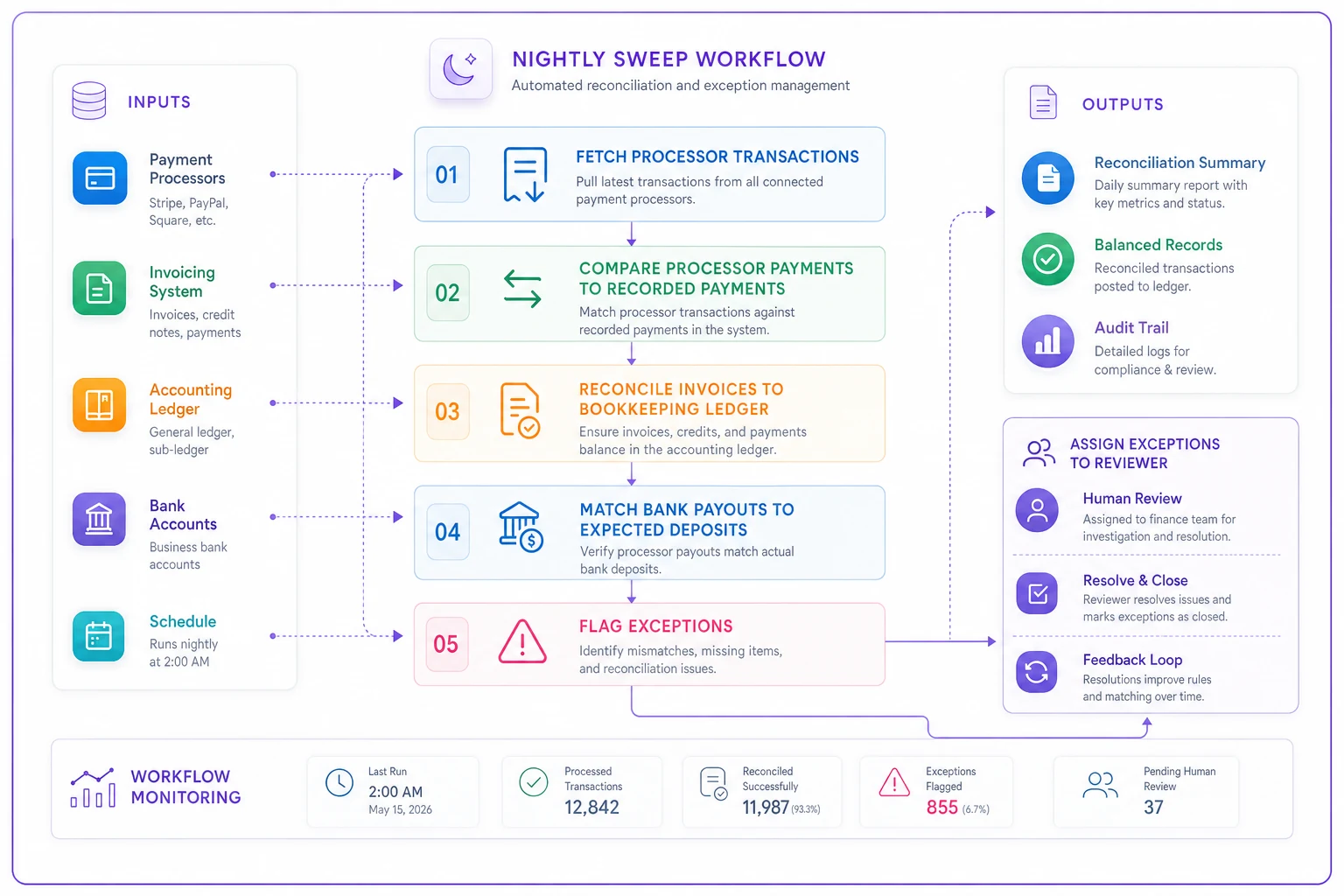
Schedule the sweep to run after end-of-day processing to reduce timing mismatches between systems.
The sweep's job is to surface drift early, while it's still one or two records instead of two hundred.
When this level of testing makes sense (and when it's overkill)
This full plan makes sense when:
-
You're processing more than a few dozen transactions a month
-
You run subscriptions or recurring billing, where errors repeat silently
-
You've already had one reconciliation that didn't tie out
-
Multiple systems hold financial truth (processor + invoicing + bookkeeping)
You can scale it down when:
-
You invoice a handful of clients monthly and reconcile by hand in ten minutes
-
You use a single all-in-one tool with no external syncing
-
Your payment volume is low enough that a missed event would be obvious immediately
Who should not skip idempotency regardless of size: anyone whose webhook handler triggers an action — sending money, marking fulfillment, charging a card. Even at low volume, a duplicate that charges a client twice costs you trust you can't easily rebuild.
A real scenario: the sync that drifted for three months
A small design studio ran invoicing through one platform and synced paid invoices into their bookkeeping tool via a prebuilt connector. It worked fine — until it didn't, in a way nobody noticed.
A processor-side refund webhook was failing silently. The studio issued refunds about twice a month, averaging a few hundred dollars each. Each failed refund event meant the bookkeeping side still showed the original payment as income. Over roughly three months, their books overstated revenue by somewhere around $3,400 — small enough not to jump out, large enough to matter when their accountant flagged a variance against the bank statements at quarter-end.
The fix wasn't dramatic. They added a nightly sweep comparing processor refunds against recorded adjustments, plus a signature check they'd been skipping. The first run surfaced seven unreconciled refunds immediately. After that, exceptions dropped to near zero each week, and reconciliation at close went from a half-day of detective work to about twenty minutes of reviewing flagged items.
The lesson wasn't "refunds are hard." It was that the integration had been quietly wrong for months, and nobody had a mechanism designed to notice. The sweep was the mechanism.
Cutover checklist: before you trust it with live money
When you flip from testing to production — or migrate from one setup to another — run through this before real transactions flow. These are the checks that catch configuration mistakes before customers do.
-
[ ] Signature verification is enabled and tested with a deliberately invalid signature (should reject)
-
[ ] Idempotency confirmed by replaying a real event twice (should not double-record)
-
[ ] All seven lifecycle events have handlers, including refund and dispute
-
[ ] Out-of-order event handling tested (payment before invoice)
-
[ ] Webhook endpoint returns 2xx on duplicates, non-2xx only on genuine processing failure
-
[ ] Nightly sweep scheduled and run once manually against real data
-
[ ] Partial payments tested against a multi-line invoice
-
[ ] Currency and fee handling verified against an actual payout
-
[ ] Export tested with a deliberately malformed row (should flag, not silently drop)
-
[ ] A rollback plan exists if the new integration starts producing mismatches
-
[ ] Someone owns the morning exception review — a named person, not "the team"
That last item matters more than most of the technical ones. A sweep that surfaces exceptions nobody reviews is just a log file. The whole point is that drift gets caught while it's small, and that only happens if a real person actually looks at it each morning.
Pulling it together
A billing integration isn't done when the happy path works — it's done when the unhappy paths are handled, logged, and swept. The events you receive, the idempotency you enforce, the failure modes you deliberately test, and the nightly reconciliation that catches what slips through aren't separate projects. They're one system whose entire job is making sure what happened in reality matches what your books say.
The businesses that avoid reconciliation pain aren't the ones with the fanciest tools. They're the ones who assumed their integration would occasionally fail and built a mechanism to catch it early. Start with idempotency, add the sweep, assign the exception review to a real person, and you've eliminated the overwhelming majority of the quiet ways billing integrations lose money.
Start with idempotency, add the sweep, assign the exception review to a real person, and you've eliminated the overwhelming majority of the quiet ways billing integrations lose money.
Ready to streamline your billing process?
Join 5,000+ businesses using Billoly to reduce billing delays, automate payments, and grow revenue efficiently.