



Most billing disputes don't start in billing. They start weeks earlier — in a sales conversation that never got written down, a scope that got "clarified" over text, or a deliverable someone promised but nobody logged. By the time the invoice goes out, the gap between what was sold and what gets billed is already baked in. The person sending the invoice is just the one who catches the blame.
This is the part of accounts receivable that nobody wants to own. Sales thinks their job ends when the deal closes. Billing thinks their job starts when the work is done. The handoff in between — where scope, price, terms, and acceptance criteria are supposed to transfer cleanly — is usually an email thread and some hope.
For most small teams, fixing collections or writing better dunning emails is treating a symptom. The real leverage is upstream: tightening the handoff so the invoice is correct and uncontested before it ever leaves. That's what AR sales alignment for small business actually means in practice, and it's less about software than about deciding what must be true before anyone can bill.
Where the handoff actually breaks
The failure isn't dramatic. It's a slow accumulation of small gaps that each seem harmless.
A deal closes. The salesperson — often the owner — knows the real terms: the discount they verbally agreed to, the extra revision round they threw in to close, the "we'll start billing once you've hired the new manager" condition. None of that makes it into a system. It lives in their head and maybe a sent-folder email.
Then work starts. Scope shifts a little. The client asks for something extra. Someone says "sure, no problem" because the relationship feels more important than the line item in that moment. Nobody updates the agreed amount.
Then the project wraps and it's invoice time. Whoever handles billing looks at the original proposal, invoices from that, and now you've got three versions of reality: what sold, what got delivered, and what got billed. The client pushes back. You dig through emails. You issue a credit or eat the difference. Multiply that by every job and you've got a quiet margin leak plus a payment delay on top.
The pattern worth noticing: disputes correlate almost perfectly with how much deal information lived only in someone's memory. The more informal the sale, the more painful the billing. A tiny shop with one owner doing everything can sometimes hold it together by sheer recall — until they can't, which is usually right when they start to grow.
What changes as you scale
The handoff problem has a specific breaking point, and it tends to show up somewhere between 3 and 10 people.
Stop chasing payments and start automating your billing.
Billoly empowers you to create, send, and track invoices effortlessly while maintaining professional client relationships.
- Customizable invoice templates
- Automated payment reminders
- Real-time payment tracking
No credit card required
Solo / 1–2 people. The same brain that sold the work also bills it. Context transfers perfectly because it never leaves one head. Disputes are usually genuine misunderstandings, not internal fumbles. The risk here isn't coordination — it's that nothing is written down, so there's no proof when a client disputes.
3–8 people. Now sales, delivery, and billing are different people, or at least different hats worn on different days. This is where it falls apart. The salesperson remembers the deal. The person who did the work knows what actually got delivered. The person invoicing knows neither and is working off a proposal that's weeks stale. Every invoice becomes a small archaeology project.
10+ people. Volume makes informal handoffs impossible. You either have mandatory fields and gates by now, or you're drowning in credits, re-bills, and a collections problem that's really a billing-accuracy problem in disguise.
The jump that catches people off guard is the 3-to-8 range, because revenue is growing and it feels like success, but dispute rate and days-to-payment quietly climb. Shops that add a salesperson, close more deals, and watch their average collection time get worse — it happens more than you'd think, because the new deals carry less documented context than the owner's old ones did.
This is the same reason the pricing-to-cash operating system matters: the cash problem and the sales problem are the same problem viewed from two ends.
The core idea: make "billable" a state you have to earn
Instead of treating billing as something you do to a project, treat "ready to bill" as a status the project has to reach. It can't be invoiced until certain things are true. Those conditions are your pre-billing controls.
Three layers do most of the work:
-
Mandatory sales fields — information that must be captured when the deal closes, before it moves to delivery.
-
SOW controls — scope, change rules, and acceptance criteria written in a way that survives contact with a real client.
-
Pre-invoice acceptance gates — a short checklist that passes before any invoice goes out.
None of this is bureaucracy for its own sake. Each gate exists because a specific thing goes wrong without it.
Layer 1: Mandatory sales fields
The goal is simple — capture the deal as it actually was, at the moment it was fresh, somewhere that isn't someone's memory. If a field is required to close the deal in your system, the information can't quietly disappear.
At minimum, every closed deal should carry these before anyone touches delivery:
-
Agreed total and billing structure (fixed, hourly, retainer, milestone — and which)
-
Any verbal concessions or discounts, written out in dollars
-
Payment terms (net days, deposit required, upfront %)
-
Billing trigger — what event starts the clock (signature, kickoff, milestone, delivery)
-
Who approves invoices on the client side, with name and email
-
Scope boundaries — a one-line "this includes / this does not include"
-
Known exceptions — the "we agreed to X even though the template says Y" items
That last two are where most of the money hides. A salesperson closing under pressure makes small promises to get the yes. Those promises are fine — if they're recorded. The problem is never the concession. It's the concession nobody told billing about.
A typical example: a marketing shop sells a $6,000 project. To close, the owner verbally agrees to include one extra landing page, normally a $900 add-on. That never gets logged. Three months later a different team member invoices the full scope-of-work, the client says "the extra page was free, remember?", and now there's an awkward email chain, a credit memo, and a payment that lands two weeks late. The concession was a good call. The missing field cost them.
Layer 2: SOW controls that actually hold up
A statement of work only reduces disputes if it anticipates how scope drifts, not just what's included on day one. Most SOWs are good at describing the work and terrible at describing what happens when the work changes — which it always does.
Three controls carry most of the weight:
Change control language. Spell out that anything outside the listed scope requires written approval before it's done, and that it gets billed separately. The key word is written. "Sure, no problem" over text is the enemy. A simple line works: "Work beyond the deliverables listed in Section 2 will be quoted and approved in writing before commencement."
Acceptance criteria. Define what "done" means for each deliverable in a way a third party could verify. "Website complete" is a dispute waiting to happen. "Five pages live on client's domain, passing on desktop and mobile, with client sign-off on staging" is not. If you can't describe acceptance objectively, you can't defend the invoice.
A deemed-acceptance clause. This is the one most small businesses skip and later wish they had. It says: if the client doesn't respond to a delivery or raise issues within a set window — say 5 business days — the deliverable is considered accepted and billable. Without it, a non-responsive client can freeze your invoicing indefinitely just by going quiet.
Here's a quick comparison of weak vs. defensible SOW language:
| Element | Weak (dispute-prone) | Defensible |
|---|---|---|
| Scope | "Social media management" | "12 posts/month across 2 platforms, 1 revision each" |
| Done | "Logo delivered" | "3 concepts, 2 revision rounds, final in PNG/SVG/AI" |
| Changes | (not mentioned) | "Out-of-scope work quoted + approved in writing first" |
| Acceptance | (not mentioned) | "Deliverables deemed accepted if no issues raised in 5 business days" |
| Billing trigger | "Upon completion" | "50% at kickoff, 50% at acceptance of final deliverable" |
The defensible column isn't longer because it's more legalistic. It's longer because it removed the ambiguity that turns into arguments.
Layer 3: The pre-invoice acceptance gate
This is the last checkpoint before money gets asked for, and it's usually the cheapest to implement — a short checklist someone runs before hitting send. The point is to catch the mismatch between sold, delivered, and billed while it's still fixable internally, instead of letting the client catch it.
A workable pre-billing QA checklist:
-
[ ] Invoice total matches the agreed total including logged concessions
-
[ ] All billed line items map to delivered, accepted work
-
[ ] Any out-of-scope items have written approval attached
-
[ ] Billing trigger has actually occurred (milestone hit, acceptance received)
-
[ ] Client-side approver name and email are correct
-
[ ] Payment terms on the invoice match the terms in the sales record
-
[ ] Reimbursables have receipts and were pre-agreed
-
[ ] Nothing is being billed that's still in an open revision round
Run that before every invoice over some threshold — anything above $1,000 is a reasonable starting point, or every project invoice regardless of size if your volume is low. Small recurring invoices can skip it once the template is proven out.
Run the pre-billing checklist before every invoice over some threshold — anything above $1,000 is a reasonable starting point.
The quiet benefit of this gate: it creates a feedback loop back to sales. When billing keeps catching "concession not logged," that tells you your Layer 1 fields aren't being filled in. The gate surfaces the upstream problem instead of burying it.
A workflow that ties it together
The deal closes and the salesperson fills the mandatory fields — can't mark it "won" without them. That record becomes the single source of truth for terms. Delivery works against the SOW; any client request that's out of scope triggers a written change note before the work starts, not after. When deliverables ship, the acceptance window starts, and either the client signs off or deemed-acceptance kicks in. Only then does the project flip to "ready to bill."
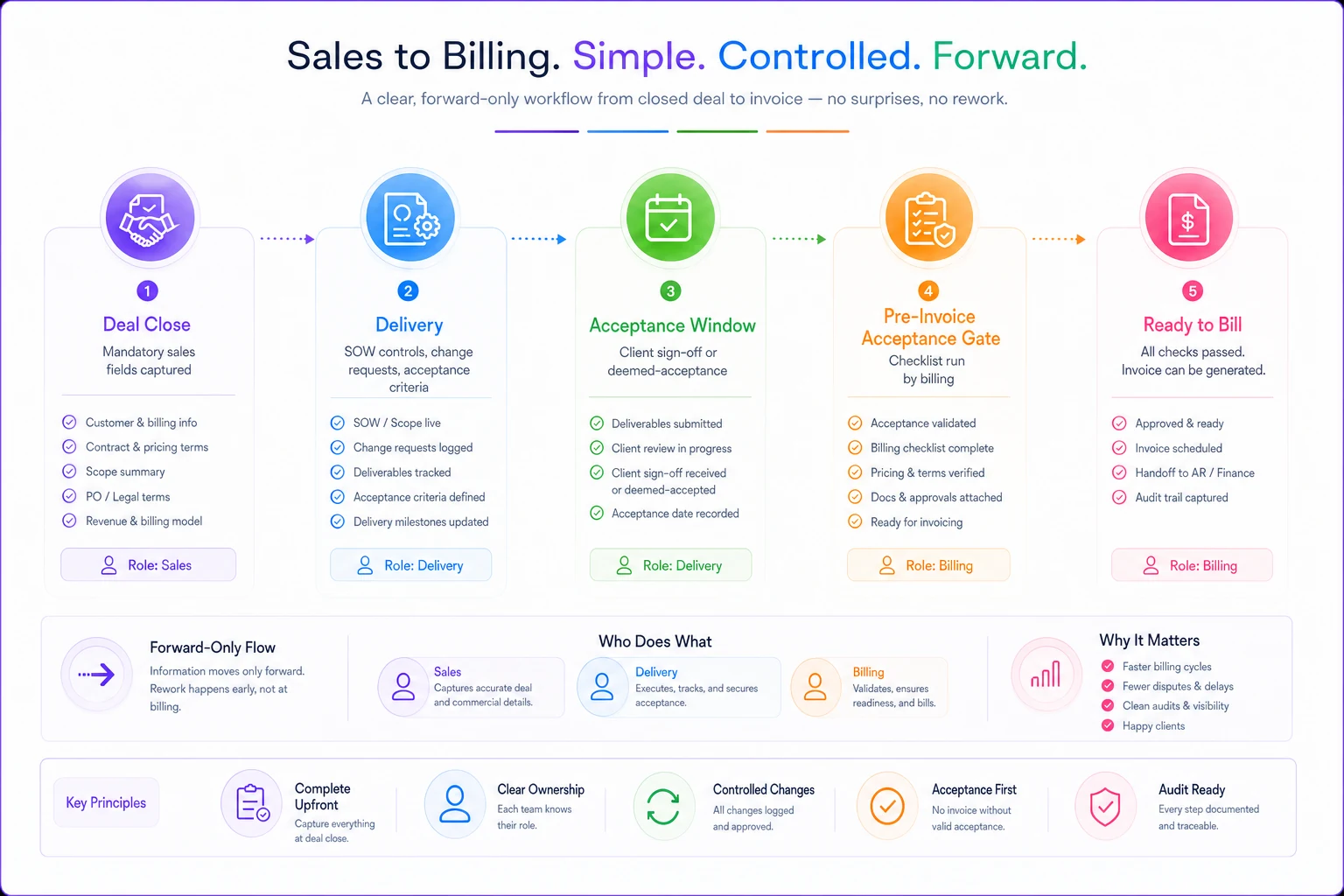
At that point, whoever invoices runs the pre-billing checklist against the original sales record — not the proposal, not memory. If everything matches, the invoice goes. If it doesn't, it kicks back for a quick internal reconciliation before the client ever sees it.
Information flows forward and only forward. Nobody downstream has to reconstruct what happened upstream, because it was captured when it was fresh. If you want to see how these roles and triggers fit into a broader billing operation, the operational invoicing playbook for small teams goes deeper on who owns what.
Most teams run this with whatever they already have — a CRM with required fields, a project tool with a "ready to bill" status, a shared checklist. The tooling matters less than the discipline of not letting a deal advance with holes in it. AI-assisted billing platforms can help by flagging mismatches automatically — invoice total vs. agreed total, missing approval on out-of-scope items — but the gate works even on paper. The software just makes it harder to skip.
A real scenario
A small commercial cleaning company, about seven people, kept running into the same month-end mess. The two owners landed accounts with custom terms — a free first-week trial here, a volume discount there, a "we'll add the second floor once your lease starts" arrangement somewhere else. The office manager who did the billing knew none of it and invoiced off the signed contracts.
The result was predictable: roughly 1 in 5 invoices got disputed or corrected, average time-to-pay sat around 45–50 days, and the owners spent a chunk of every month untangling "that's not what we agreed to" calls.
They didn't buy anything fancy. They added seven mandatory fields to how deals got recorded, wrote a deemed-acceptance line into their service agreements, and gave the office manager a pre-billing checklist to run before sending anything. She also got permission to kick invoices back to the owners when something didn't reconcile.
Within a couple of billing cycles, disputes dropped to somewhere around one in fifteen or twenty, and time-to-pay came in closer to the mid-30s. Nothing about the actual selling or cleaning changed. They just stopped letting deal context evaporate between the handshake and the invoice.
When this is worth it — and when it's overkill
When it makes sense: You've got more than one person touching the sale-to-invoice path. You sell custom or semi-custom work where terms vary by deal. You've noticed disputes or credit memos creeping up as you grow. You've caught yourself invoicing from memory or from a stale proposal.
When it's probably overkill: You're solo with a handful of flat-rate, identical engagements and near-zero disputes. Adding mandatory fields and gates to a business that bills five predictable invoices a month is just friction. Keep it light — maybe just a deemed-acceptance clause and a single note field for concessions.
Who should be careful: Teams that over-correct and build so many required fields that salespeople start gaming them — filling in junk just to mark the deal closed. If the fields become a chore people route around, they're worse than nothing. Start with the three or four that map to your actual disputes, and add only when a real problem justifies it.
The takeaway
Billing accuracy is a sales-handoff problem wearing a finance costume. The invoice is just where the gaps become visible. If you want fewer disputes, faster payment, and less month-end firefighting, the leverage isn't in the collections call or the dunning sequence — it's in making sure the deal that got sold is the deal that gets billed, with nothing lost in between.
Start small. Pick two or three mandatory fields that map to your most common disputes. Add a deemed-acceptance clause to your agreements. Write a seven-line checklist someone runs before invoicing. Those three moves, done consistently, will do more for your cash flow than almost anything you can bolt on downstream.
Ready to streamline your billing process?
Join 5,000+ businesses using Billoly to reduce billing delays, automate payments, and grow revenue efficiently.