



Most cash flow problems aren't caused by bad clients. They're caused by an AR system that stopped fitting the business three months ago and nobody noticed. The freelancer who tracked everything in their head suddenly has four projects and forgets to invoice one. The five-person shop that had one person handling billing hits twelve people and now nobody knows who chases the overdue account. The 30-person company still runs collections through a shared inbox and wonders why DSO keeps creeping up.
What breaks at each stage is predictable. That's actually good news — it means you can plan for it instead of reacting to a cash crunch. This roadmap walks through the transitions: what triggers the need to change, what to build at each stage, who owns it, and the specific KPI thresholds that tell you it's time to level up. Not a wishlist. The stuff that actually keeps money from slipping through the cracks as you grow.
Why AR breaks at growth transitions (and not in between)
AR systems rarely fail gradually. They fail at transitions. A setup that works fine at $200k in revenue can hold together right up until you add the person or the client volume that overwhelms it — and then it collapses fast.
The reason is that AR is really three jobs pretending to be one: creating invoices, tracking what's owed, and chasing what's late. At small scale, one person does all three and their brain is the system. The "database" is memory. The "escalation rule" is a gut feeling that a client is getting sketchy. It works because the load is low enough that a single human can hold it all.
Growth breaks this in two ways. First, volume outpaces memory. You can track 8 open invoices in your head. You cannot track 60. Second — and this is the one people miss — coordination cost explodes when the job gets split. The moment invoicing and collections are done by different people, you need shared status, handoff rules, and a definition of "done" that everyone agrees on. Most teams don't build that until something falls apart.
A typical example looks like this: a design studio grows from two founders to seven people. The founders always handled their own client billing. Now three of the seven can create invoices, but nobody owns follow-up. An invoice goes out, the client doesn't pay, and everyone assumes someone else is watching it. Sixty days later it surfaces during a cash review. That's not a discipline problem. It's a system that never got redesigned for more than one person.
The four stages and what actually changes
Growth in AR isn't smooth. It comes in stages with clear breakpoints. Here's the map before we go deep on each.
Stop chasing payments and start automating your billing.
Billoly empowers you to create, send, and track invoices effortlessly while maintaining professional client relationships.
- Customizable invoice templates
- Automated payment reminders
- Real-time payment tracking
No credit card required
| Stage | Team size | Core AR risk | What you need to build | Primary KPI to watch |
|---|---|---|---|---|
| 1. Solo | 1 | Forgetting to invoice at all | A repeatable billing rhythm | % of billable work invoiced on time |
| 2. Small team | 2–10 | No clear ownership of follow-up | Roles + a single source of truth | DSO + % of invoices with an owner |
| 3. Coordinated team | 10–25 | Handoff gaps between billing and collections | SLAs, escalation ladder, aging discipline | Aging past 60 days + escalation compliance |
| 4. Scaled ops | 25–50 | Inconsistent process across many people | Standardized workflow + reporting cadence | DSO stability + bad-debt rate |
The mistake most owners make is trying to jump straight to stage 4 tooling when they're a stage 2 business. You end up with an elaborate system nobody follows. Or the opposite — running stage 1 habits at stage 3 size, which is where the real cash leaks live. Match the system to the stage you're actually in.
Stage 1: Solo — the invoicing rhythm problem
When you're solo, your AR risk isn't collections. It's simpler and more embarrassing: work you did and never billed for. Freelancers lose more money to un-sent invoices than to deadbeat clients. You finish a project, move to the next fire, and the invoice sits in "I'll do it Friday" for three weeks.
What you need here is almost boring — a rhythm, not a system. Pick a fixed billing day. Every project that hit a milestone or wrapped that week gets invoiced that day, no exceptions. The goal is to remove the decision entirely. Deciding when to invoice each project individually is what kills you.
The trigger to move past this stage: you miss billing on a project because you forgot, OR you find yourself spending more than an hour a week just remembering what to invoice. That's the signal your memory has become the bottleneck.
A minimal stage 1 checklist:
-
One recurring billing day per week, on the calendar, non-negotiable
-
A single list of active projects with their billing status (spreadsheet is fine)
-
Payment terms written on every invoice, same terms every time
-
A rule
no work starts without a signed agreement or deposit
-
A weekly 10-minute check of what's outstanding
Tooling threshold: you don't need billing software yet if you have fewer than ~10 active clients and can see everything at a glance. A spreadsheet plus a calendar reminder genuinely works. Buying a platform now mostly adds setup time you don't have.
Stage 2: Small team — the ownership vacuum
This is where most cash leaks start, and it's the transition people handle worst. The second someone besides you can create an invoice, you have an ownership problem. Not because people are careless — because "who's chasing this" was never assigned.
In practice, this usually happens when the founder is still mentally the "AR person" but no longer has time to actually do it. Invoices go out from multiple people. Follow-up happens for the clients someone remembers and doesn't happen for the rest. There's no shared view, so two people email the same client about the same overdue invoice, or nobody does.
-
A single source of truth. One place where every open invoice lives, its status, and who owns the next action. If it lives in three inboxes, you don't have a system.
-
An owner for every invoice's follow-up. Not a team responsible in the abstract. A named person for each invoice.
At this stage you also want a basic follow-up sequence so chasing isn't improvised every time. This is worth getting right early — the timing and tone of reminders makes a real difference in recovery, and it's cheap to standardize when you're small.
KPI triggers to watch at stage 2:
-
DSO drifting above your payment terms by more than ~10 days
-
Any invoice hitting 45+ days without a logged follow-up
-
More than a couple invoices per month where nobody's sure who owns it
Sample role — Billing Coordinator (part-time or shared):
> Owns the master AR list. Ensures every issued invoice has an owner and a next-action date. Runs the weekly overdue review. Sends first- and second-round reminders. Flags anything past 60 days to the founder. This is often 5–10 hours a week and frequently sits with an ops person or bookkeeper rather than a dedicated hire.
If you want a deeper breakdown of how to structure roles, SLAs, and escalation at this size, the accounts receivable operating model for 1–10 person businesses goes into the specific matrices worth setting up.
Tooling threshold: this is usually where a spreadsheet stops being enough. Once three or more people touch billing, you want shared invoice software with visible status. AI-assisted billing platforms start earning their keep here mostly by removing the manual tracking — automatically flagging invoices that crossed a threshold, drafting reminder sequences on schedule, and keeping one live status view so nobody has to reconcile three inboxes. The value isn't fancy; it's that the "who owns this and where does it stand" question answers itself.
Stage 3: Coordinated team — handoffs and the aging problem
Somewhere around 10–25 people, AR splits into distinct roles for real. One person or group creates invoices. Someone else handles collections. Maybe a project lead approves what gets billed. Now you have handoffs, and handoffs are where money gets lost at this stage.
The classic failure: an invoice gets created but the collections person doesn't know the client disputes part of it, because the project lead knew but never passed it on. Or the project wrapped, billing wasn't notified, and the invoice goes out two weeks late — which pushes payment out two weeks and quietly inflates DSO across the whole book.
What you need to build here is SLA discipline and an escalation ladder. Specifically:
-
A defined time between "work is billable" and "invoice is sent" (e.g., within 3 business days)
-
A defined follow-up cadence tied to days overdue, with an owner at each step
-
A clear escalation trigger — at what day and dollar amount does something move from the collections person to a manager, and then to legal or a collections agency
The escalation ladder matters more than people think. Without it, everything either gets chased forever with no teeth or gets abandoned. With a clear rule — "at 90 days and over $X, it escalates automatically" — nobody has to make an uncomfortable judgment call under pressure.
At this stage aging reports become your primary management tool. You're not reading every invoice anymore; you're managing buckets. What percentage of your AR is 0–30, 31–60, 61–90, 90+? The 61–90 bucket is the one to obsess over — it's the leading indicator of bad debt. Money that ages past 90 rarely comes back at full value.
A workflow that holds at this stage looks roughly like: project lead marks work billable → billing creates and sends invoice within the SLA window → status auto-updates in the shared system → reminders fire automatically at set intervals → anything crossing the overdue threshold surfaces on the collections owner's daily list → items past the escalation trigger route to a manager. The handoffs are defined and visible, not verbal.
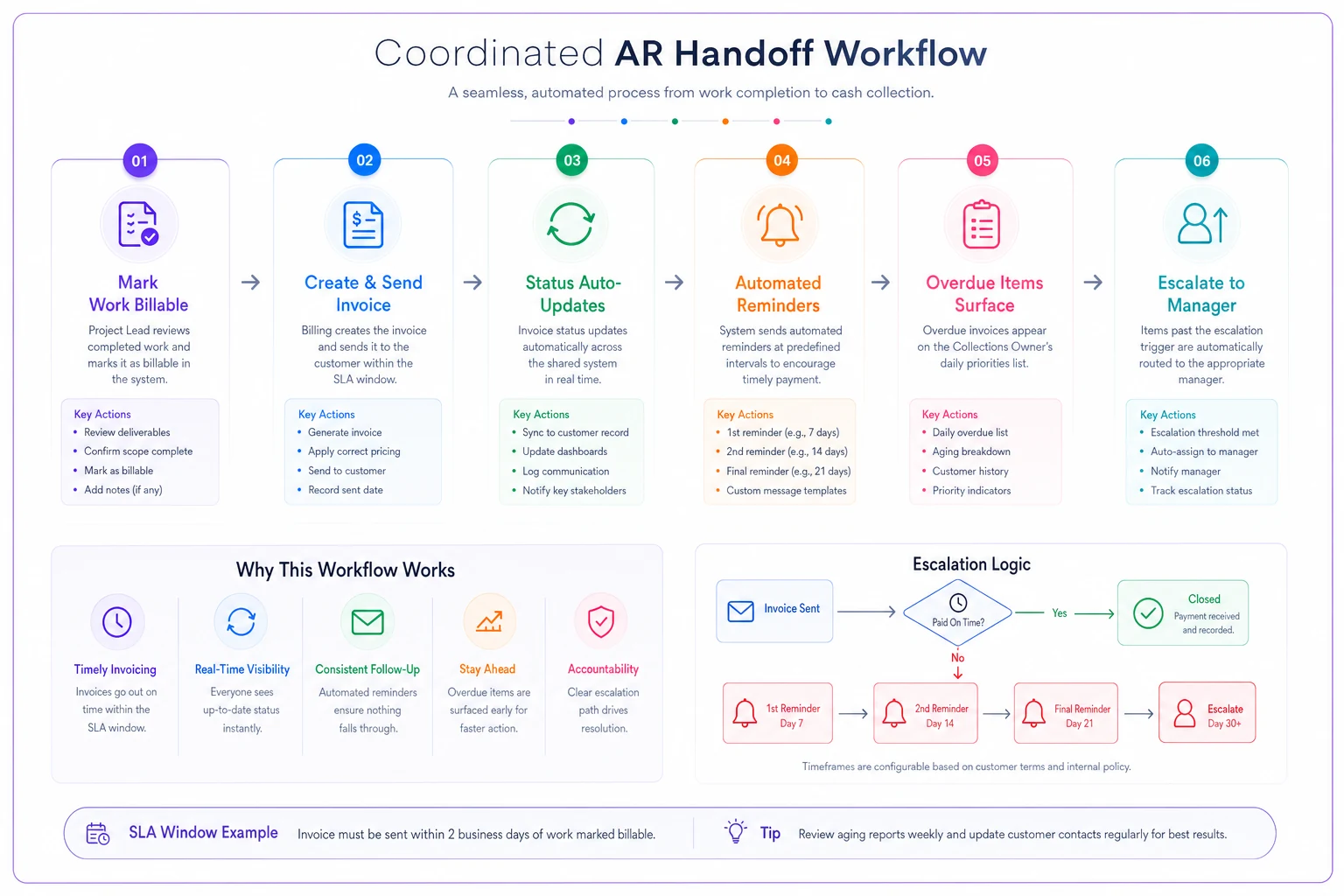
Diagram showing the handoff workflow and escalation points.
KPI triggers to move past stage 3:
-
Aging past 60 days consistently above ~15% of open AR
-
Escalation compliance dropping — overdue items not being escalated on time
-
DSO variance getting wild month to month (a sign the process depends on individuals, not the system)
The operational invoicing playbook for small teams covers the trigger-and-checklist side of this in more detail if you're building out the handoff rules.
Stage 4: Scaled ops (25–50) — consistency across many hands
At 25–50 people the enemy changes again. It's no longer ownership or handoffs — you've solved those or you wouldn't have made it here. Now it's consistency. You have multiple people creating invoices, multiple people collecting, possibly across different service lines or regions, and they're all doing it slightly differently.
That variance is expensive. One team offers Net 30, another quietly grants Net 45 to keep clients happy. One collector escalates at 60 days, another waits until 120. The aggregate effect is a DSO you can't control because the process isn't actually one process — it's fifteen personal versions of a process.
What you build here is standardization and a reporting cadence. Everyone works from the same terms policy, the same reminder templates, the same escalation rules. And leadership reviews AR on a fixed cadence — weekly aging review, monthly DSO and bad-debt reporting — so drift gets caught in weeks, not quarters.
Staffing at this stage typically means a dedicated AR function: an AR lead who owns the process and metrics, one or more collections specialists, and clear coordination with the finance/bookkeeping side for reconciliation and close. The AR lead's actual job is process consistency and exception handling, not doing every follow-up personally.
Sample role — AR Lead:
> Owns the entire AR process, policy, and KPIs. Maintains standardized terms, reminder sequences, and escalation rules. Runs weekly aging reviews and monthly reporting to leadership. Manages collections specialists. Handles high-value or disputed accounts personally. Coordinates with finance on reconciliation and bad-debt write-offs. Target metrics: DSO within a defined band, aging past 90 days below a set threshold, bad-debt rate under ~1–2%.
Tooling threshold at this stage: manual tracking is completely off the table. You need a platform that enforces the standard process — consistent terms, automated reminder cadences everyone follows by default, aging reports leadership can actually trust, and status that stays accurate without someone updating it by hand. This is where AI automation does the most quiet heavy lifting: routing overdue items to the right owner, drafting the next escalation step in the right tone, and surfacing the accounts that need a human decision instead of burying them in a report nobody opens. The goal isn't to remove people — it's to make sure fifty people's worth of billing behaves like one consistent system.
When to level up — and when not to
The temptation at every stage is to build ahead of where you are. Resist it. A three-person shop doesn't need an escalation ladder with legal thresholds. A solo freelancer doesn't need billing software with role permissions. Over-building creates process people ignore, and ignored process is worse than no process because it gives you false confidence.
Level up when the KPI trigger fires, not when it feels sophisticated. The whole point of the trigger thresholds in this roadmap is to take the guesswork out. DSO creeping past terms, invoices without owners, aging past 60 days climbing — those are the signals. Not headcount alone, and definitely not "the competitor down the street has a fancy system."
When staying simple is the right call: if your current setup is producing stable DSO, low aging, and you're not spending real time firefighting collections, don't touch it. Adding complexity to a working system is a common and expensive mistake. The system should be exactly as heavy as your cash flow requirements and no heavier.
Who should not rush this: if you have very few clients, all on deposits or upfront payment, your AR risk is genuinely low. Building a full collections apparatus is wasted effort. Spend that energy on the parts of the business that are actually leaking.
A real scenario: the studio that stopped losing 60-day money
A digital agency around 18 people had a familiar problem. Project leads handled their own client billing, collections was "whoever had time," and DSO had drifted to roughly 58 days against Net 30 terms. About 20% of their open AR was sitting past 60 days at any given moment. Nothing was catastrophically wrong — no huge write-offs yet — but cash was consistently tighter than the revenue suggested it should be, and they'd twice had to delay a hire waiting on receivables.
The fix wasn't dramatic. They separated the roles cleanly — billing creation moved to one coordinator, collections to one specialist — put every open invoice into a single shared system with a named owner, and set an escalation rule at 75 days. Reminder sequences went out on a fixed schedule instead of whenever someone remembered. Weekly aging reviews became a standing 20-minute meeting.
Within about four months, DSO came down to the high 30s and the past-60 bucket dropped to under 10% of open AR. No new clients, no changed terms, no aggressive tactics. They just stopped losing invoices in the handoff gaps and stopped letting overdue accounts drift with no owner. The freed-up cash covered the hire they'd been sitting on. The money wasn't lost to bad clients — it was lost to a system that hadn't grown up with the company.
The through-line
The reason AR quietly leaks cash as businesses grow is almost never a single dramatic failure. It's a system that fit the last stage getting stretched into the next one. Memory replaces process at solo scale and works. Then volume grows and memory fails. One person owns everything at small-team scale and works. Then the job splits and ownership evaporates. Handoffs get defined at coordinated scale and work. Then more hands create inconsistency.
Each stage has a specific thing that breaks and a specific thing to build, and the KPI triggers tell you when you've hit the wall. If you know what's coming, you can build the next layer just before you need it instead of after a cash crunch forces your hand. That's the entire game — not perfect collections, just an AR system that keeps pace with the business instead of lagging one stage behind it.
Ready to streamline your billing process?
Join 5,000+ businesses using Billoly to reduce billing delays, automate payments, and grow revenue efficiently.