

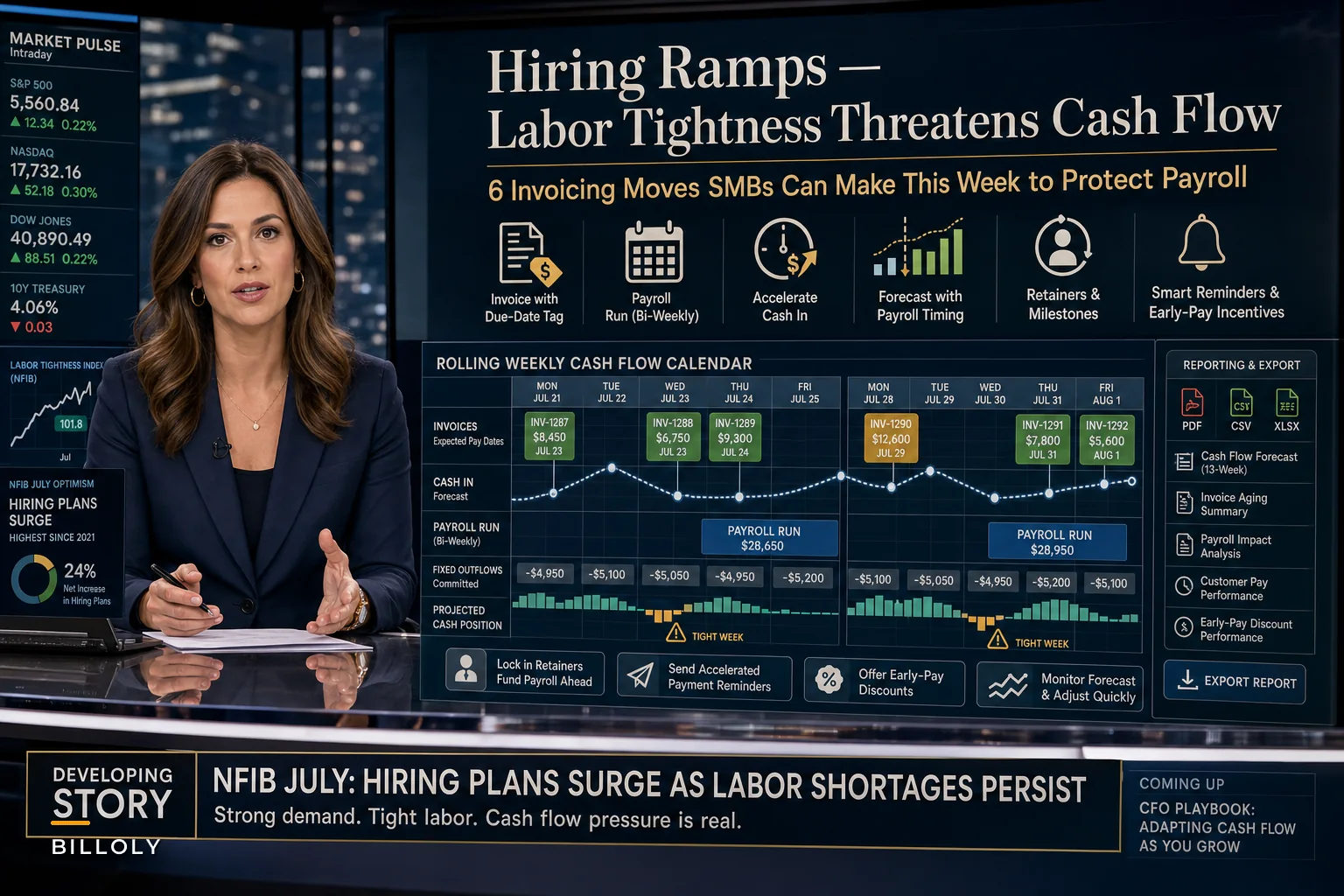

The July numbers surprised a lot of people. Small-business optimism climbed to an 11-month high, and hiring plans jumped to their strongest reading since October — while owners kept flagging labor shortages and wage pressure as their biggest headaches. Reuters covered the split pretty bluntly in its rundown of the NFIB data: businesses want to grow, but the people they need cost more and are harder to find.
What doesn't make headlines: when a small firm hires into a tight labor market, the payroll commitment lands weeks before the revenue that new hire generates. You're paying salary, employer taxes, onboarding time, maybe a signing incentive — all going out on a fixed two-week or monthly rhythm. Meanwhile your receivables are still running on their usual "whenever the client gets around to it" schedule.
That mismatch is the real problem. Not wages. Timing. And the fix isn't in payroll — it's in how you invoice and collect.
First, understand the trap you're walking into
Worth a quick reframe before the tactics, because it changes how you'll read the rest.
Payroll is the most rigid outflow a small business has. You can stretch a vendor payment. You can delay a software renewal. You cannot tell a new hire "we'll pay you the 15th instead of the 1st because a client is slow." The moment you add headcount, you're converting flexible cash pressure into fixed cash pressure.
What comes up repeatedly across small operations is that owners model the cost of a new hire — salary plus taxes, roughly 1.25x base — but never model the timing gap. That's the 30 to 60 days between when payroll starts and when that hire's output actually converts to collected cash. A designer you bring on the 1st might not touch a billable project until week two. That project might not invoice until month-end. That invoice might not pay for another 30 days. You've funded somewhere around 8–10 weeks of salary before a dollar comes back.
That gap is what breaks people. Everything below exists to shrink it.
Move 1: Shift new-hire-related work to deposit-first billing
The cleanest way to fund new payroll is to make the work that requires it pay upfront. Not across the board — just the new capacity.
Stop chasing payments and start automating your billing.
Billoly empowers you to create, send, and track invoices effortlessly while maintaining professional client relationships.
- Customizable invoice templates
- Automated payment reminders
- Real-time payment tracking
No credit card required
If you're hiring to take on more projects, those new projects are your opening to reset terms. Existing clients are used to your old arrangement and will push back on changes. New work has no baseline expectation, so you set terms that match your new cost structure. A 30–40% deposit on new engagements, collected before the hire touches the work, directly offsets front-loaded payroll.
When this makes sense: you're hiring specifically to expand delivery capacity and you have a pipeline of new clients who haven't been quoted yet.
When it backfires: trying to retroactively add deposits to long-standing clients mid-relationship. You'll burn goodwill you can't afford right when you need referrals to keep the pipeline full.
The mistake people make is treating deposits as an all-or-nothing policy change. It's not. It's a wedge you apply to new revenue only, and it happens to line up almost perfectly with new payroll timing.
Move 2: Compress your billing cycle from monthly to bi-weekly
This sounds boring. It's probably the highest-leverage change on this list.
Most service businesses invoice monthly out of habit, not logic. Monthly billing means you accumulate up to 30 days of work before you even ask for money, then wait another 15–30 days for it to land. Match that against a payroll that fires every two weeks and you've built a structural deficit into your own schedule.
Moving to bi-weekly invoicing — or invoicing at project milestones instead of calendar months — pulls receivables forward without touching your rates or straining client relationships in any painful way. Clients rarely object to being billed more often for the same total amount. They object to surprise bills and bigger bills.
Here's a rough comparison of how the timing shifts:
| Billing approach | Avg. days work-to-invoice | Typical days invoice-to-cash | Effective cash lag |
|---|---|---|---|
| Monthly, net-30 | ~20 | ~30 | ~50 days |
| Bi-weekly, net-15 | ~10 | ~18 | ~28 days |
| Milestone + deposit | ~5 | ~15 | ~20 days |
Cutting your effective lag roughly in half is the difference between funding one payroll cycle out of pocket versus three. None of it required raising a single price.
Move 3: Build a weekly cash view, not a monthly one
You can't manage a bi-weekly payroll obligation with a monthly cash picture. The resolution is too coarse — you'll see a shortfall the week it hits instead of the month before.
Track expected inflows against committed outflows on a rolling weekly basis. Every open invoice gets a realistic expected-pay date — not the due date on the invoice, but the date that client actually tends to pay — and every payroll run, tax deposit, and fixed cost gets mapped onto the same calendar. Now you can see tight weeks coming four or five weeks out, which is enough runway to accelerate a collection or push back a discretionary spend.
Use clients' actual payment habits as the expected-pay date rather than the invoice due date when building the weekly view.
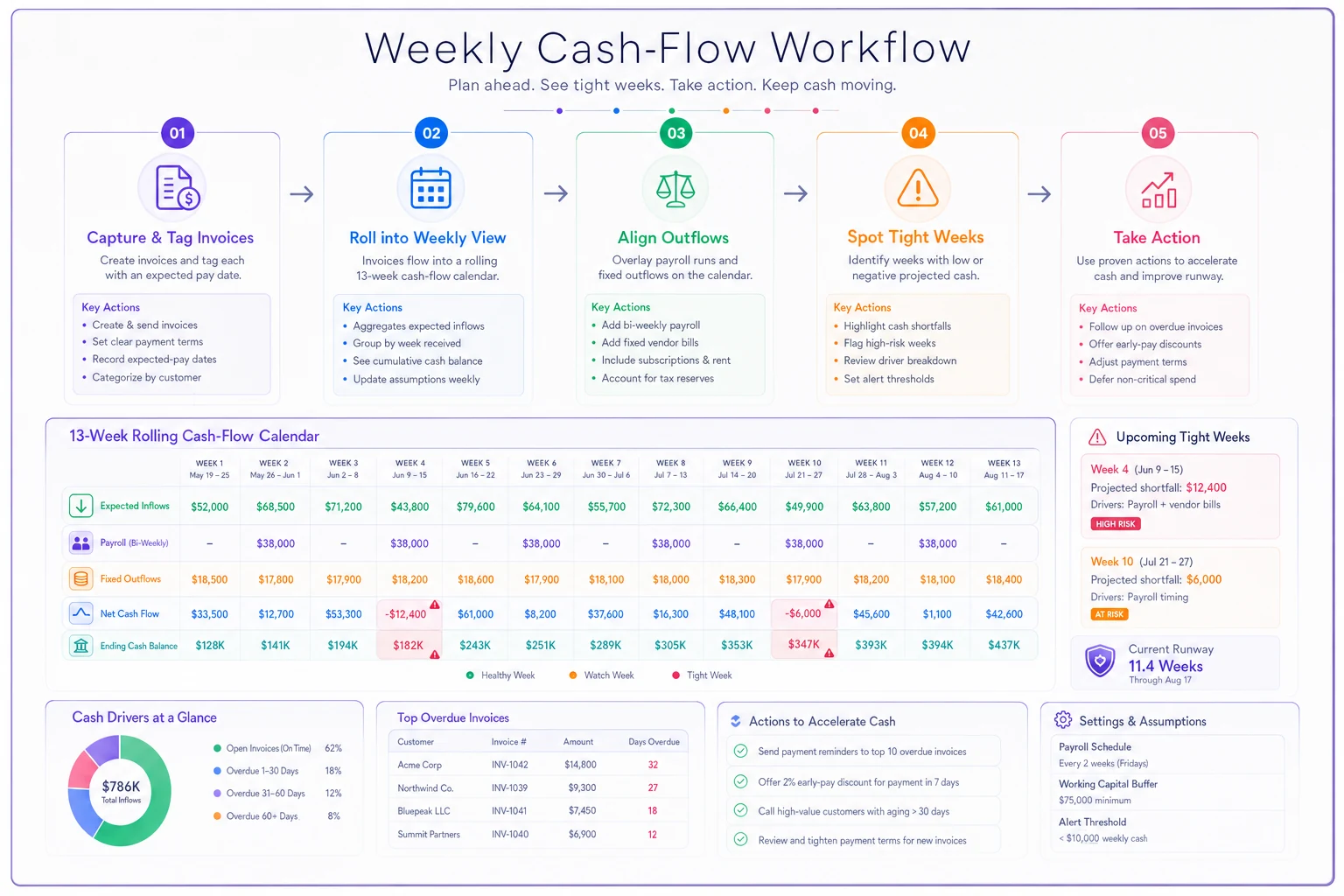
If you've never run this kind of forecast before, the walkthrough on building a weekly, invoice-driven cash-flow model lays out the exact structure — built for solo operators but scales fine to a small team adding its first hires.
Owners who forecast weekly almost never get surprised by payroll. Squeezed sometimes, sure. But a squeeze you see coming is a manageable problem. One that shows up on payday is an emergency.
Move 4: Tier your clients by payment behavior and act on it
Not all receivables are equal, and during a hiring ramp you can't treat them like they are.
-
Reliable (pays on or before terms) leave them alone, maybe offer a small early-pay incentive to pull cash forward.
-
Slow but good (pays 15–30 days late, always pays eventually) tighten terms on new work, add a reminder cadence, consider requiring deposits going forward.
-
Chronic (60+ days, needs chasing every cycle) stop extending unbilled work, move to prepay or milestone-only billing, and be honest with yourself about whether they're worth the cash drag now that your fixed costs went up.
A chronically slow client was survivable when your only fixed cost was your own draw. Once you've got real payroll, that same client is financing their slowness with your wage bill. The math changes even if the client hasn't.
You don't have to fire them. You just stop letting them set the terms.
Move 5: Automate follow-up so collections don't compete with delivery
The quiet killer during a growth phase: you're managing people, still doing the work, and trying to chase invoices at the same time. Collections is the first thing to slip because it feels awkward and non-urgent — right up until it's very urgent.
The realistic answer isn't more personal discipline. It's removing the task from your plate entirely. Structured reminder sequences — a nudge a few days before the due date, a firmer note at due date, escalating follow-ups after — recover money without you having to remember or feel uncomfortable initiating it. Operational platforms that handle invoicing usually let you configure these cadences once so they run on their own, which matters a lot more when your attention is split across a bigger team.
During a hiring ramp, your time is the scarcest resource in the building. Manual collections is exactly the kind of low-skill, high-friction task that shouldn't be eating it.
Move 6: Hold a payroll-specific buffer, funded by the moves above
Every dollar you pull forward through deposits, faster billing cycles, and tighter collections shouldn't just get spent. A portion should sit in a dedicated buffer covering at least one full payroll run — ideally two.
Think of it as a shock absorber. A big client pays late, a hire ramps slower than expected, a project slips — none of those should threaten payday if you're holding two cycles of cushion. The businesses that survive a hiring push aren't always the ones with the most revenue. They're the ones who kept payday sacred even when a receivable went sideways.
Fund it gradually. Route a fixed slice of every deposit and every early collection into the buffer until it's full, then leave it alone. Least glamorous move on this list. Probably the one that saves the most businesses when things get tight.
A real scenario: a 3-person marketing shop adding a fourth
A small content and paid-ads studio — owner plus two part-timers — decided to bring on a full-time strategist to handle bigger retainers. Base was around $58k, fully loaded closer to $72k–$74k a year, roughly $6k a month landing every two weeks starting immediately.
Their old setup: monthly invoicing, net-30, with a couple of chronically slow clients paying at 45–60 days. Effective cash lag sat near 50 days. The strategist started billable work in week two, but the first invoice covering that work wouldn't collect until almost two months in. On paper they were funding roughly three payroll cycles before any offsetting cash arrived.
What they changed, in order:
-
Put all new retainers on a 35% deposit, milestone-billed.
-
Moved existing retainers from monthly to bi-weekly, net-15 — framed as "smaller, more frequent invoices," and nobody pushed back.
-
Built a rolling weekly cash view mapping expected inflows against every payroll date.
-
Moved their two chronic-late clients to prepay on renewal.
Inside about six weeks, their effective cash lag dropped to somewhere around 25–28 days, and the deposits from two new retainers covered roughly the first month and a half of the new salary outright. Total billings barely moved that quarter. It was purely a timing fix — they funded the hire with cash they were already owed, just sooner.
Where to start if you only do one thing
If the whole list feels like too much during a busy stretch, the priority is pretty clear. Compress the billing cycle first — biggest timing improvement for the least friction. Then build the weekly cash view so you can actually see the tight payroll weeks coming. Everything else is optimization on top of those two moves.
The broader takeaway from the NFIB's own read on the data — full survey release here — is that a lot of owners are about to make the same bet at the same time: hire now, grow into it. The ones who come out ahead won't necessarily have the best hires. They'll be the ones whose cash timing was ready for payday before the new name showed up on the payroll.
Wages went up. Make your receivables move faster to meet them.
Ready to streamline your billing process?
Join 5,000+ businesses using Billoly to reduce billing delays, automate payments, and grow revenue efficiently.