

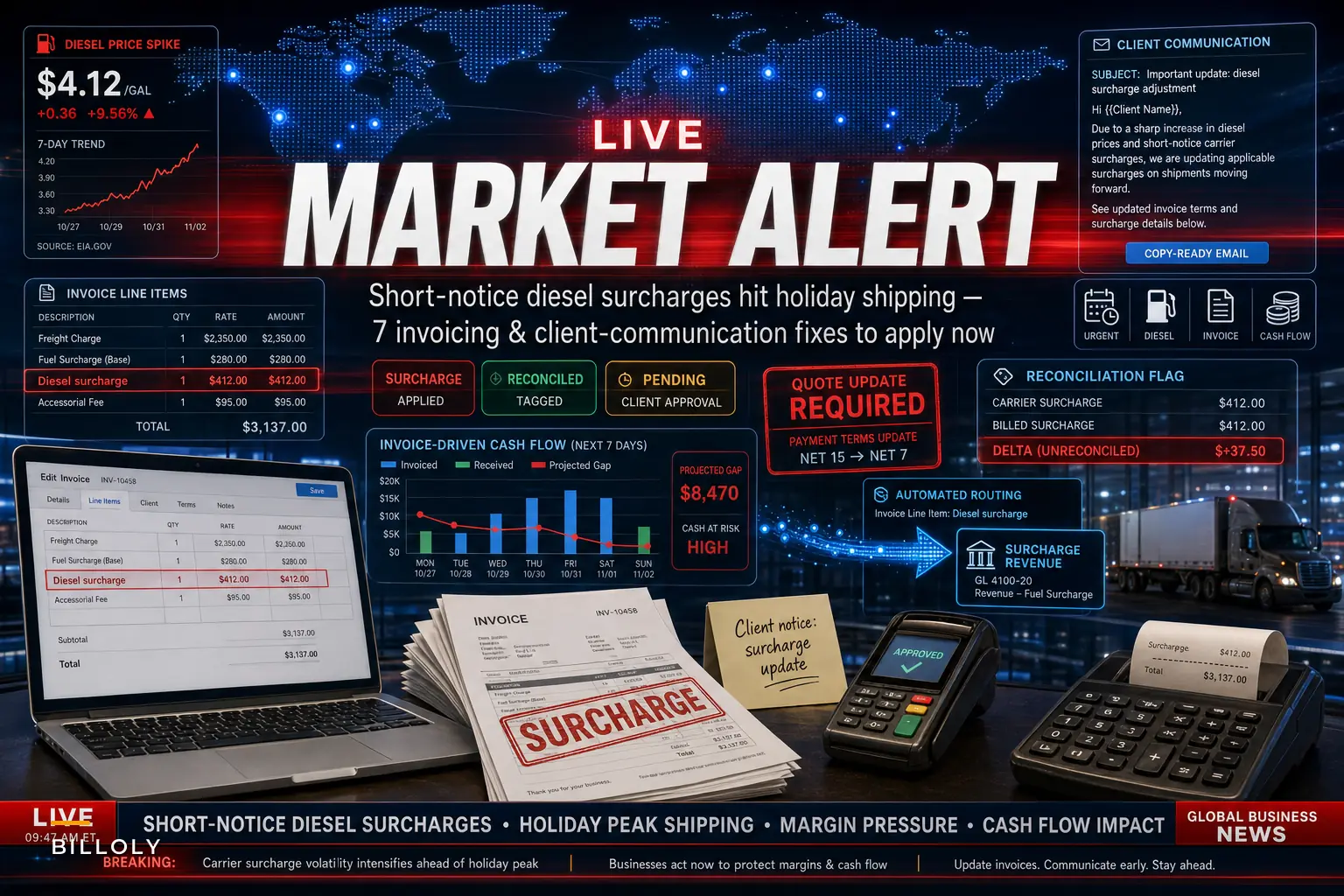

Diesel went up, and the carriers moved fast. According to a recent Reuters report, US retailers are staring down record holiday delivery costs as parcel carriers push fuel and peak surcharges to historic levels. If you ship goods, pass delivery charges through to clients, or quote projects with shipping baked in, the number on your carrier invoice this December is going to be bigger than the number you planned around in October.
The problem isn't the surcharge itself. Surcharges are a known cost. The problem is timing — carriers adjust their fuel surcharge tables weekly, but most small businesses re-quote clients monthly, quarterly, or basically never until something breaks. That mismatch is the real issue here.
The core issue: your billing cadence is slower than the carrier's pricing cadence
Both UPS and FedEx recalculate fuel surcharges on a weekly basis, indexed to published diesel and jet fuel prices. The surcharge percentage that applied when you quoted a client in early November may be two or three points higher by the time you actually ship in mid-December.
For a one-off $12 package, nobody notices. But stack peak-season volume on top of a rising weekly index, and the gap compounds. A business shipping a few hundred boxes through the holidays can eat hundreds — sometimes low thousands — in surcharge drift that never made it onto a client invoice.
The underlying failure is that most SMB quoting treats shipping as a static line item. It isn't. During peak season with diesel spiking, it behaves more like a variable rate that resets every week. When your invoice assumes a fixed number and the carrier charges a moving one, you absorb the difference. Every time.
The fixes below aren't really about "adding a surcharge line." They're about closing the cadence gap between how carriers price and how you bill.
Fix 1: Separate the base freight from the surcharge on every invoice
If your invoice shows a single "Shipping: $38" line, you've already lost the argument when a client questions it. You can't explain a number you've blended into oblivion.
Stop chasing payments and start automating your billing.
Billoly empowers you to create, send, and track invoices effortlessly while maintaining professional client relationships.
- Customizable invoice templates
- Automated payment reminders
- Real-time payment tracking
No credit card required
-
Base freight / delivery — the carrier's base rate
-
Fuel & peak surcharge — the variable portion, shown as its own line
This does two things. It makes the surcharge legible — clients see it's a carrier-driven pass-through, not margin you're padding. And it gives you a clean field to tag and report on later, which matters when you're reconciling what you charged versus what the carrier actually billed.
Businesses that itemize surcharges separately get far fewer "why is shipping so high?" emails during peak season. The transparency pre-answers the question.
Fix 2: Quote shipping as an estimate with a reconciliation clause, not a fixed price
This is the single most effective change for anyone passing through carrier costs. Instead of promising "$40 shipping," quote an estimated range and state plainly that the final surcharge is billed at the carrier's rate on the ship date.
> Shipping is estimated at $36–$44 per order. Fuel surcharges are set weekly by the carrier and billed at the actual rate on the date of shipment. Any difference from the estimate appears as a separate adjustment line.
Set this expectation before the holiday rush, not in a surprise invoice afterward. Clients accept variability when they're warned. They resent it when it shows up silently.
When a fixed shipping price actually makes sense
-
Your shipments vary in weight, zone, or volume
-
Surcharge percentages are moving fast (like now)
-
Your margins on freight are thin enough that a few points matter
If you're a service business that ships occasionally and marks up shipping generously, a buffer absorbs the drift just fine.
Fix 3: Build a surcharge buffer into fixed-price and project quotes
For anyone who can't pass surcharges through line-by-line — fixed-fee project work that includes delivery, or product pricing where shipping is "free" — the buffer needs to be baked into the price itself.
A simple way to size it: pull your last 8–10 carrier invoices, find the surcharge as a percentage of base freight, and add a cushion for peak-season escalation.
| Scenario | Base freight | Surcharge % (off-peak) | Surcharge % (peak estimate) | Buffer to build in |
|---|---|---|---|---|
| Light, local | $18 | ~14% | ~18–20% | add ~6% |
| Mid-weight, regional | $34 | ~16% | ~21–23% | add ~7% |
| Heavy, multi-zone | $61 | ~18% | ~24–27% | add ~9% |
These aren't carrier-published numbers — they're the kind of ranges you'll see when you actually run your own invoices. Base the buffer on your shipping profile. A light-local shipper and a heavy multi-zone shipper face completely different exposure.
Fix 4: Add a dated client notice before the first peak surcharge hits
A short proactive notice sent in early November does more to protect relationships than any invoice footnote. It reframes the surcharge as an industry-wide reality instead of something you decided to do.
> Heads up: carriers have raised fuel and peak surcharges for the holiday season due to higher diesel costs. Shipping-related charges on orders from now through January may run higher than usual, shown as a separate line on your invoice.
Businesses that send this get almost no pushback. The ones that stay silent and let the first big invoice do the talking spend December fielding disputes instead of fulfilling orders.
Fix 5: Tag surcharge revenue separately so reconciliation doesn't become a nightmare in January
Nobody thinks about this one until close. When surcharges are blended into a generic "shipping income" bucket, you have no way to check whether what you charged clients matched what the carrier charged you. During peak season, with rates moving weekly, that reconciliation gap can hide real leakage.
Tag it. Create a distinct line or category for pass-through surcharge revenue, matched against a distinct expense category for carrier surcharges billed to you. At month-end, one comparison:
-
Total surcharge revenue invoiced to clients
-
Total surcharge expense from carrier invoices
-
The delta — near zero on pure pass-throughs, or equal to your intended markup
If step 3 shows a surprise, you've caught the drift while it's still fixable instead of finding it buried in a quarterly P&L.
This is where billing and invoicing platforms with automation earn their keep — the better ones can tag and route surcharge line items to the right revenue category automatically, and flag invoices where the charged surcharge drifts from the carrier's actual rate. It's not magic; it just removes the manual matching that nobody has time for in December. If you're doing this by hand across hundreds of orders, you'll miss some. A system that applies the tagging rule on every invoice doesn't.
Automate surcharge tagging in your billing system to avoid manual matching in December.
Here's a simple workflow to automate tagging and reconciliation.
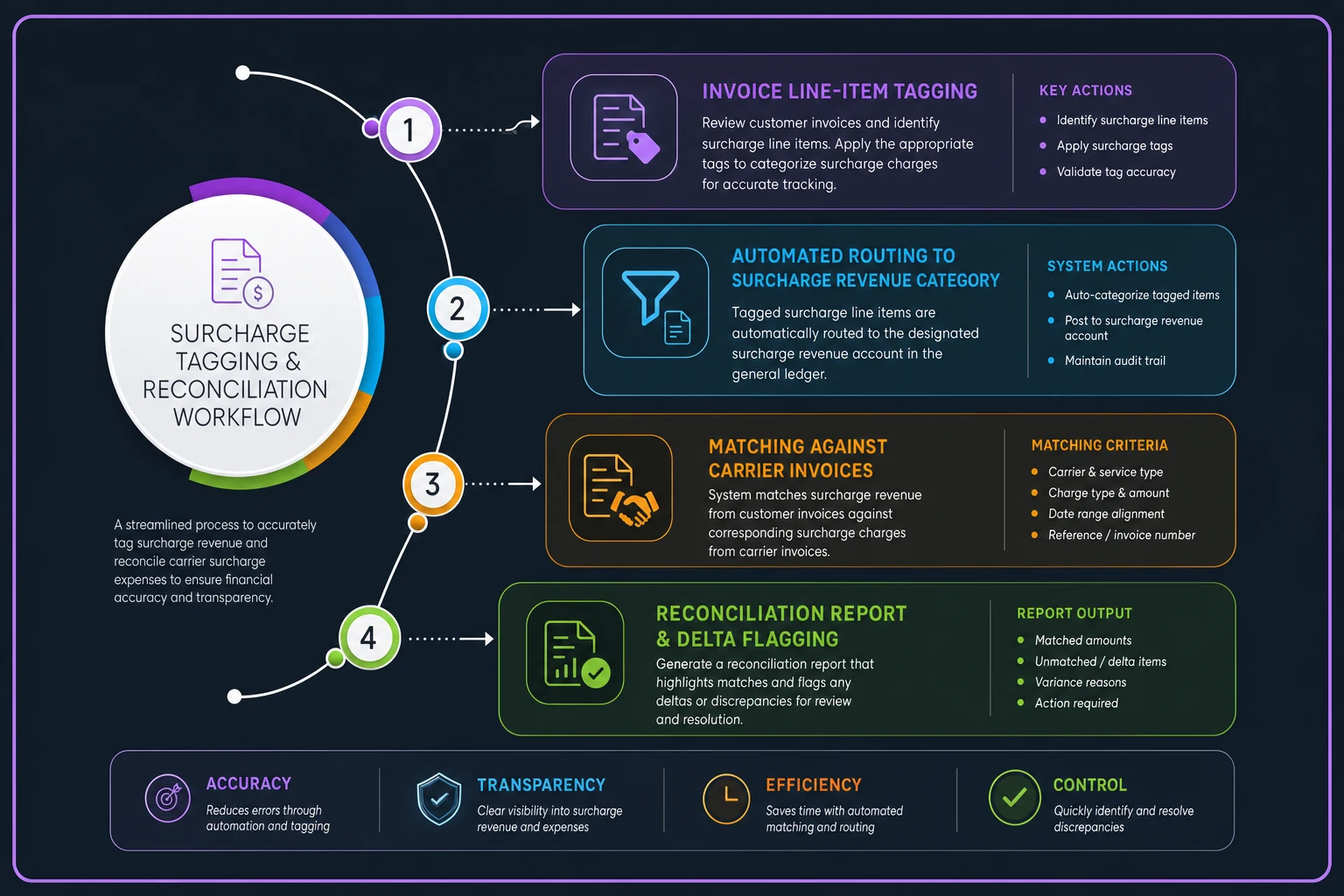
If you're doing this by hand across hundreds of orders, you'll miss some. A system that applies the tagging rule on every invoice doesn't.
Fix 6: Shorten payment terms on surcharge-heavy orders
Higher surcharges mean you're fronting more cash to carriers before clients pay you. If a client is on net-45 and your surcharge exposure jumped, you're financing their shipping for a month and a half during the exact period your own outflows peaked.
-
For high-shipping orders, shift surcharge-heavy invoices to net-15 or require a deposit covering estimated shipping
-
Collect the shipping and surcharge portion upfront even when the product balance stays on normal terms
You don't have to reprice the whole relationship. Isolating just the volatile pass-through portion for faster payment solves most of the cash-flow squeeze without a hard conversation about terms.
Fix 7: Re-run your short-term cash forecast with the new surcharge reality
Most SMB cash forecasts assume last quarter's shipping costs. During a diesel spike, that assumption is wrong by enough to matter.
-
Expected shipment volume per week
-
Estimated surcharge rate (use the high end — carriers aren't trending down right now)
-
Carrier payment timing vs. client payment timing
The mistake most people make is forecasting the revenue side and forgetting the outflow timing. You might fully recover every surcharge dollar eventually, but if the carrier debits you three weeks before clients pay, that gap is a real liquidity problem during your busiest, most cash-hungry weeks.
A real scenario: the cost of blended shipping lines
Consider a small home-goods seller shipping roughly 400–500 orders across the holiday window, passing shipping through to customers at checkout but using a flat estimate set back in September.
Diesel climbs, carrier surcharges tick up weekly, and the flat estimate no longer covers actual cost. The seller eats about $1.80–$2.40 per order in uncovered surcharge drift. Across peak volume, that's somewhere in the $900–$1,100 range — gone, mostly unnoticed until the January reconciliation, because shipping income and shipping expense sat in one blended bucket.
After splitting freight and surcharge into separate lines, switching checkout to a weekly-updated estimate, and tagging surcharge revenue against carrier surcharge expense, the next peak looked different. The drift didn't vanish entirely — some weeks the estimate still lagged the index — but the recovered portion covered most of it, and the reconciliation that used to take a frustrated afternoon in January became a five-minute comparison. The real win wasn't the recovered dollars. It was finally knowing the number instead of absorbing it blind.
Who should skip most of this
If shipping is a trivial fraction of your revenue, or you mark up delivery heavily enough that surcharge swings disappear into your margin, don't bother with estimate clauses and weekly reconciliation. The overhead isn't worth it. A buffer and separate invoice lines are plenty.
These fixes matter most for thin-margin shippers, pass-through billers, and anyone whose client invoices are slower to update than the carriers' weekly rate tables. That's the group getting quietly squeezed right now.
Pulling it together before the rush
The diesel spike is the trigger, but the lesson outlasts this particular season: carrier pricing is variable and fast, and your invoicing needs to reflect that instead of pretending shipping is a fixed number. The seven fixes above — itemize, estimate-plus-reconcile, buffer fixed quotes, notice clients early, tag revenue separately, tighten terms on volatile orders, and re-forecast cash — all close the same gap between how carriers charge and how you bill.
If you want the broader, season-agnostic playbook, the companion piece on preparing invoices for peak-season shipping surcharges goes deeper on the margin-protection side.
For right now, with the holiday peak already here, start with Fix 1 and Fix 4 — separate your lines and warn your clients this week. Those two take an afternoon and prevent most of the December mess.
Ready to streamline your billing process?
Join 5,000+ businesses using Billoly to reduce billing delays, automate payments, and grow revenue efficiently.