

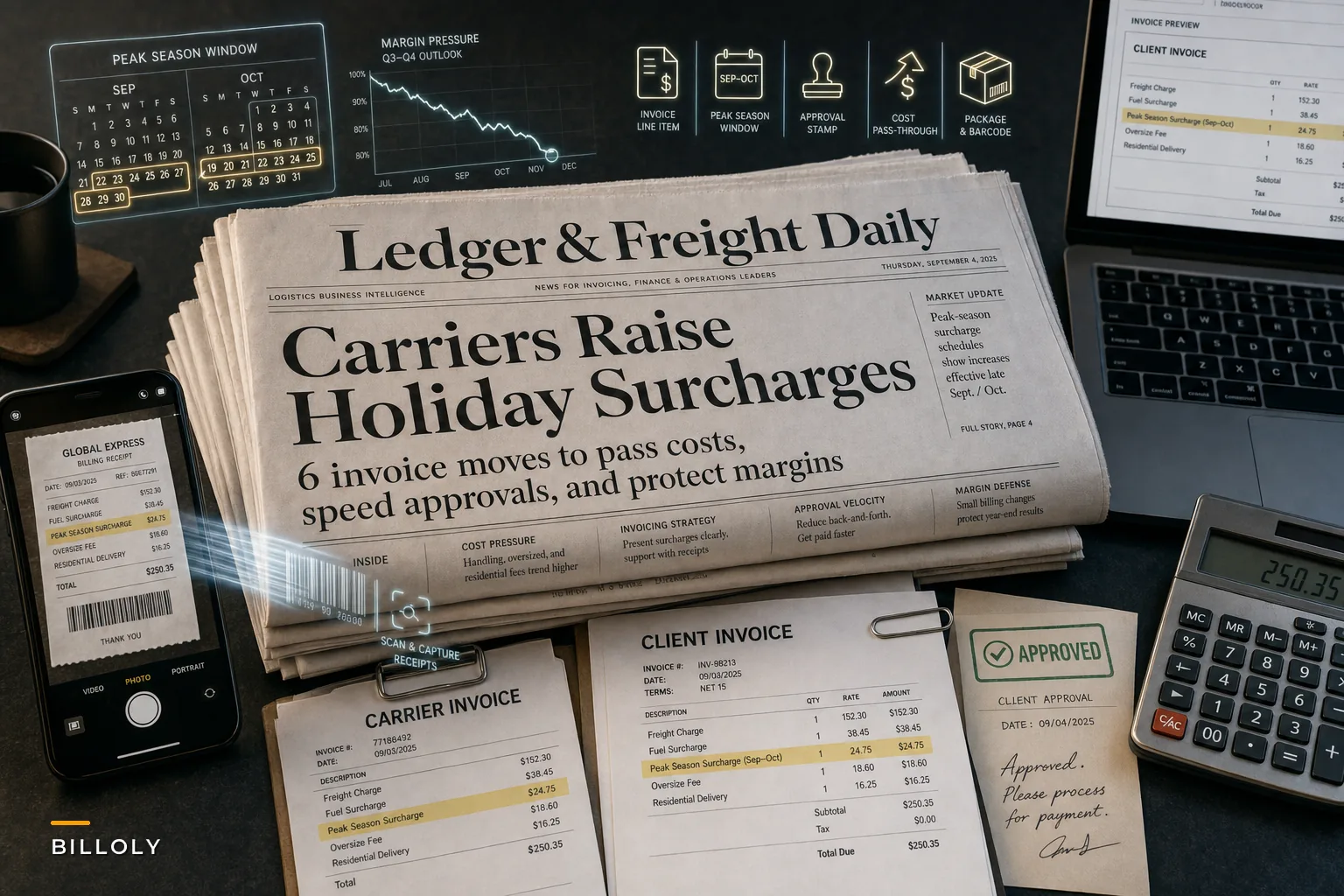

The peak-season surcharge schedule is out again, and the numbers are worth paying attention to. UPS published its 2026 holiday demand fees with higher handling, large-package, and demand surcharges starting Sept. 27 and Oct. 25, running through Jan. 16, 2027. A recent Supply Chain Dive report broke down how these fees stack across residential deliveries, oversized packages, and volume tiers — and the effective dates cover the exact window when most product businesses do the bulk of their annual shipping.
If you ship goods or bill shipping back to clients, this isn't just a cost problem. It's an invoicing problem. The businesses that get burned aren't the ones paying the surcharge — everyone pays it. It's the ones quietly absorbing it because their invoice template, quote language, and approval workflow weren't built to pass it through cleanly.
Here are six billing moves that protect your margin before the rush hits.
Why peak-season surcharges quietly destroy margins
Base shipping rates are predictable. You quote them, mark them up if you want, and everyone moves on. Surcharges are different — they're time-bound, they vary by package dimension and destination, and they often don't show up until the carrier invoice hits days or weeks after you've already billed the client.
A typical sequence: you ship a large package in mid-November, invoice the client the base rate you always use, collect payment, then in early December your UPS bill arrives with a large-package handling fee plus a peak demand fee stacked on top. That gap is yours to eat. On a single shipment it's annoying. Across a busy Q4, a product seller doing a few hundred shipments can watch $1,500–$3,000 disappear into fees nobody billed for.
The official UPS peak demand surcharge schedule shows just how many separate fee categories exist — and that's the real trap. It's not one number. It's a moving set of numbers, which makes clean pass-through genuinely hard when your invoice only has a single "Shipping" line.
The six billing moves
1. Split shipping into base rate and surcharge lines
Stop chasing payments and start automating your billing.
Billoly empowers you to create, send, and track invoices effortlessly while maintaining professional client relationships.
- Customizable invoice templates
- Automated payment reminders
- Real-time payment tracking
No credit card required
The single biggest fix is structural. Stop using one "Shipping" line. Break it into two:
-
Shipping (base) — the freight cost you already quote
-
Peak-season carrier surcharge — itemized separately, with dates or fee type noted
Two reasons this matters. First, clients accept surcharges more easily when they're labeled as a carrier fee rather than buried in a vague shipping number that suddenly looks 22% higher than last month. Second, you create a clean audit trail for the moment a client asks why shipping went up. You point at the line. Done.
A quick example of how this reads on an invoice:
| Line item | Amount |
|---|---|
| Product subtotal | $840.00 |
| Shipping (base, ground) | $46.00 |
| Peak-season carrier surcharge (Nov–Jan) | $11.50 |
| Invoice total | $897.50 |
That $11.50 line is the difference between a protected margin and a silent loss. Small per invoice, not small across a season. Most clients don't push back on a clearly labeled carrier fee — they push back when the total shipping number jumps with no explanation.
2. Add surcharge language to quotes and contracts now
Passing a fee through only works if the client agreed to it before you shipped. Businesses that struggle here are the ones trying to add a surcharge line after sending a quote that said "shipping included."
> Shipping estimates reflect base carrier rates. Carrier peak-season surcharges in effect from late September through mid-January will be passed through at cost and itemized separately on your invoice.
That one sentence removes almost every awkward conversation about it later. You're not marking anything up — you're just telling them the carrier charges more during the holidays and you're not absorbing it for them.
3. Decide your pass-through policy and be consistent
Not every business should pass through every fee.
Pass through at cost when:
-
You ship physical products and shipping is clearly a reimbursable client cost
-
Margins are thin enough that eating fees moves the needle on profitability
-
Your clients are businesses who expect itemized costs
Build it into your price instead when:
-
You sell to consumers who react badly to extra fees at checkout
-
Your average order value is high enough that a flat shipping price protects the experience
-
Surcharge variability is small relative to product margin
One thing worth flagging: if you've built your brand around "free shipping" or flat-rate simplicity, adding a visible surcharge line mid-season can cost you more in conversion than the fee itself. Quietly raising your baseline shipping price for the season is cleaner. Just don't do both.
The mistake that creates real problems is inconsistency — passing surcharges to some clients and absorbing them for others without a clear rule. That creates billing disputes when clients compare notes and makes Q4 numbers impossible to forecast.
4. Tighten your reimbursable approval timeline
Peak-season shipping surcharges land late on carrier invoices, which means your reimbursable submission lands late too — and every day of delay pushes reimbursement into January, when you actually need the cash.
The fix is a faster submission cadence. During the surcharge window, don't wait for month-end to batch reimbursables. Submit shipping pass-throughs weekly and attach carrier documentation while it's fresh. If you want a detailed breakdown of format, receipt capture, and submission timing that gets clients to approve quickly, the walkthrough on invoicing reimbursable expenses so clients approve fast covers the exact structure that cuts back-and-forth.
The pattern worth internalizing: the longer a shipping surcharge sits unbilled, the more likely it becomes a cost you absorb. Speed of submission is margin protection.
Here's a simple weekly submission workflow that teams can follow:
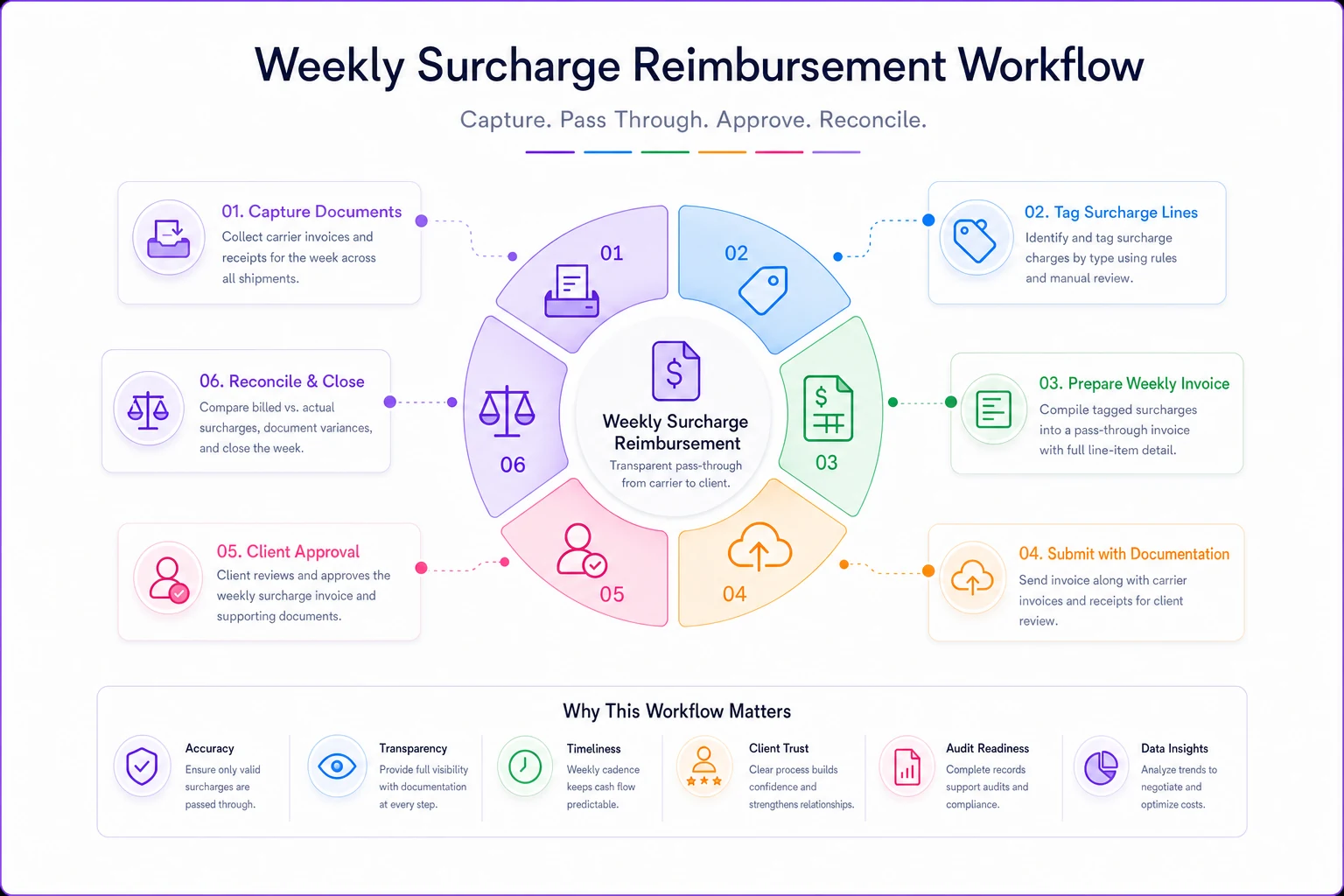
Keeping the cadence tight and documentation attached is the practical difference between getting reimbursed in December and carrying the cost into the new year.
5. Capture a surcharge field for bookkeeping and tax
If shipping and surcharges land in the same bucket in your books, you lose visibility into what peak season actually cost — and you make January reconciliation harder than it needs to be.
Add a distinct field or category for peak-season surcharges. It takes a few minutes to set up and pays off in three ways:
-
You can compare billed surcharges against actual carrier surcharges to catch leakage
-
Reimbursable pass-throughs are cleanly separated from marked-up shipping revenue
-
Year-end reporting is cleaner when the reimbursable portion is isolated
A simple reconciliation habit that catches problems early:
-
Pull your carrier invoice surcharge total for the week
-
Pull the surcharge lines you billed clients that same week
-
Compare the two numbers
-
Investigate any gap over a small threshold immediately
-
Adjust the next invoice if a fee slipped through unbilled
Most billing platforms let you tag or map a custom line so surcharges flow into their own category automatically instead of getting lumped into general shipping. Set that up once before the season and you're done.
6. Refresh your cash-flow forecast for the surcharge window
Your Q4 forecast is probably built on last year's shipping costs. If so, it's already off. Peak surcharges raise your outbound cash needs during the same weeks inbound payments may be delayed by holiday slowdowns.
Rebuild the forecast with two adjustments: higher per-shipment cost for the Sept–Jan window, and a realistic lag between when you incur the fee and when the client reimburses it. Even a rough estimate beats nothing. If you ship 200 packages in November with an extra $6–$12 in surcharges each, that's $1,200–$2,400 in additional outflow you're floating until reimbursement clears.
A quick real scenario
A small home-goods seller shipping through UPS did about 260 orders across last year's peak window. Their invoices used a single flat shipping line based on base rates. When carrier bills came in with stacked large-package and demand fees, they absorbed roughly $2,100 in surcharges they never billed — a significant chunk on oversized items that triggered the worst fees.
The fix was unglamorous: two shipping lines instead of one, a one-sentence surcharge clause in their order confirmation, and weekly reconciliation of billed versus actual surcharges. This season they're passing fees through cleanly and expect to recover most of that $2,100. No price increase on the product itself. Just billing that finally matched what the carrier was actually charging.
The checklist to run before Sept. 27
The checklist to run before Sept. 27
-
Split "Shipping" into base + surcharge lines on your invoice template
-
Add peak-surcharge language to quotes, order confirmations, and SOWs
-
Decide and document your pass-through policy by client type
-
Set a weekly reimbursable submission cadence for the surcharge window
-
Create a distinct bookkeeping category for surcharges
-
Rebuild your Q4 cash-flow forecast with higher shipping costs and reimbursement lag
-
Schedule a weekly billed-vs-actual surcharge reconciliation
Schedule a weekly billed-vs-actual surcharge reconciliation
The underlying problem this exposes
Peak surcharges aren't really the story. They're a stress test for whether your billing setup can handle a cost that's variable, time-bound, and delayed. Most small-business invoice templates can't — they were built for stable, predictable costs, so anything that moves gets absorbed by default.
The businesses that protect margin through Q4 aren't smarter about shipping. They built invoices that reflect what actually happened, workflows that submit reimbursables before cash lag becomes a cash problem, and books that keep surcharges visible instead of buried. Get that setup running once before the season starts and this year's fee schedule becomes a line item instead of a surprise.
Get that setup running once before the season starts and this year's fee schedule becomes a line item instead of a surprise.
Ready to streamline your billing process?
Join 5,000+ businesses using Billoly to reduce billing delays, automate payments, and grow revenue efficiently.