


The gap between "I paid for this on the client's behalf" and "the client actually reimbursed me" is where a lot of freelancers and small shops quietly lose money. Not through unpaid balances necessarily, but through delays, partial rejections, and the slow drip of "can you resend that receipt?" emails that push a two-week reimbursement into a two-month one.
Most of the friction isn't about the money itself. Clients rarely dispute a $180 hotel night or a $46 rideshare because they think you're cheating them. They dispute it because your invoice made it hard to approve. The approver — usually someone in accounts payable or a project lead who's not the person who hired you — can't match your line item to a policy, can't read the receipt, or can't tell if the expense was pre-approved. So they sit on it.
This post is narrowly about that: the invoice reimbursable expenses format that gets approved on the first pass, how to capture receipts so they survive an AP review, when to submit, and the policy language that quietly removes the reasons people delay.
The specific way reimbursables get stuck
Here's the pattern. A consultant flies out for a two-day engagement, spends around $1,400 across flights, hotel, meals, and ground transport, and lumps it all onto the next monthly invoice as a single line: "Travel expenses — $1,437.50."
That invoice goes to the client contact, who forwards it to finance. Finance doesn't know what the trip was, whether meals are covered under the contract, or why there's no itemization. They email back asking for a breakdown and receipts. The consultant digs through their inbox and camera roll, finds most of them, and resends. Finance notices the hotel receipt shows a $60 room-service charge that isn't reimbursable per the client's travel policy — which the consultant never saw. Now there's a negotiation over $60 that holds up the entire $1,437.
That's the core problem. One unclear line item and one missing receipt can freeze the whole reimbursement, not just the disputed portion. The approver's default when something is unclear is to pause everything, because approving a bad expense is a bigger risk to them than delaying a good one.
This usually happens for three reasons stacked together: the expenses aren't itemized to the level AP needs, the receipts aren't attached in a usable form, and nobody agreed in writing beforehand what counts as reimbursable. Fix those three and most reimbursement delays disappear.
What the invoice format actually needs to show
The mistake people make is treating reimbursables like a summary. AP doesn't want a summary — they want to match each expense to a category, a date, and a receipt. Your job is to make that matching trivial.
Stop chasing payments and start automating your billing.
Billoly empowers you to create, send, and track invoices effortlessly while maintaining professional client relationships.
- Customizable invoice templates
- Automated payment reminders
- Real-time payment tracking
No credit card required
A reimbursable line should carry enough context that someone who wasn't on the trip can approve it without asking a single question. That means date, category, vendor, brief purpose, amount, and a receipt reference. Compare the two approaches:
| Element | Weak format (gets questioned) | Strong format (gets approved) |
|---|---|---|
| Description | "Travel expenses" | "Airfare — client kickoff, ORD→AUS 3/12" |
| Grouping | One lump sum | Itemized by category and date |
| Amount detail | $1,437.50 total | Each expense on its own line |
| Receipt link | "Receipts available on request" | Receipt #R-04 attached, matched to line |
| Markup disclosure | Hidden or unclear | "Billed at cost, no markup" stated |
| Pre-approval reference | None | "Per approved trip budget 2/28" |
The strong version isn't longer because you're padding it. It's longer because every field you fill in is a question the approver doesn't have to ask you. That's the entire game. Every unanswered question is a delay measured in days, because it requires a full email round-trip and a context switch on their end.
One more thing on format: keep reimbursables visually separate from your fees. If your billable work and your pass-through costs are tangled together in the same section, the approver can't tell what they're actually signing off on. Reimbursables get scrutinized differently than fees — often by a different person — so they should live in their own clearly labeled block with their own subtotal.
Receipt capture that survives an AP review
Receipts are where good invoices die. The expense is legitimate, the format is clean, and then the receipt is a blurry photo of a crumpled thermal-paper slip where the total is already fading. AP can't verify it, so they hold it.
Receipt problems are almost always capture problems, not storage problems. People capture badly in the moment and pay for it three weeks later when they're assembling the invoice and half the receipts are unreadable or missing entirely.
A few capture habits that eliminate most of this:
-
Capture at the point of transaction, not at invoicing time. The moment you pay, photograph or forward the receipt. Waiting until month-end means you're reconstructing from memory and hunting through emails.
-
Get the whole thing in frame. Vendor name, date, itemized amounts, total, and payment method all need to be visible. Cropped receipts get rejected because AP can't confirm the date or that you paid.
-
Forward email receipts to a single dedicated inbox. Digital receipts — rideshares, flights, software — should go to one address so they're not buried in your personal inbox.
-
Note the purpose immediately. A one-line note — "client dinner, 3 attendees, ABC project" — attached to the receipt saves you from guessing later and satisfies most meal-substantiation rules.
-
Convert thermal receipts fast. Those fade. Photograph them the day you get them, because a receipt that's blank by month-end is functionally no receipt at all.
Photograph thermal receipts the day you get them.
The meals point deserves emphasis. Meal reimbursements get flagged more than anything else because approvers often need to know who was present and the business purpose, not just the amount. A $46 dinner receipt with no context invites a question. The same receipt annotated "dinner, client + 2 team, project X" gets waved through.
Submission timing: when you send matters as much as what you send
There's a rhythm to reimbursement approval that most people ignore. Submitting reimbursables with your main invoice at month-end feels efficient, but it often works against you — your reimbursables now compete for attention with a much larger fee amount and can get caught in the same review cycle.
Two timing patterns tend to work better depending on the size of the expense.
For large or time-sensitive reimbursables — a $1,400 travel block, a $900 equipment purchase you fronted — submit them separately and promptly, ideally within a few days of the expense while the context is fresh. The client contact still remembers approving the trip, so it moves fast. Wait three weeks and you're re-explaining why the expense happened at all.
For small recurring reimbursables — mileage, small supplies, occasional software — batch them monthly. Submitting a $12 expense on its own creates more processing overhead than it's worth and can annoy AP.
Reimbursement approval speed tracks with memory. The faster you submit after the expense, the less the approver has to reconstruct, and the more likely the person who authorized the cost is still the person reviewing it. Delay introduces personnel changes, forgotten context, and budget-cycle boundaries that all slow things down.
A simple submission process that keeps this clean:
-
At the expense — capture receipt, note purpose, tag it to the client/project.
-
Within 48 hours for large items — send a standalone reimbursable invoice with itemized lines and attached receipts.
-
At month-end for small items — batch remaining reimbursables into one summary block with a subtotal.
-
On submission — reference the pre-approval and state your reimbursement terms (net 15, etc.).
-
After 7 days of silence — a short, factual nudge referencing the specific expense date and amount, not a generic "checking in."
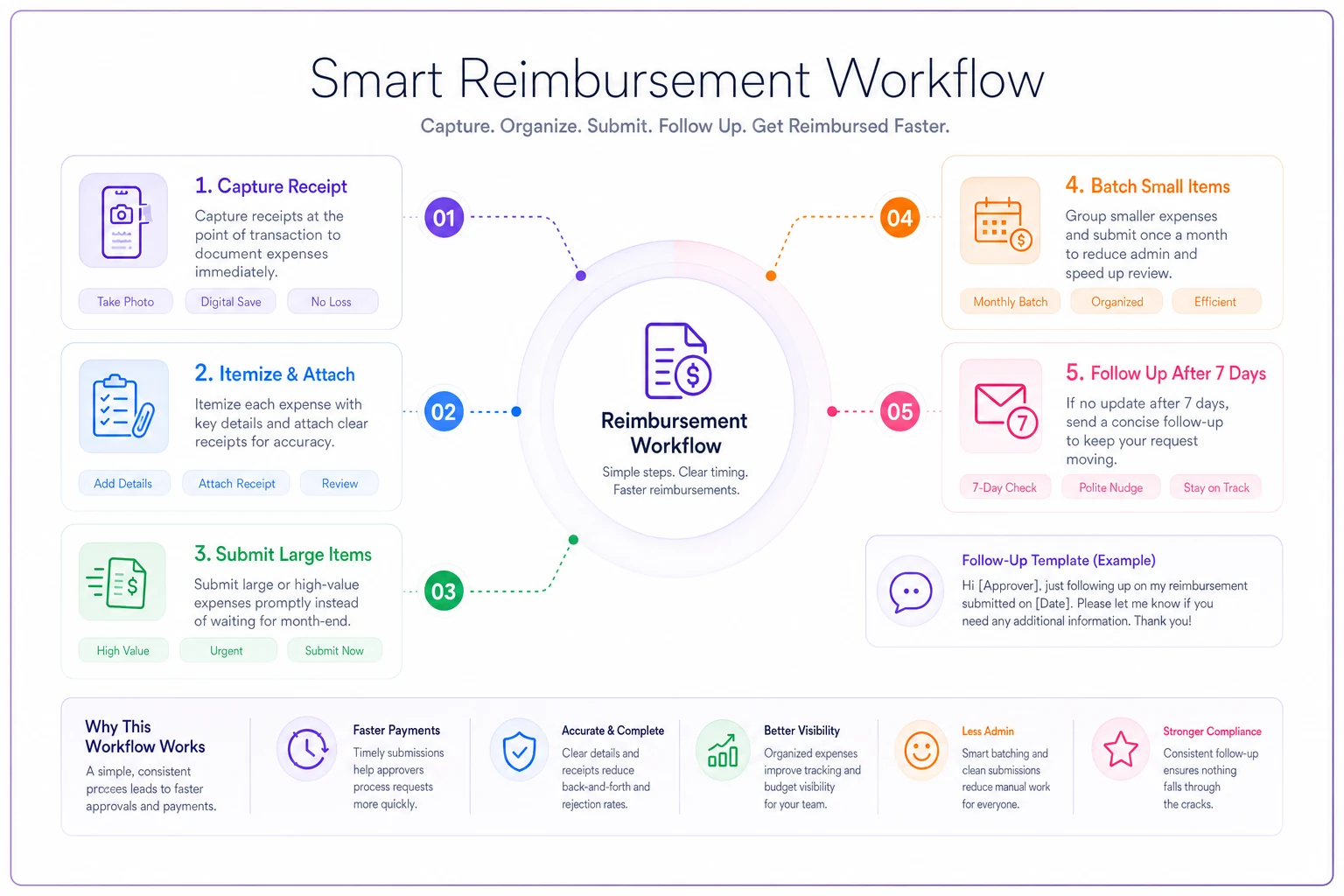
This workflow shows the timing and steps to keep reimbursements moving.
The policy language that removes disputes before they start
Most reimbursement disputes come down to something that was never agreed on in writing. The client thinks meals aren't covered; you assumed they were. The client expected economy airfare; you booked premium economy. Nobody wrote it down, so now you're arguing after the money's already spent.
The fix is agreeing on reimbursable terms in the contract or engagement letter, before any expenses happen. This is the single highest-leverage thing on the list and it costs you nothing but a paragraph. Language worth pinning down:
-
What's reimbursable — categories covered (travel, lodging, materials) and what isn't (alcohol, personal expenses, upgrades beyond a defined class).
-
Caps or thresholds — daily meal limits, per-trip budgets, or a dollar figure above which pre-approval is required.
-
Pre-approval rules — anything over, say, $250 needs written sign-off before you spend.
-
Markup terms — whether expenses are billed at cost or with a stated handling percentage. State this explicitly; hidden markups are the fastest way to poison trust with AP.
-
Receipt and submission requirements — that you'll provide itemized receipts and submit within a defined window, and that they'll reimburse within a set term.
On your invoice itself, a short standing line does a lot of work: "All reimbursable expenses billed at cost per engagement letter dated [X]. Itemized receipts attached." That one sentence answers the "is there a markup?" question and the "was this agreed?" question in a single stroke.
If you also present reimbursables and tax items cleanly on the invoice, the client's accountant can reconcile downstream without chasing you — which matters because the accountant is often the person who actually releases your payment.
When to itemize hard, and when it's overkill
Not every reimbursable needs the full treatment. Over-documenting a $9 parking fee wastes your time and clutters the invoice.
Itemize thoroughly when: the expense is large, the category is commonly scrutinized (travel, meals, entertainment), the client has a formal AP process, or the expense wasn't obviously pre-discussed. These are the ones that get held up, so the documentation pays for itself.
Keep it light when: the amounts are small and recurring, you're dealing with a single decision-maker who approves quickly, and there's an established pattern of trust. A solo client who's reimbursed you for the same monthly supplies for a year doesn't need a five-field breakdown on a $15 line.
Who should not front reimbursables at all: if a client has a history of slow-paying or disputing expenses, stop advancing their costs. Have them book travel directly, or require an expense advance up front. Fronting significant money for a client who takes 75 days to reimburse turns you into their interest-free lender, and no amount of clean formatting fixes that.
A real scenario
A freelance brand designer was doing occasional on-site work for a mid-size agency client, fronting travel and materials that ran roughly $600–$900 a month. She submitted everything as a single "expenses" line on her monthly invoice with receipts "available on request." Reimbursements were taking around 40–50 days because every invoice triggered an email thread — AP wanted itemization, then receipts, then clarification on which trip a hotel charge belonged to.
She changed three things. She itemized each expense by date and category, attached labeled receipts directly to the invoice, and added the agreed pre-approval and "billed at cost" language pulled from her engagement letter. She also started sending larger travel reimbursements as standalone invoices within a couple of days of the trip instead of waiting for month-end.
Reimbursement time dropped to roughly two weeks, and the back-and-forth emails mostly stopped. Nothing about the actual expenses changed — same trips, same amounts. The only difference was that AP could now approve without asking her anything. That's usually the whole story with reimbursables: the money was never really in question, the format was.
The short version
Reimbursable expenses get paid slowly for boring, fixable reasons — vague line items, unusable receipts, bad timing, and terms nobody wrote down. Itemize each expense with enough context that a stranger in accounts payable can approve it cold.
Capture receipts the moment you pay, in full frame, with a note on purpose. Submit large expenses fast and batch small ones. And settle the reimbursement rules in writing before you spend a dollar on the client's behalf.
Do those things and reimbursements stop being a negotiation. They become a formality — which is exactly what they should have been the whole time.
Ready to streamline your billing process?
Join 5,000+ businesses using Billoly to reduce billing delays, automate payments, and grow revenue efficiently.