

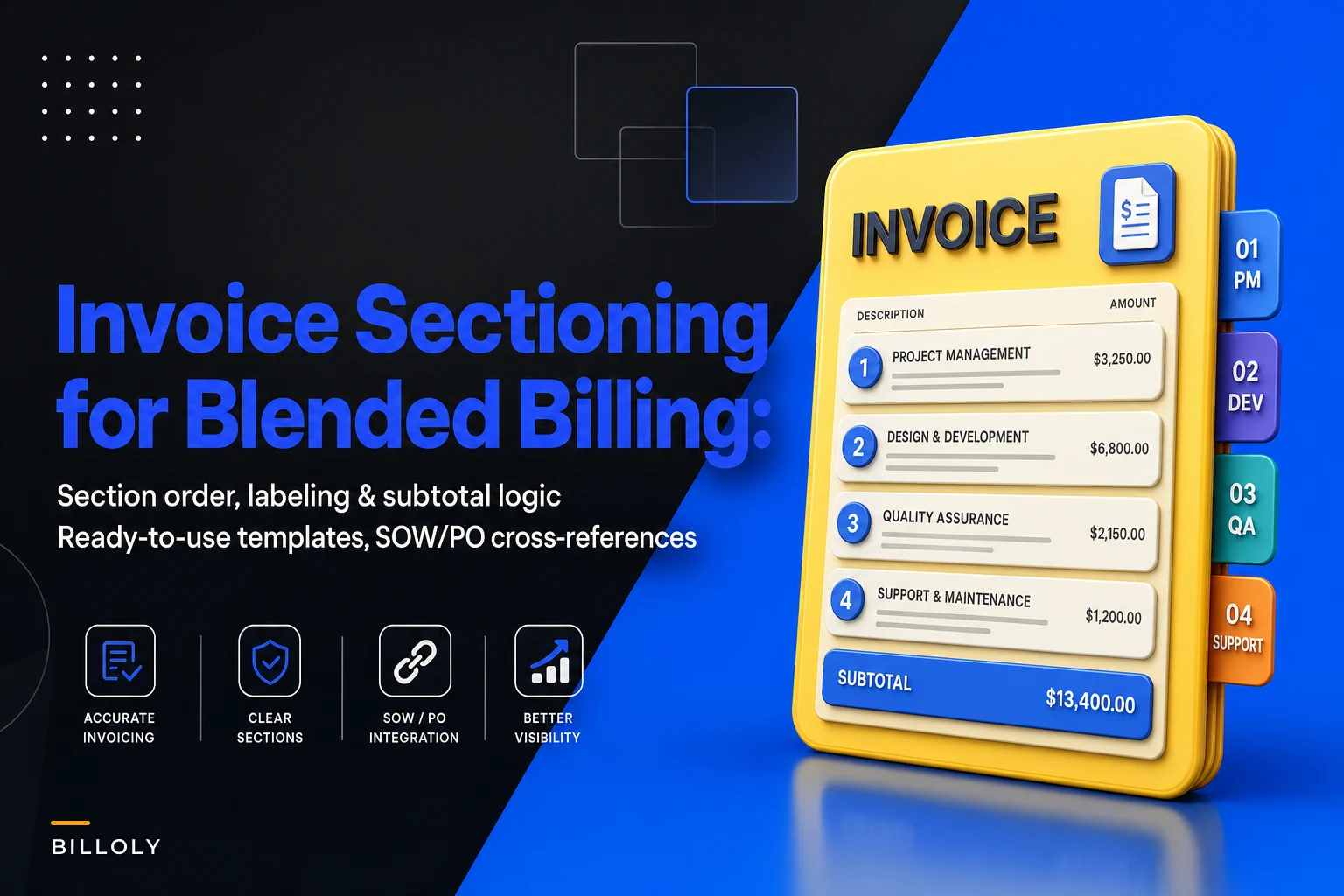

Most blended invoices aren't confusing because of the numbers. They're confusing because of the arrangement. A consultant throws nine line items into one flat list — three hours of advisory work, a fixed strategy deliverable, a flight, a software license they fronted — and the client opens it, can't tell which charges are "the work" versus "the stuff you spent on my behalf," and sits on it for three weeks while they mentally sort it out.
The fix isn't a prettier template. It's sectioning. When each billing type lives in its own clearly-labeled block with its own subtotal, approval gets faster because the client can approve the parts they understand immediately and only question the one thing they're unsure about. This guide is specifically about how to order, name, and subtotal those sections — not what to charge, and not the line-item wording itself, which is a separate problem covered in the line-item templates and workflows guide.
Why flat invoices break down with three billing types
A single flat list works fine when everything is one type. Ten hours, one rate, done. The moment you blend, the client's brain has to do extra work to categorize every row before they can evaluate it.
When a client reviews an invoice, they're silently answering three questions per line: Is this something we agreed to? Is the amount right? Do I have authority to approve it? For hourly work, "is the amount right" means checking the rate and hours. For a fixed fee, it means "did we agree on this number for this deliverable." For a reimbursable, it means "is there a receipt and did we authorize this spend." Those are three different mental checks.
Mix them into one column and the client has to re-ask "which kind of charge is this?" on every single row before they can even start evaluating. That's where the delay lives. Not in disagreement — in sorting.
The pattern shows up most in project work where scope evolved. A web project starts as a fixed build, picks up hourly change requests mid-stream, and racks up reimbursables like stock photo licenses and a paid plugin. By the final invoice you've got all three, and if they're interleaved by date, the client literally cannot see at a glance how much of the bill is "the project" versus "extras."
The recommended section order
Order matters more than people expect. The sequence should move from most expected to least expected — you want the client reading downhill, agreeing with the obvious stuff first and building momentum before they hit the charges most likely to raise a question.
Stop chasing payments and start automating your billing.
Billoly empowers you to create, send, and track invoices effortlessly while maintaining professional client relationships.
- Customizable invoice templates
- Automated payment reminders
- Real-time payment tracking
No credit card required
-
Fixed-fee / agreed deliverables — first, because it's the least disputable. The number was agreed in advance. The client recognizes it instantly.
-
Hourly / time-based work — second, because it requires the client to trust your time tracking but is still "work you did."
-
Reimbursable expenses / pass-throughs — last, because these need the most scrutiny (receipts, authorization) and often require a different approver on the client's side.
-
Credits, retainers applied, or deposits — after reimbursables, as adjustments.
-
Taxes and grand total — the final block.
Putting reimbursables last is probably the single most useful structural move here. In a lot of client organizations, a project manager can approve the fee and hours but someone in finance has to sign off on pass-through expenses. If the expenses sit at the bottom in their own block, the PM can approve the top two sections and forward only the expense block for the extra sign-off — instead of the whole invoice stalling behind one $240 flight.
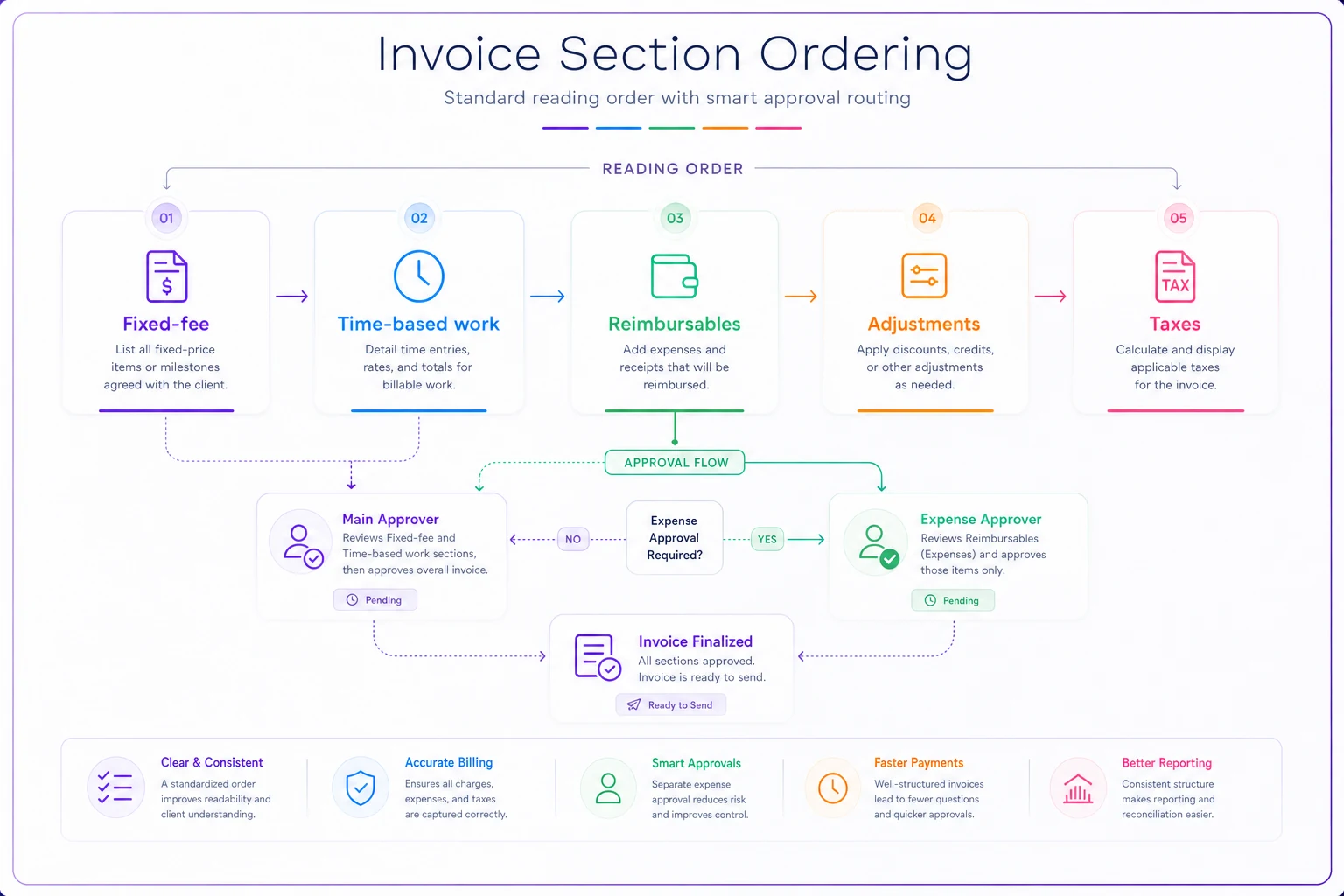
This illustrates the recommended reading order and approval flow.
Naming conventions that remove ambiguity
Section headers are doing more work than they look like. Vague headers force the client to read the line items just to figure out what the section even is.
-
Name the section by billing type, not by project phase. "Fixed-Fee Deliverables" beats "Phase 1" because the client already knows what phase 1 was — what they don't know is how you're billing it.
-
Say "Reimbursable" or "Pass-Through Expenses," never just "Expenses." The word "expenses" alone makes clients wonder if it's your overhead being passed on. "Reimbursable" signals "you agreed to cover these."
-
Put the billing basis in the header. "Time-Based Work — billed at $145/hr" kills the most common question before it's asked.
-
Keep the same header names across every invoice to the same client. Consistency lets them develop a scanning habit. By invoice three they're looking in the same spot every time.
One small thing that saves a surprising number of back-and-forth emails: in the reimbursable header, add a short note like "Receipts attached, see pages 2–3." Clients who can't immediately see backup documentation assume it doesn't exist and reply asking for it.
Subtotaling rules
Every section gets its own subtotal. No exceptions. A section without a subtotal forces the client to add the rows themselves, and nobody does that — they just defer the whole thing.
The subtotaling logic that holds up:
| Section | Subtotal shows | Why |
|---|---|---|
| Fixed-Fee Deliverables | Sum of agreed fees | Client matches it to the contract number |
| Time-Based Work | Hours × rate, plus a total-hours count | Total hours is the number they actually sanity-check |
| Reimbursable Expenses | Sum of pass-throughs, marked if non-taxable | Finance treats these differently |
| Adjustments / Retainer Applied | Shown as a negative | Makes the deduction obvious |
| Grand Total | All sections combined + tax | The only number they pay from |
One detail people consistently miss: for time-based work, show total hours as its own subtotal number, separate from the dollar subtotal.
Clients reconcile hours against their own sense of the work far more than they reconcile dollars. "You billed 18 hours this month" is a number they have an opinion about. "You billed $2,610" isn't — it's just the result of the math.
Handle tax carefully when reimbursables are involved. If some pass-throughs are non-taxable (you're re-billing at cost) while your services are taxable, the tax line has to come after the sections, computed only on the taxable blocks — otherwise the math won't tie out and the client's bookkeeper will bounce it back.
Sample section templates
Here's the skeleton. Adapt the labels, keep the structure.
Section 1 — Fixed-Fee Deliverables Homepage redesign (agreed per SOW) $2,400.00 Brand style guide (agreed per SOW) $1,100.00 Subtotal $3,500.00
Section 2 — Time-Based Work (billed at $145/hr) Change requests — content revisions 6.5 hrs $942.50 Extra integration testing 4.0 hrs $580.00 Total hours 10.5 hrs Subtotal $1,522.50
Section 3 — Reimbursable Expenses (at cost, receipts attached) Stock photo license (non-taxable) $89.00 Premium plugin — 1 yr (non-taxable) $149.00 Subtotal $238.00
Section 4 — Totals Taxable subtotal (Sections 1 + 2) $5,022.50 Sales tax (8.25%) $414.36 Non-taxable reimbursables $238.00 GRAND TOTAL $5,674.86
Three common scenarios, laid out
Retainer invoice with overage. The retainer covers a block of hours; the client went over. Structure it as: Section 1 — Retainer Applied (shown as the flat monthly fee), Section 2 — Hours Over Retainer (the overage at the hourly rate), Section 3 — reimbursables if any. The key is showing the retainer as a used block, not a credit. Something like "Monthly retainer — 20 hrs included, 23.5 hrs used, 3.5 hrs billed below" tells the whole story in one header.
Milestone invoice. When billing on project milestones, the milestone fee is the fixed section — but name the milestone, don't just write "Milestone 2 payment." Write "Milestone 2 — Beta build delivered (agreed $4,000)." Clients approve milestone invoices fast when the header names the deliverable they just received. If there's hourly work from out-of-scope requests during that milestone, it goes in its own section below, so they never confuse "the milestone" with "the extras."
Expense-heavy project. On something like an event or a build where reimbursables might be 40% of the invoice, give the reimbursable section the most structure — group it by category (travel, materials, third-party services), subtotal each group, then subtotal the section. A single flat list of 30 expense lines is where disputes breed. Grouped and subtotaled, the client approves category by category.
A short real scenario
A small marketing studio — two people, mostly retainer clients with project add-ons — had one anchor client who consistently paid 30–40 days late. Not because they were short on cash. Because every invoice blended the retainer, overage hours, and ad spend they'd fronted, all in one list, and the client's office manager kept kicking it to their finance person "to sort out the expense part," where it sat.
They restructured to three sections: retainer applied up top, overage hours in the middle, fronted ad spend in its own block at the bottom with a line that said "pre-approved, receipts attached." Nothing about the amounts changed. Payment time dropped to roughly the 12–15 day range within two billing cycles, because the office manager could approve the top two sections herself and only forward the bottom block for finance sign-off — instead of forwarding the whole thing and waiting.
The lesson wasn't "charge differently." It was "let the client approve in pieces."
Small formatting rules that reduce confusion
A few mechanical things that punch above their weight:
-
Put a thin rule or whitespace gap between sections. Visual separation does half the categorizing work for the reader's eye.
-
Right-align all dollar amounts so subtotals stack into a clean column the client can scan vertically.
-
Bold only the grand total. If three numbers are bold, none of them stand out.
-
Keep reimbursable receipts as attachments referenced by page, not embedded in the line items. The invoice stays scannable; the backup is there if needed.
-
Don't interleave by date across sections. Date order feels logical to you because that's how the work happened. To the client it scrambles the categories.
-
Repeat the section structure identically every billing cycle. A client who's seen your layout three times stops reading it carefully and starts just approving it.
Repeat the section structure identically every billing cycle. A client who's seen your layout three times stops reading it carefully and starts just approving it.
When sectioning like this is overkill
If an invoice is genuinely single-type — pure hourly, pure fixed fee, no pass-throughs — don't force three empty sections onto it. A flat list is clearer for a simple bill, and bolting on a sectioning framework where it isn't needed just adds visual noise.
It's also overkill for very small amounts. A $320 invoice with one hour of work and a $40 reimbursable doesn't need formal section headers and separate subtotals — the client can hold two numbers in their head. Reserve the full structure for invoices where the blend actually creates sorting work, which in practice means anything with more than five or six mixed line items, or more than one approver on the client side.
Blended invoices get paid slowly not because clients object to the charges, but because a flat list makes them do categorization work before they can approve anything. Sectioning by billing type, ordering from most-expected to least-expected, subtotaling each block, and putting reimbursables last so they can be split off for separate sign-off — those four moves do most of the heavy lifting. The amounts stay exactly the same. What changes is how fast someone can look at the page and say "yes, pay this."
Ready to streamline your billing process?
Join 5,000+ businesses using Billoly to reduce billing delays, automate payments, and grow revenue efficiently.