



The invoices that get disputed the most aren't the expensive ones. They're the confusing ones. And nothing confuses a client faster than an invoice that mixes three billing types on the same page — hourly work, a fixed project fee, and reimbursable expenses — without any structure separating them.
You send it, feel good about it, and then two weeks later you get the dreaded reply: "Can you explain what I'm looking at here?" Now you're on a call walking someone line by line through your own math, and every minute of that call is unpaid.
This is one of the most common billing headaches for freelancers and small service businesses that do project work with a variable component. Not a prettier template — a line-item structure and workflow that removes the ambiguity before it ever reaches the client.
Why blended invoices break down in the first place
The problem isn't the mix of fees. Plenty of businesses legitimately bill hourly, fixed, and reimbursable all at once — a consultant with a flat retainer plus overage hours plus travel, a contractor with a fixed build fee plus material passthroughs, a designer with a project rate plus stock asset costs.
The problem is that most invoicing tools treat every line as equal. They stack everything into one flat list with a description, quantity, rate, and amount. That format works fine when all your lines are the same kind of charge. The second you blend types, the reader loses the plot.
-
Consulting — 12 — $150 — $1,800
-
Strategy package — 1 — $2,500 — $2,500
-
Airfare — 1 — $412 — $412
To you, that's obvious: hourly, fixed, reimbursable. To the client, it's three unrelated numbers with no signal about which are negotiable, which are pre-agreed, and which are just money you spent that they're paying back. The airfare line especially — it's sitting right next to your profit lines, so it looks like margin. Clients push back on reimbursables constantly, not because they don't owe them, but because the invoice presents them as if they're part of your fee.
Disputes on blended invoices almost always trace back to one of three things: the client didn't know a charge was hourly (they thought it was covered by the fixed fee), the reimbursable wasn't visibly tied to a receipt, or the totals didn't obviously roll up in a way they could verify. All three are structural problems, not relational ones.
The core fix: group by billing type, not by task
Stop listing charges chronologically or by task. List them by billing category, each as its own visually separated section with its own subtotal.
Stop chasing payments and start automating your billing.
Billoly empowers you to create, send, and track invoices effortlessly while maintaining professional client relationships.
- Customizable invoice templates
- Automated payment reminders
- Real-time payment tracking
No credit card required
Three sections. Three subtotals. One grand total. That eliminates the majority of "what am I looking at" replies.
Here's what a properly structured blended invoice looks like:
| Section | Contents | Subtotal shown? | What the client understands |
|---|---|---|---|
| Fixed Fees | Pre-agreed flat amounts (packages, milestones, deliverables) | Yes | "This was quoted. Not negotiable." |
| Hourly / Time-Based | Rate × hours, with date and task detail | Yes | "This is variable. I can verify the hours." |
| Reimbursable Expenses | Passthrough costs, marked at cost, receipt-backed | Yes | "This is money you spent for me. I owe it, and there's proof." |
The visual separation does something psychological. Fixed fees read as settled. Hourly reads as earned and verifiable. Reimbursables read as not your income — which is exactly the framing that stops clients from haggling over a $412 flight as if it were profit.
When reimbursables get their own labeled section, dispute rates on them drop noticeably. It's the same dollar amount either way, but the framing changes whether the client feels like they're being charged or being reimbursed. Those feel completely different to the person paying.
Line-item templates for each section
Each section needs slightly different columns because each billing type answers a different question in the client's head.
Fixed Fees section — the client's question is "was this what we agreed?"
| Description | Amount |
|---|---|
| Website redesign — full build | $4,500 |
| Brand guidelines document | $1,200 |
| Subtotal: | $5,700 |
Keep it minimal. You don't want to invite line-level scrutiny on a flat fee.
No quantities, no rates. A fixed fee with a "quantity" column just tempts people to divide it out and start negotiating the pieces.
Hourly section — the client's question is "can I trust these hours?"
| Date | Task | Hrs | Rate | Amount |
|---|---|---|---|---|
| Mar 3 | Stakeholder interviews | 2.5 | $150 | $375 |
| Mar 7 | Content audit | 4.0 | $150 | $600 |
| Mar 11 | Revision round 2 | 1.75 | $150 | $262.50 |
| Subtotal: | $1,237.50 |
This section needs the most detail, because verifiability is what prevents disputes.
The date and specific task matter enormously. "Consulting — 12 hrs" invites suspicion. Twelve individually dated, described entries invite trust. Same total, completely different reaction.
Reimbursables section — the client's question is "why am I paying for this and is it padded?"
| Date | Expense | Vendor | Receipt | Amount |
|---|---|---|---|---|
| Mar 7 | Round-trip airfare | United | [R-104] | $412.00 |
| Mar 7 | Airport parking | SFO | [R-105] | $54.00 |
| Mar 8-9 | Hotel (1 night) | Marriott | [R-106] | $228.00 |
| Subtotal: | $694.00 |
This section lives or dies on receipt linkage.
That receipt reference column is the quiet hero of the whole invoice.
The receipt workflow that kills reimbursable disputes
Reimbursables generate disputes for a boring reason: the client can't see the proof at the moment they're deciding whether to pay. If they have to email you and ask for receipts, you've already introduced friction and delay.
-
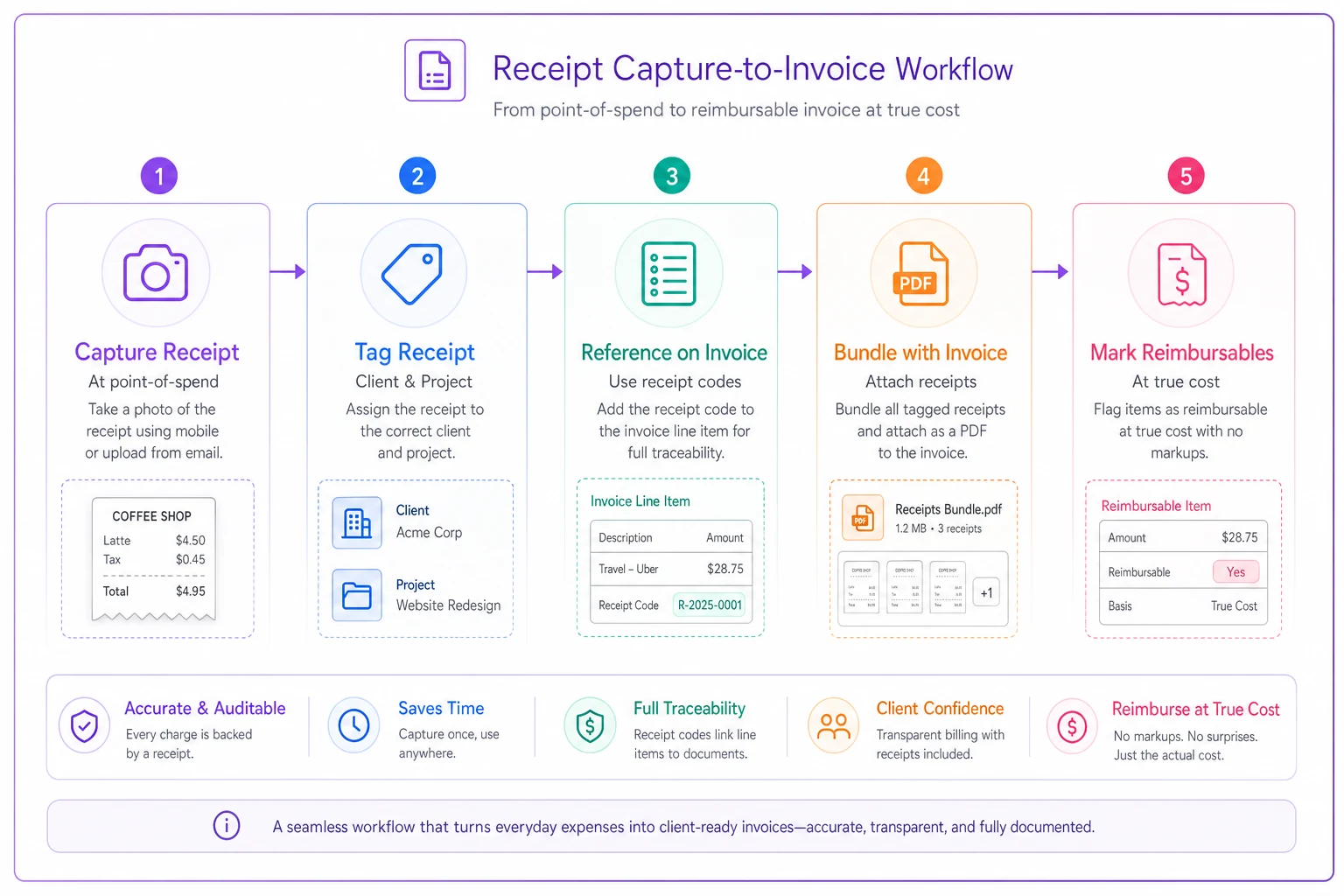
Capture at point of spend. The second you incur a reimbursable cost, photograph or save the receipt and give it a reference code (R-101, R-102, etc.). Doing this in the moment — not at invoice time — is what prevents the end-of-month scramble where you're guessing which charge was for which client.
-
Tag each receipt to a client and project. A receipt with no project tag is a receipt you'll misfile. Tag it immediately.
-
Reference the code on the invoice line. The
[R-104]in the table above maps directly to a receipt. -
Bundle the receipts with the invoice. Either attach them as a combined PDF or link to a shared folder. Never make the client ask.
-
Mark the reimbursable at true cost. If you're marking expenses up, that markup does not belong in the reimbursable section — it belongs in fixed or hourly as a clearly labeled service fee. Mixing a markup into a "reimbursement" is the fastest way to lose a client's trust when they eventually see the real receipt.
Capture receipts at the point of spend to avoid the end-of-month scramble where you can't remember which client paid for what.
Here's a quick visual of the receipt-to-invoice workflow.
That last point is where a lot of businesses quietly sabotage themselves. Passing through a $412 flight as "$500 travel" feels harmless until the client sees the boarding pass. Now every future reimbursable you send is under suspicion.
Dispute-avoidance displays: the small things that prevent big arguments
Beyond the three-section structure, a handful of display choices do a disproportionate amount of dispute prevention.
-
Show a running comparison against the estimate. If you quoted "40 hours estimated," show actual hours against it. Clients dispute overages they weren't warned about, not overages they can see coming.
-
Include a one-line "what changed" note on any hourly section that exceeded estimate. "Revision rounds 3–4 added per your Mar 9 request." That single sentence prevents the "why is this higher than expected" email.
-
Put the agreed contract reference somewhere visible. A line like "Fixed fees per SOW dated Feb 12" quietly settles the "I don't remember agreeing to this" pushback before it starts.
-
Never let a reimbursable exceed a receipt. Round down, not up. Absorb the odd 40 cents. It's not worth the credibility hit.
-
Show three subtotals plus a grand total. People trust math they can verify. A grand total that obviously equals the three subtotals added together lets the client check your work in five seconds — which paradoxically means they trust it enough not to.
Disputes are usually about surprise, not about amount. Clients rarely fight a charge they understood and anticipated. They fight charges that appear without context. Every display element above exists to remove surprise.
Tying it to time-tracking so the hourly section builds itself
The hourly section is the one most prone to errors — and to that awkward Sunday-night session where you're reconstructing your week from memory. Hours rebuilt from memory are almost always either under-billed (you forget things) or padded-looking to the client (round numbers everywhere: 2 hours, 4 hours, 3 hours).
Log time against the specific project as you work, so the invoice's hourly section is a direct export rather than a memory exercise. This is where operational software earns its place — not as a gimmick, but because a platform that ties time entries to a client and project can auto-populate the dated, described line items that make the hourly section trustworthy. The odd numbers (1.75 hrs, 2.5 hrs) that come from real tracking actually read more credible than a column of clean round hours.
The same logic applies to reimbursables. A system that lets you attach a receipt to a project when you spend the money means the [R-104] references are already sitting there when you build the invoice. The goal isn't automation for its own sake — it's that the invoice assembles from data you already captured, instead of being reconstructed under time pressure the night it's due.
A real scenario
A freelance UX consultant doing project work for mid-size clients was billing everything in one flat list — fixed design fee, hourly research overage, and travel reimbursements all stacked together. Invoices ran around $6k–$9k per project. Roughly one in three came back with questions, and the reimbursables specifically got haggled over almost every time. Payment averaged a bit over five weeks because of the back-and-forth.
The only change was restructuring into the three labeled sections with subtotals, dated hourly lines, and receipt references bundled with each invoice. Same rates, same clients, same work.
The "can you explain this" replies mostly stopped. Reimbursable pushback dropped to near zero once the receipts traveled with the invoice. Average time-to-payment came down to roughly three weeks — not because the client suddenly had more money, but because there was nothing left to argue about before paying.
When this structure makes sense — and when it's overkill
Use the three-section blended structure when:
-
You genuinely mix billing types on the same invoice
-
Reimbursables are a recurring source of questions
-
Your projects run long enough that clients lose track of what was agreed
-
You've had even one "explain this invoice" call
It's probably overkill when:
-
You bill a single flat rate with no variable component — one clean list is fine, and sections would just add clutter
-
Your reimbursables are trivial (a few dollars occasionally) and never questioned
-
You have long-term clients who already understand your format cold
The point isn't to make every invoice more elaborate. It's to add structure exactly where blended billing creates ambiguity — and leave simple invoices simple.
The takeaway
A blended invoice isn't confusing because it combines fee types. It's confusing because most templates flatten those fee types into one undifferentiated list where the client can't tell earned income from pre-agreed fees from money they simply owe you back. Separate them into three labeled sections, each answering the specific question in the client's head, back the reimbursables with receipts that travel alongside the invoice, and let real time-tracking build the hourly section so it reads credible instead of reconstructed.
Do that, and the mixed billing invoice stops being the thing you dread sending and starts being the thing that gets paid without a single follow-up email.
A blended invoice isn't confusing because it combines fee types. It's confusing because most templates flatten those fee types into one undifferentiated list where the client can't tell earned income from pre-agreed fees from money they simply owe you back. Separate them into three labeled sections, each answering the specific question in the client's head, back the reimbursables with receipts that travel alongside the invoice, and let real time-tracking build the hourly section so it reads credible instead of reconstructed.
Do that, and the mixed billing invoice stops being the thing you dread sending and starts being the thing that gets paid without a single follow-up email.
Ready to streamline your billing process?
Join 5,000+ businesses using Billoly to reduce billing delays, automate payments, and grow revenue efficiently.