



Most people don't choose a billing structure. They inherit one. The first client wanted a fixed quote, so now everything is fixed-price. Or a referral came in asking for an hourly rate, and suddenly the whole business runs on timesheets nobody enjoys filling out.
The problem is that the billing model you default to quietly shapes everything downstream — your cash flow timing, how much admin work you carry each month, how stable your revenue feels, and even how clients behave. Pick the wrong one for a given engagement and you'll feel it in disputes, scope creep, and the gap between invoice dates and money actually landing in your account.
This guide is about matching a billing structure to the specific engagement in front of you, not some abstract ideal. The right answer for a six-week brand sprint is usually different from an ongoing SEO relationship, even inside the same agency.
Start with the five variables that actually decide this
Before comparing models, be honest about what you're optimizing for. Every engagement sits somewhere on these five axes, and the "best" billing structure is just the one that scores well across whichever ones matter most right now.
-
Risk — Who absorbs the cost if the work takes longer than expected? Fixed-price puts that on you. Hourly puts it on the client.
-
Predictability — How well can you forecast both the scope and the revenue? Vague scope kills fixed-price. Stable scope makes retainers easy.
-
Client relationship — Is this a one-off transaction or a long partnership? Subscriptions and retainers reward relationships. Project fees suit transactions.
-
Cash-flow timing — When do you need the money relative to when you do the work? Deposits and retainers pull cash forward. Hourly pushes it back.
-
Administrative cost — How much tracking, reconciling, and explaining does each invoice require? Hourly is the heaviest. Flat subscriptions are the lightest.
What comes up repeatedly across service businesses is that owners weigh risk and predictability heavily when they quote, then completely forget about administrative cost until three months later when they're drowning in timesheets and line-item disputes. Admin cost is the sneaky one. It doesn't show up in the proposal, but it eats your evenings.
The five models, side by side
No model is "best" — each is a trade.
Stop chasing payments and start automating your billing.
Billoly empowers you to create, send, and track invoices effortlessly while maintaining professional client relationships.
- Customizable invoice templates
- Automated payment reminders
- Real-time payment tracking
No credit card required
| Model | Who carries scope risk | Cash-flow timing | Admin cost | Best fit |
|---|---|---|---|---|
| Hourly | Client | Lags work (bill after hours logged) | High — tracking, approvals, disputes | Undefined scope, discovery, open-ended support |
| Fixed-price project | You | Front/milestone-loaded if structured well | Medium — change orders required | Clear, bounded deliverables |
| Retainer | Shared | Predictable, usually billed ahead | Low–medium | Ongoing work with roughly steady volume |
| Subscription | You (productized) | Billed ahead, recurring | Low | Standardized, repeatable deliverables |
| Hybrid | Split by component | Mixed | Highest — mixed invoices | Engagements with both fixed and variable parts |
The table makes it look clean. In practice, real engagements rarely fit one column neatly. A website project is fixed-price until the client wants "just a few small tweaks" every week for six months after launch — and now you're doing unpaid hourly work disguised as a fixed-price relationship.
Hourly: when it's right and when it quietly bleeds you
Hourly works best when nobody can honestly define the scope yet. Discovery phases, legacy-system cleanup, ad-hoc advisory, anything where the next task depends on what you find in the last one. The client carries the risk, which is fair when the risk is genuinely unknowable.
When this actually makes sense: early-stage discovery, troubleshooting work, or any engagement where estimating would basically be guessing. It's also useful when the client has a habit of changing direction — hourly makes their indecision their cost instead of yours.
When it's a bad idea: repeatable, well-understood work. If you've built forty versions of the same thing, billing hourly means you're penalizing yourself for getting faster. The better you get, the less you earn. That's backwards.
The hidden cost of hourly isn't the rate — it's the administrative weight. Every hour needs tracking. Every invoice invites scrutiny. Clients question the 0.75 hours logged for "email coordination." A typical pattern: a consultant bills somewhere around $9k–$12k a month hourly, then spends a half-day defending the timesheet and re-sending clarifications. That half-day is unbilled, and it tends to be the most draining part of the month.
Fixed-price: great margins, until scope creep eats them
Fixed-price is where the money is if your scope is tight and your estimation is honest. You carry the risk, but you capture the upside when you're efficient. Clients love it because they know the number upfront.
The failure mode is predictable. You quote a logo and brand package at, say, $6,500. Three rounds of revisions were in scope. By round seven, you're underwater, and you didn't write a clear enough change-order clause to charge for the extra rounds. The margin you quoted quietly became a loss.
Sample change-order clause worth adapting:
> "This fixed fee covers the deliverables and revision rounds specified in Section X. Work requested beyond this scope will be quoted separately as a written change order and billed at [rate]. Work on the change order begins only after written approval."
That one clause is the difference between a profitable fixed-price shop and one that resents every client by month three. The mistake isn't usually pricing too low — it's failing to draw a hard line around what the price actually buys.
Retainers: predictability for both sides, if you define "what's included"
Retainers are the sweet spot for ongoing relationships with roughly steady volume. You get predictable revenue billed ahead of the work; the client gets guaranteed access and priority. Cash flow smooths out, and admin drops because you're not re-quoting every month.
The catch is defining what the retainer actually buys. Vague retainers — "ongoing marketing support" — turn into bottomless buckets where the client assumes everything is covered and you assume limits exist. Define it in hours, deliverables, or scope, and specify what happens to unused capacity.
Rollover clause worth considering:
> "The monthly retainer includes up to [X hours / deliverables]. Unused hours expire at month-end and do not roll over. Work exceeding the included amount will be billed at [rate] or require an upgraded tier."
Non-rollover language feels aggressive at first, but it protects you from the client who ignores you for two months then demands 60 hours of banked time in week one of month three. Settle this before it happens, not during an awkward email thread.
Subscriptions: retainers' productized cousin
A subscription is a retainer where the deliverable is so standardized you can promise the same output every cycle. Monthly bookkeeping. A set number of social posts. A fixed reporting package. The difference from a retainer is rigidity — subscriptions sell a product, not access to your time.
This is the lowest-admin model when it fits, because the invoice is identical every month and there's nothing to track or explain. The risk sits with you: if a "simple" subscription client turns complicated, your margin erodes quietly across many months instead of surfacing in one obvious overage.
Who should NOT do this: anyone whose work genuinely varies client to client. Forcing variable work into a flat subscription just means some clients subsidize others, and the heavy ones eventually feel underserved while the light ones feel overcharged. Both churn.
Hybrids: usually the honest answer, always the messiest invoice
Most real engagements are hybrids whether you call them that or not. A fixed-price build plus an hourly support tail. A retainer plus pass-through ad spend. A subscription base plus project add-ons.
Hybrids are often the correct choice because they let each component carry risk appropriately — fix the part you can scope, bill hourly for the part you can't. The downside is purely operational: your invoices now mix billing logics, and that's where clients get confused and payments slow down.
If you go hybrid, the invoice itself has to be unmistakably clear about which line is fixed, which is hourly, and which is a reimbursable pass-through. We've covered the line-item templates and workflows for exactly this in mixing hourly, fixed and reimbursable fees on one invoice without confusion. A clean blended invoice is what keeps hybrid billing from generating "wait, what am I actually paying for?" emails.
A quick decision process
When you're unsure which way to go on a specific engagement, run through this in order:
-
Can you define the scope precisely today? If no → hourly for now, revisit once scope firms up.
-
Is the work bounded and one-time? If yes → fixed-price with a change-order clause.
-
Is it ongoing with roughly steady volume? If yes → retainer with defined inclusions.
-
Is the ongoing work identical every cycle? If yes → productize it as a subscription.
-
Does it have both a bounded part and an open-ended part? If yes → hybrid, and plan the blended invoice from day one.
-
Which variable hurts most if you get it wrong — cash-flow timing, risk, or admin load? Let that break any remaining tie.
Here's a simple visual to keep the decision flow in mind.
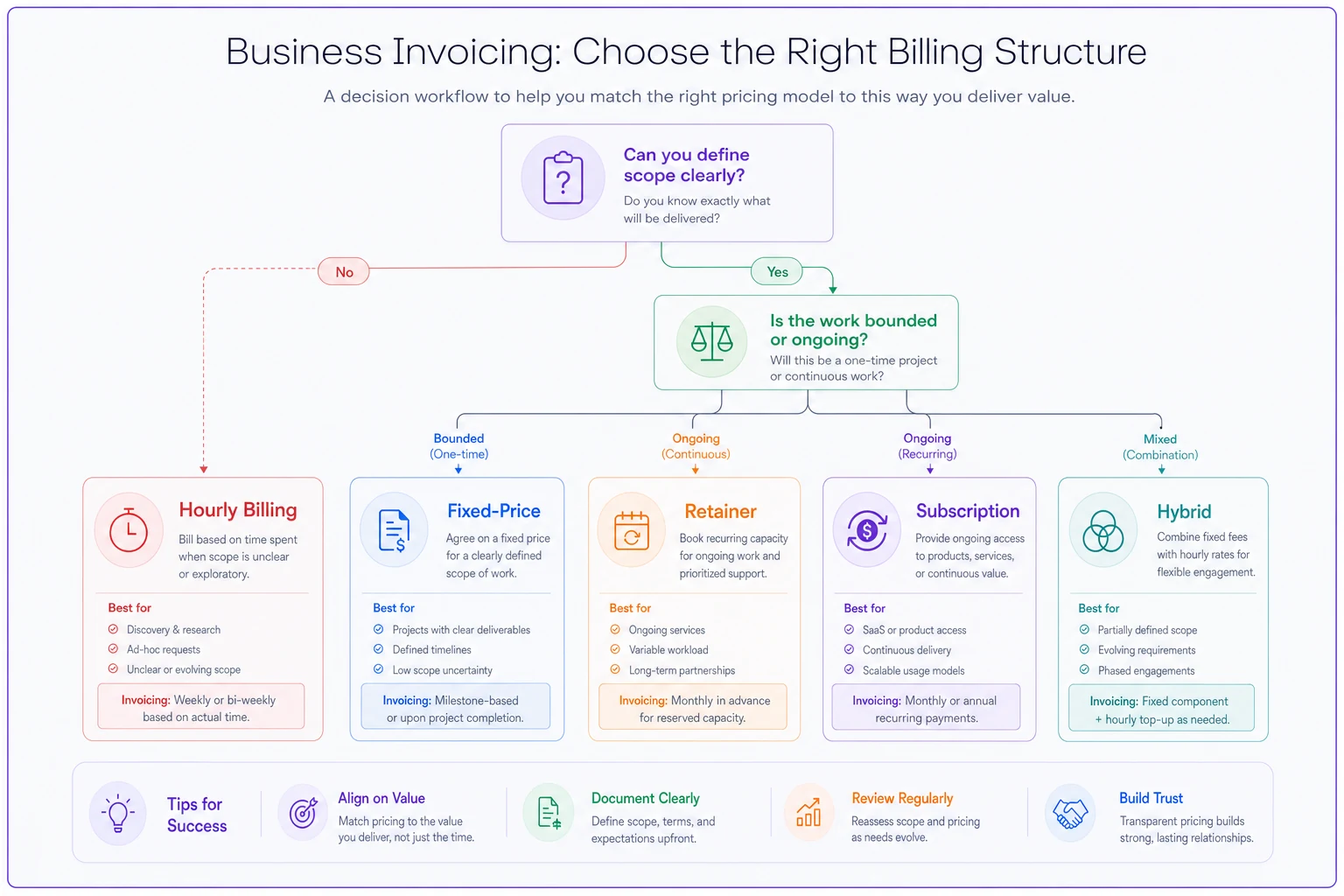
The order matters. A lot of people start at step 3 or 4 because recurring revenue sounds appealing, then force an engagement that was never repeatable into a subscription and spend a year resenting it.
A real scenario: moving a design studio off hourly
A small branding studio — three people, somewhere between $18k–$22k in monthly revenue — billed everything hourly. Their work was actually quite repeatable: brand packages, pitch decks, the occasional website. But because scope felt "undefined," they defaulted to the clock.
Two problems surfaced. First, their best designer got fast, which meant the studio earned less on identical projects than it had two years earlier. Second, roughly a third of each month's admin time went to logging hours and defending invoices.
They split the work. Brand packages moved to fixed-price with a three-round revision cap and a change-order clause. Ongoing clients moved to a monthly retainer with defined deliverables. Genuinely open-ended discovery work stayed hourly — the only place it actually belonged.
Revenue didn't explode overnight, but two things shifted within a quarter. Monthly revenue became predictable enough to actually plan hiring, landing around $24k–$27k as efficiency stopped working against them. Invoice-defense time nearly disappeared because fixed and retainer clients knew the number before the month started. The qualitative change mattered as much as the numbers: the owner stopped dreading the first of the month.
Migration checklist: switching a client to a new model
Changing an existing client's billing structure is delicate. Here's the sequence that avoids spooking people:
-
[ ] Pull 3–6 months of actual data on the account (hours, deliverables, overages) so your proposal is grounded, not guessed.
-
[ ] Decide the new model and the specific number before the conversation.
-
[ ] Frame the change around their benefit — predictability, priority, no surprise invoices.
-
[ ] Draft the new agreement with explicit scope/inclusion language and a change-order or overage clause.
-
[ ] Set a clean cutover date tied to a billing cycle, not mid-cycle.
-
[ ] Run one transition invoice that clearly closes the old model and opens the new one.
-
[ ] Confirm the new cadence in writing (billing date, payment terms, what triggers extra charges).
-
[ ] Watch the first two cycles closely for scope assumptions that didn't make it into the contract.
The step people skip is the first one. They switch based on gut feeling about which client is "annoying" rather than what the data actually shows. Sometimes the client who feels unprofitable is fine, and the quiet, easy one is the one eating your margin.
Billing cadence recommendations
Cadence silently controls cash flow,
-
Hourly bill every two weeks, not monthly. Shorter cycles mean smaller invoices, disputes while the work is still fresh, and less cash tied up in work already delivered.
-
Fixed-price deposit upfront (commonly 30–50%), then tie remaining payments to milestones rather than calendar dates. Never leave the final payment as the only real leverage.
-
Retainer bill in advance of the service period. You're guaranteeing availability; get paid for it before you provide it.
-
Subscription bill in advance, automate it, set it to recur. The invoice should require zero thought — that's the whole point of productizing.
-
Hybrid align the components where you can. If the fixed base bills on the 1st, bill the variable overages for the prior period on the same invoice so the client gets one clear statement instead of two confusing ones.
and it's easy to get lazy about.
A few negotiation tips that actually hold up
When you propose a structure, anchor on the client's problem, not your preference. "A retainer means your requests get priority and you never get a surprise invoice" lands better than "I prefer recurring revenue."
Offer a tiered choice rather than a single take-it-or-leave-it number. Clients who see three options spend their energy choosing between your options instead of negotiating you down. A smaller "lite" retainer sitting next to the one you actually want makes your target tier feel reasonable by comparison.
And resist the urge to discount the structure itself. If a client pushes back on a deposit or a change-order clause, that's not really a pricing objection — it's a risk-transfer objection. Caving means quietly taking back the risk you just priced out. Hold the structure; flex the number slightly if you have to.
Bringing it together
There's no universally correct billing structure, only a correct match between a model and a specific engagement's risk, predictability, relationship, cash-flow needs, and admin load. The firms that get this right don't pick one model and apply it everywhere — they keep three or four in their toolkit and choose deliberately each time a new engagement shows up.
Start by naming the one variable that would hurt most if you got it wrong on this client. Build outward from there. And when the honest answer is a hybrid — as it often is — put the real work into the invoice itself, because a blended engagement lives or dies on whether the client can read, understand, and approve what they're paying for at a glance.
Ready to streamline your billing process?
Join 5,000+ businesses using Billoly to reduce billing delays, automate payments, and grow revenue efficiently.