


The August PCE numbers landed in a way that surprised a lot of people. Core inflation came in at 3.0%, lighter than expected, while consumer spending jumped harder than most forecasters had penciled in. As Reuters reported, the combination gave the Fed some breathing room on rates. CNBC's breakdown noted the same split — cooling prices, hotter demand.
That split is the interesting part. "Inflation is cooling" sounds like relief. "Spending is surging" sounds like opportunity. But operationally, those two things pull your cash flow in opposite directions at the same time, and that's exactly where margins quietly leak.
More demand means more invoices, more receivables outstanding, more cash tied up in work-in-progress before anyone pays you. Meanwhile, moderating headline inflation doesn't mean your input costs — energy, freight, subcontractors — moved down. They often lag. So you can be busier than ever and still watch your bank balance tighten. That's the quiet version of a cash crunch that catches people off guard, because it doesn't feel like a slowdown. It feels like a boom.
Seven concrete, invoice-level moves that respond to this specific environment — not generic "watch your cash flow" advice.
1. Re-time your invoicing cadence before demand outruns your billing
The first thing that breaks when demand surges isn't delivery. It's billing speed.
A typical pattern: a two-person agency goes from sending maybe 18 invoices a month to 30+ in a busy stretch. Delivery keeps up because everyone's grinding. But invoicing slips to "end of the week" or "when I get a sec," and suddenly invoices that should've gone out on day one of completion are going out eight or nine days late. On Net 30 terms, that's roughly a week of extra float you're financing for free — every single invoice.
The move: tie invoicing to a completion trigger, not a calendar block. The moment a milestone closes or a project ships, the invoice goes out that same day. In a rising-demand period, "I'll batch it Friday" is how you accidentally lend your clients an interest-free loan during a window when your own costs may be climbing.
The businesses that handle demand surges well aren't the ones with the best sales. They're the ones whose billing never falls behind delivery.
2. Add pass-through clarity for energy and freight now, not after the hit
Moderating inflation at the index level hides a lot of volatility underneath. Transport and energy in particular tend to swing even when the broad number cools. If your cost of fulfilling an invoice includes shipping, fuel, or materials that move with those markets, you want the pass-through visible on the invoice before the swing, not bolted on afterward.
Stop chasing payments and start automating your billing.
Billoly empowers you to create, send, and track invoices effortlessly while maintaining professional client relationships.
- Customizable invoice templates
- Automated payment reminders
- Real-time payment tracking
No credit card required
The mistake is burying variable costs inside a single lump-sum line. When freight jumps 12% mid-quarter, you either eat it or you have an awkward conversation about why the "same service" costs more. Neither is great.
| Line item | Fixed vs. variable | Why separate it |
|---|---|---|
| Base service / labor | Fixed | Stable, predictable, no explanation needed |
| Materials | Variable | Lets you adjust without touching your core rate |
| Freight / shipping | Variable (pass-through) | Client sees it's a cost, not your margin |
| Energy / fuel surcharge | Variable (pass-through) | Easy to adjust up or down transparently |
When costs are itemized this way, a price change on one line reads as a market reality, not a rate hike. Clients argue far less with a freight line that moved than with a total that moved.
3. Revisit early-payment discounts — but do the math for *this* environment
Early-pay discounts feel generous, and in a tight-cash, low-demand period they can be worth it. But when demand is strong and your receivables are growing, handing out a 2% discount on every invoice can quietly become one of your larger expenses.
Run the actual annualized cost. A 2% discount for paying 20 days early works out to roughly a 36% annualized rate. If your real problem isn't cash scarcity but billing-cadence lag (see #1), you're paying 36% to solve a problem you could've fixed for free by invoicing on time.
When an early-pay discount makes sense:
-
You have a genuine near-term cash gap you need to close
-
A specific client is consistently slow and the discount reliably accelerates them
-
Your cost of alternative capital (a line of credit) is higher than the discount
When it's a bad idea:
-
You're offering it blanket, to everyone, out of habit
-
Your clients already pay close to on time
-
You're busy and your margin is already thinning from input costs
In a demand-up environment, selective beats blanket. Offer discounts surgically, to the clients who actually need the nudge.
4. Stress-test payroll timing against a shorter, lumpier payment cycle
More invoices going out doesn't mean more cash coming in on a smooth schedule. Higher receivable volume usually means lumpier collections — bigger gaps between a flood of invoices and the clustered payments that follow 30 to 45 days later.
The risk shows up at payroll. You scaled up, maybe added a contractor or two to handle the surge, and now your outflows grew immediately while your inflows arrive on a lag. A business can be more profitable on paper and still miss a payroll run purely on timing.
A weekly, invoice-level view beats a monthly guess here. Mapping expected receipts against known outflows week by week — not month by month — is what catches the gap before it becomes an emergency. If you don't already run one, this weekly invoice-driven cash-flow model is built exactly for this situation, where sales are rising faster than your payment cycle can keep up.
5. Tighten your onboarding-to-first-invoice window
When demand surges, new clients arrive faster than your intake process was designed for. The usual casualty is the gap between "client said yes" and "first invoice sent." A missing tax ID, no PO number on file, an unconfirmed billing contact — small gaps that each add days of delay before you can even bill.
A tight intake sequence that keeps that window short:
-
Capture billing details at signature, not at first invoice — legal name, billing email, PO requirement, tax info.
-
Confirm the approval chain up front — who signs off, what dollar threshold triggers extra approval.
-
Send a $0 "welcome" invoice or statement so the client's AP system has you on file before real money moves.
-
Set the payment method before work starts — don't discover their process on the first real invoice.
-
Lock the first billing date in writing so there's no "we didn't expect this yet" surprise.
Slow first payments are almost never about the client being difficult. They're about missing information you could have collected on day one. In a busy stretch, that discipline is what keeps new revenue from sitting stuck in limbo.
6. Build a collections plan that scales with volume — before you need it
A collections process that works fine at 20 invoices a month can quietly fall apart at 40. Not because the approach is wrong, but because manual follow-up doesn't scale with your attention. When you're slammed with delivery, chasing payment is the first thing that drops.
The failure mode is predictable: you stop checking the aging report, a handful of invoices drift from 30 days to 60 to 90 without anyone noticing. By the time you look, you've got several thousand dollars sitting in the oldest bucket — and the longer an invoice ages, the harder it gets to collect.
A simple volume-proof structure:
-
Day 3 after due gentle, automatic reminder — assume it slipped through
-
Day 10 second nudge, slightly firmer, restate the amount
-
Day 21 direct personal outreach, not a template
-
Day 35+ escalation — payment plan offer or formal process
The early steps should run on their own so your personal time only gets spent on the genuinely stuck ones. During a demand surge, that separation is the difference between collections that hold up and collections that quietly fall behind.
Automate the Day 3 and Day 10 reminders so they never drop off your radar when delivery gets busy.
Here's a simple workflow visualization.
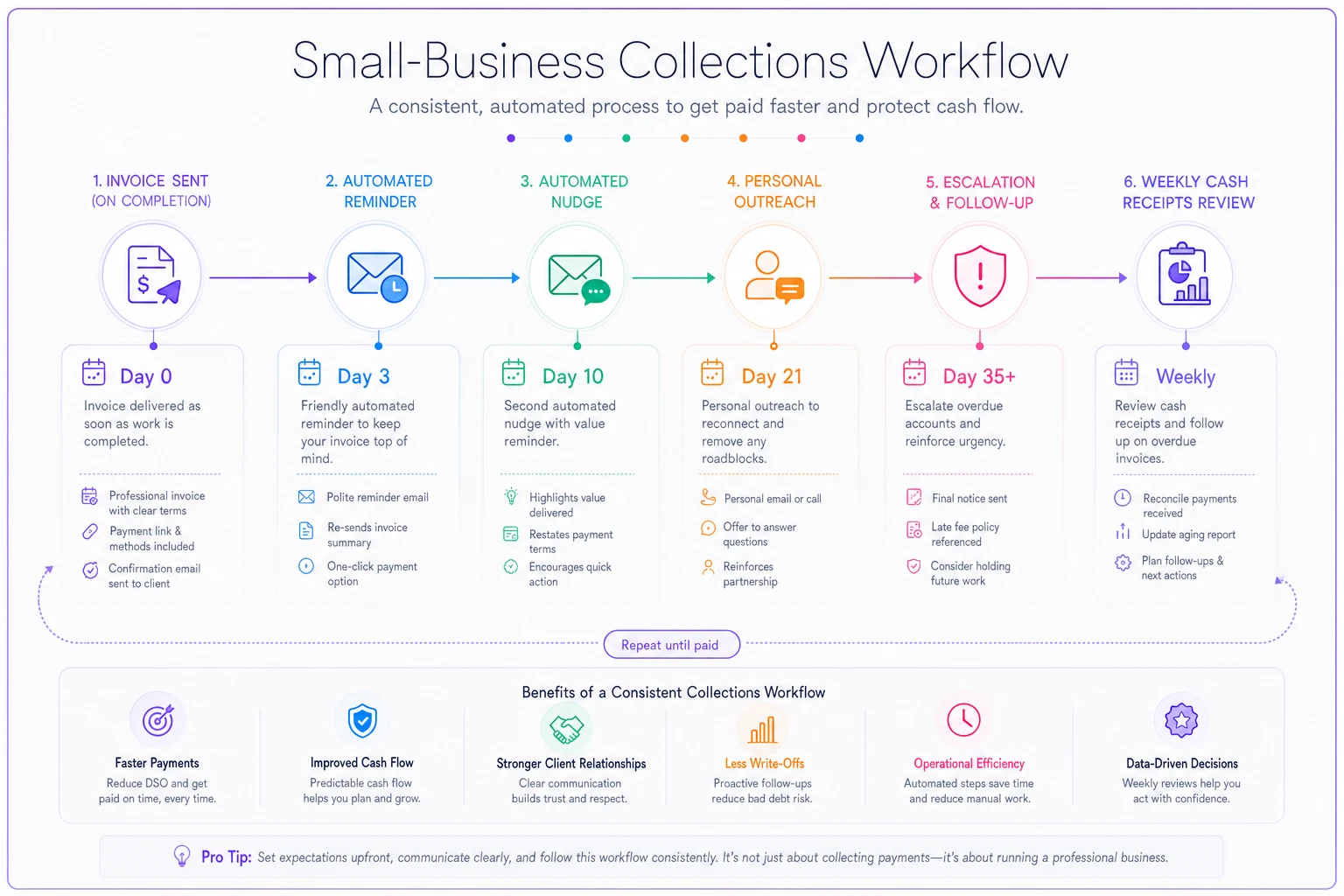
This keeps human time focused on the exceptions, not routine follow-up.
7. Re-examine your terms on new work, not just your rates
Everyone thinks about raising rates when demand is strong. Fewer people think about tightening terms, which often protects cash flow more than a price bump does.
If you're busier, you have more leverage to shift new clients from Net 45 to Net 30, require a deposit on larger projects, or move to milestone billing instead of billing everything at the end. A deposit on a $9k project isn't just cash in the door — it's a filter that screens out clients who were never serious, which matters more when your capacity is scarce.
Who should not do this: if you have a handful of anchor clients who make up most of your revenue and they're on comfortable terms, don't go aggressive and risk the relationship over a few days of float. Terms leverage is for new work and marginal clients, not your core book.
A real scenario: the busy quarter that almost broke payroll
A small design-and-print shop — four people — hit a strong stretch as demand picked up. Monthly invoicing went from around 22 invoices to roughly 38. Revenue looked great. But they were billing at project completion, batching invoices weekly, and their paper and freight costs had crept up about 9% even as the headline inflation number cooled.
For about six weeks, they were busier and tighter at the same time. Receivables ballooned to somewhere north of $40k outstanding while a freight surcharge they hadn't passed through ate roughly $1,500–$2,000 of margin they'd assumed was theirs. They came within a few days of needing to delay a contractor payment.
What fixed it wasn't dramatic. They moved invoicing to same-day on completion, broke freight into its own pass-through line, and started running a weekly receipts-vs-outflows view instead of eyeballing the bank balance. Within two billing cycles, the outstanding balance dropped by roughly a third and the payroll anxiety went away. Same revenue. Same clients. Just tighter mechanics.
The underlying problem this moment exposes
The real lesson from an environment like this one — cooling prices, surging demand — is that growth hides cash-flow problems until it suddenly doesn't. When sales are flat, your billing weaknesses show up slowly. When demand jumps, those same weaknesses compound fast, because every new invoice carries the same delay, the same buried pass-through, the same manual follow-up that was already marginal.
None of the seven moves above require new software or a big overhaul. They're small structural changes to when you bill, how you itemize, which clients you discount, and how closely you watch the weekly picture.
The businesses that come out of a demand surge stronger aren't the ones who sold the most. They're the ones whose billing kept pace with their delivery, so the extra revenue actually landed in the bank instead of getting stuck in float. Strong demand is a good problem to have — just don't let it quietly cost you the margin you worked to earn.
Ready to streamline your billing process?
Join 5,000+ businesses using Billoly to reduce billing delays, automate payments, and grow revenue efficiently.