


Service businesses attempting recurring billing often create a disaster of angry clients, payment disputes, and endless scope arguments. Hundreds of service companies make the same mistake: copying SaaS billing models without understanding that service work is completely different.
The retainer trap that kills trust immediately
A marketing consultant charges $3,000 monthly for "ongoing marketing support." Three months later, the client questions what they're actually getting.
The problem starts with vague language. "Ongoing support" means nothing when the client expects daily work but you planned for 15 hours monthly. You're arguing about value that could've been prevented with better contract structure.
Define recurring invoices for service businesses around specific deliverables, not time blocks. Instead of "20 hours of consulting," structure it as "monthly strategy review, weekly performance reports, and campaign optimization." The client knows exactly what arrives each month, even when time investment varies.
A landscape designer switched from hourly billing to $2,500 monthly retainers. Within four months, three of five clients canceled. The fix wasn't lowering prices—it was restructuring agreements to show seasonal value. Winter months focused on planning and design work. Spring included weekly site visits. Summer covered maintenance oversight. Fall handled next year's preparation. Same annual revenue, but clients understood value throughout the year instead of questioning quiet months.
Phased subscriptions beat flat monthly rates
Service businesses need flexibility that rigid monthly subscriptions can't provide. Phased subscription models work better for most service providers.
Stop chasing payments and start automating your billing.
Billoly empowers you to create, send, and track invoices effortlessly while maintaining professional client relationships.
- Customizable invoice templates
- Automated payment reminders
- Real-time payment tracking
No credit card required
Phase 1: Discovery/Setup (Months 1-2) Higher initial rate covering onboarding, system setup, initial analysis. Be explicit about what gets built during this phase.
Phase 2: Active Delivery (Months 3-8) Standard monthly rate with clearly defined deliverables. This is your core service period.
Phase 3: Maintenance/Optimization (Month 9+) Lower monthly rate for ongoing support, quarterly reviews, minor adjustments.
An SEO agency using this model saw churn drop from 40% at month six to 15%. Clients understood they were paying for different value at different stages, not the same thing forever.
Contract language matters here. Instead of "services will be provided monthly," use "Phase 1 services include comprehensive audit, keyword research, and content strategy development. Phase 2 transitions to content creation, link building, and monthly optimization based on Phase 1 findings."
Billing cadence that matches business reality
First-of-month billing creates unnecessary friction for service businesses. Your work doesn't stop and start with calendar months, so why should your billing?
Consider these alternatives:
Project milestone billing: Charge after completing specific deliverables rather than arbitrary dates. A web designer bills 25% after mockups, 50% after development, 25% after launch. The recurring element comes from maintenance packages that follow.
Rolling 30-day cycles: Start billing cycles from the project start date, not the calendar month. A consultant starting work on the 15th bills every 15th, keeping billing aligned with work periods.
Quarterly with monthly draws: Bill quarterly for the full amount but allow clients to pay in three monthly installments. Reduces invoice processing while maintaining cash flow.
A business coach switched from monthly to quarterly billing with monthly payment options. Administrative time dropped 60% while client retention improved—quarterly commitments felt more substantial than month-to-month relationships.
Contract language that prevents scope creep
Vague contracts create disputes. Specific language prevents them.
Bad language: "Monthly retainer includes strategic consulting and support"
Better language: "Monthly retainer includes: Two 60-minute strategy sessions, unlimited email support (2-business-day response), monthly performance report, and quarterly business review. Additional services available at standard hourly rate."
Include explicit exclusions. "Retainer does not include: hands-on implementation, paid advertising management, content creation beyond monthly report, or emergency response (available separately)."
The phrase that saves relationships: "Services outside scope will be discussed and approved via separate proposal before work begins." This prevents slow erosion of profitability from incremental requests.
Setting expectations that reduce churn
Churn happens when reality doesn't match expectations. Your contract and onboarding process must align these from day one.
Create a "Service Level Agreement" section that specifies:
-
Response times for different request types
-
Delivery schedules for recurring items
-
Meeting cadences and formats
-
Communication preferences and boundaries
-
How scope changes get handled
A PR agency includes a "Typical Month" document with every retainer agreement. It shows exactly what happens week by week, preventing the "what am I paying for?" conversation three months later.
The 90-day review clause: "After three months, both parties will review the arrangement and adjust scope, deliverables, or pricing as needed." This prevents silent dissatisfaction from building into sudden cancellation.
Payment terms that protect cash flow
Standard net-30 terms don't work for recurring services. You need terms that ensure payment arrives before work continues.
Auto-billing requirement: "Monthly retainer fees will be automatically charged to the payment method on file on the [date] of each month. Services may be suspended for failed payments."
Deposit structure: "Initial deposit equal to final month's retainer fee required. Deposit applied to final month of service with 30-day termination notice."
Late payment consequences: "Failed payment attempts result in immediate service pause until payment received. Two consecutive failed payments constitute breach of contract."
These aren't harsh—they're clear. Clients respect boundaries when you set them upfront.
The pause option that saves relationships
Sometimes clients need to stop services temporarily without ending the relationship. Build this into your contracts:
"Client may pause services once per year for up to 60 days with 14-day advance notice. Paused accounts retain priority scheduling upon restart. Pause requests beyond 60 days require contract renegotiation."
A graphic designer offering pause options retained 70% of clients who would've otherwise cancelled completely. Most returned within 45 days when business picked back up.
Making recurring invoices for service businesses actually recurring
Technical setup matters as much as contract language. Manual invoicing kills the recurring model before it starts.
-
Automatic invoice generation on specified dates
-
Payment retry logic for failed charges
-
Clear invoice descriptions matching contract language
-
Automatic late payment reminders
-
Easy client portal for payment updates
Without automation, you're just doing monthly invoicing with extra steps. The recurring model only works when payments happen without your intervention.
Use the exact contract wording in invoice descriptions so clients immediately see what each charge covers.
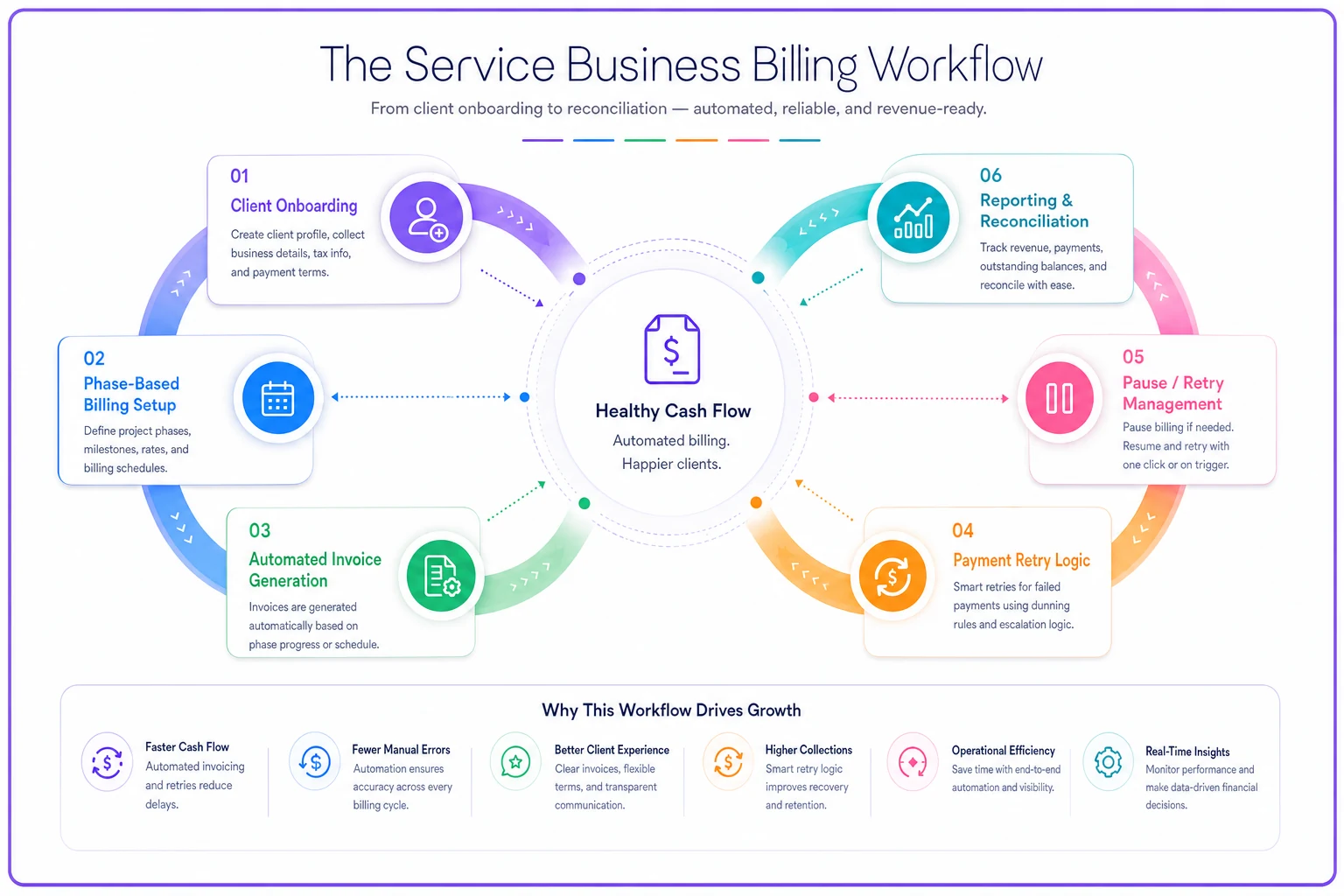
AI-powered billing platforms handle the complexity of phased billing, automatic adjustments, and pause management without manual tracking. They match your contract terms to billing logic, preventing the misalignment that creates disputes.
Termination terms that protect both parties
Ending recurring relationships cleanly prevents burned bridges and legal disputes.
Notice periods: "Either party may terminate with 30-day written notice. Final invoice covers work through termination date."
Immediate termination triggers: "Immediate termination allowed for: non-payment beyond 15 days, breach of confidentiality, illegal activity request, or mutual written agreement."
File handover process: "Upon termination, all client materials, access credentials, and work product delivered within 5 business days. Client responsible for preserving delivered materials."
Kill fee structure: For specialized services, include "Early termination before Phase 2 completion requires payment of 50% of remaining Phase 2 fees as kill fee."
Common friction points and fixes
These issues appear repeatedly in service contracts:
| Friction Point | Why It Happens | The Fix |
|---|---|---|
| "What am I paying for?" questions | Vague deliverables | Monthly deliverable checklist in contract |
| Scope creep arguments | No boundaries defined | Explicit exclusions list |
| Payment timing disputes | Unclear billing triggers | Specific dates and automation |
| Quality concerns | No performance metrics | Measurable success criteria |
| Communication overload | No boundaries | Defined response times and channels |
These issues appear repeatedly in service contracts:
Building trust through transparency
The most successful recurring service relationships share radical transparency. Your contracts should include:
Monthly reports: Even when not required, showing work builds trust. Include time summaries, deliverables completed, and upcoming focus areas.
Shared dashboards: Give clients real-time visibility into work progress, whether through project management tools or simple shared documents.
Proactive communication: Send weekly updates even when nothing dramatic happened. Silence creates anxiety about value.
A fractional CFO includes a "Value Delivered" section in monthly reports, explicitly connecting work performed to business outcomes. Client retention exceeds 18 months average, triple the industry standard.
Transitioning existing clients to recurring models
Moving current clients to recurring invoices for service businesses requires careful positioning. Don't force everyone into the new model immediately.
Start with your best clients—those who already work with you consistently. Offer them preferential rates or grandfather pricing for early adoption. Position it as simplifying their life, not just yours.
The transition conversation: "We've worked together for six months, averaging $2,800 monthly. I'd like to formalize this into a recurring arrangement that gives you priority scheduling and locks in current rates. The agreement includes everything we're already doing, just with clearer expectations and automatic billing."
About 60% of existing clients will transition if you frame it correctly. The rest might not be ideal for recurring models anyway.
When NOT to use recurring models
Some service businesses shouldn't force recurring invoices. If your work is genuinely project-based with clear endpoints, recurring billing creates unnecessary friction.
Bad fits for recurring models:
-
One-time intensive projects (website rebuilds, initial setups)
-
Seasonal businesses with no off-season value
-
Services with wildly variable monthly workloads
-
Clients who genuinely need sporadic support
For these situations, consider hybrid models: project fees with optional maintenance packages, seasonal contracts with defined active periods, or retainer banks where clients prepay for hours used as needed.
The key is matching your billing model to how your services actually work. Force-fitting everything into monthly subscriptions backfires.
Making it sustainable long-term
Recurring service models fail when providers burn out from unlimited demands or clients feel locked into unnecessary services. Build sustainability into your contracts from the start.
Include scope evolution language: "Services and pricing reviewed quarterly to ensure alignment with business needs. Adjustments implemented with 30-day notice."
Set boundaries that protect your capacity: "Retainer includes up to X deliverables monthly. Additional requests quoted separately or rolled to following month based on mutual agreement."
Create off-ramps that don't feel like failure: "After 12 months, clients may transition to as-needed support at current hourly rates with priority scheduling benefits retained."
Why most attempts fail
The pattern repeats across industries. Service providers implement recurring billing without understanding that recurring services work differently than recurring products. Software runs continuously. Services require active delivery decisions every month.
You're not selling access to a platform. You're selling expertise, judgment, and customized work that varies based on changing business needs.
Successful recurring invoices for service businesses acknowledge this reality. They create structured flexibility, not rigid subscription boxes.
Recurring invoices for service businesses work when they reflect service delivery realities, not software subscription models. Your contracts need to acknowledge that services ebb and flow, value shifts over time, and both parties need flexibility to adjust as businesses evolve.
The businesses getting this right aren't using complex legal documents. They're using clear, specific language that sets expectations, defines boundaries, and creates structured flexibility for both parties. They're automating the billing mechanics so energy focuses on service delivery, not payment processing.
They're building trust through transparency, consistency, and delivery—the foundations that make clients want to continue month after month, regardless of contract terms.
Ready to streamline your billing process?
Join 5,000+ businesses using Billoly to reduce billing delays, automate payments, and grow revenue efficiently.