

You know that sinking feeling when a client who owes you $12,000 suddenly goes dark after you've delivered half the project? Or when your retainer client keeps pushing scope while their monthly payment sits unpaid for 47 days?
Cash flow problems kill more businesses than bad products. The root cause usually traces back to payment structures that leave too much room for interpretation. Generic invoicing templates don't cut it when you're dealing with ongoing services, project milestones, or retainer relationships.
The businesses that maintain healthy cash flow aren't just better at collections—they structure their payment terms differently from day one. They use contract language that ties payments to deliverables. They break projects into bite-sized milestones. They require deposits that actually cover their risk.
The Hidden Cost of Standard Invoicing for Service Work
Most service businesses default to one of two broken models: hourly billing with net-30 terms, or project-based pricing with 50% up front and 50% on completion. Both create massive cash flow gaps.
Take a marketing agency working on a three-month rebrand project worth $24,000. With traditional 50/50 terms, they collect $12,000 to start, then nothing for three months while burning through payroll, software costs, and contractor fees. By month two, they're basically financing the client's project.
-
$6,000 deposit on contract signing
-
$6,000 at brand strategy approval (week 3)
-
$6,000 at design concept approval (week 6)
-
$6,000 at final delivery (week 12)
Now cash comes in every three weeks instead of every three months. The agency can cover costs as they go. Each payment is tied to client approval, creating natural pause points if the client goes MIA or keeps changing direction.
Contract Clauses That Actually Protect Your Cash Flow
The difference between getting paid and chasing payments often comes down to a few sentences in your contract. Generic templates leave massive loopholes.
Stop chasing payments and start automating your billing.
Billoly empowers you to create, send, and track invoices effortlessly while maintaining professional client relationships.
- Customizable invoice templates
- Automated payment reminders
- Real-time payment tracking
No credit card required
For retainer relationships: "Monthly retainer of $4,500 is due on the 1st of each month and covers up to 30 hours of services as outlined in Schedule A. Payment is required before work begins for that month. Unused hours do not roll over. Work stops if payment is more than 5 days late."
This eliminates ambiguity. Payment comes first. Hours are capped. Late payment has immediate consequences. Too many retainer agreements say something vague like "monthly payment of $4,500 for ongoing services" and wonder why clients treat payment as optional.
For milestone-based projects: "Client acknowledges that each milestone payment is triggered by delivery of specified components, not client approval or satisfaction. Delivered work meets milestone requirements when it substantially conforms to specifications in Schedule B. Client has 5 business days to request specific revisions or payment becomes due."
This clause prevents clients from holding payments hostage over subjective preferences. You've probably seen situations where a client sits on deliverables for weeks, then claims they're not ready to pay because they haven't had time to review. This language flips the dynamic—silence equals acceptance.
For deposits: "Initial deposit of $3,000 is non-refundable and reserves production schedule. Deposit covers initial research, planning, and setup costs that begin immediately upon payment. Project timeline starts from deposit receipt date, not project kick-off date."
The non-refundable language protects you when clients ghost after paying deposits. The timeline starting from payment—not kick-off—prevents clients from paying a deposit then delaying the actual start for months while expecting the same delivery date.
Sample Payment Schedules for Different Service Models
Payment timing makes or breaks cash flow, especially for businesses juggling multiple clients.
Web Development Projects
| Milestone | Amount | Trigger | Week |
|---|---|---|---|
| Deposit | $3,000 | Contract signing | 0 |
| Design approval | $4,000 | Client approves mockups | 2 |
| Development start | $4,000 | Live staging site demo | 4 |
| Final delivery | $4,000 | Site goes live | 8 |
This structure front-loads payments when you're doing the heaviest lifting. By week 4, you've collected 73% of the project value, which aligns with the reality that most of your costs hit early in the project.
Consulting Retainers
-
Week 1
$6,000 retainer payment due (covers month's services)
-
Week 2
Kick-off call and initial audit delivery
-
Week 3
Mid-month check-in and recommendations
-
Week 4
Monthly report and next month's invoice sent
-
Week 5 (Month 2, Week 1)
Next payment due or services pause
Requiring payment before the month starts, not after services are delivered. You're not a bank. Clients who can't pay upfront for consulting probably can't afford you anyway.
Creative Services with Ongoing Revisions
-
$2,000 non-refundable deposit (locks in start date)
-
$2,500 after initial concepts presented (regardless of feedback)
-
$2,500 after round 1 revisions delivered
-
$2,000 upon final file delivery
Each payment is tied to your delivery, not their approval. This prevents endless revision cycles where clients hold final payment hostage while requesting "just one more small change" for weeks.
Invoice Templates That Reduce Payment Friction
Your invoice design directly impacts payment speed. Cluttered invoices with vague descriptions get pushed to the bottom of the payment pile. Clear invoices with specific deliverable references get paid faster.
Invoice #2024-047 Due Date: November 15, 2024 Amount Due: $4,500 Project: Website Redesign - Phase 2 of 4 Milestone: Design Approval (as defined in Agreement dated Oct 1, 2024)
-
Homepage mockup (3 concepts delivered Oct 28)
-
Interior page templates (5 templates delivered Oct 30)
-
Mobile responsive layouts (delivered Nov 1)
-
Client feedback incorporated (revisions delivered Nov 5)
Next Milestone: Development Phase ($4,500 due upon staging site launch)
Payment Instructions:
-
ACH Transfer
[routing and account details]
-
Credit Card
[payment link]
-
Check
[mailing address]
Late Payment Terms: 1.5% monthly interest after 5-day grace period. Work pauses on day 6.
This format explicitly ties the invoice to contract terms, lists what you've delivered, and makes consequences clear. Compare this to a vague invoice that just says "Project Phase 2 - $4,500" and you'll see why one gets paid immediately while the other sits in accounting purgatory.
Managing Scope Creep Through Payment Structures
Scope creep isn't just a project management problem—it's a cash flow problem. Clients who keep expanding project scope while paying the same amount are essentially getting free work. The solution isn't better project management. It's payment structures that make scope expansion expensive.
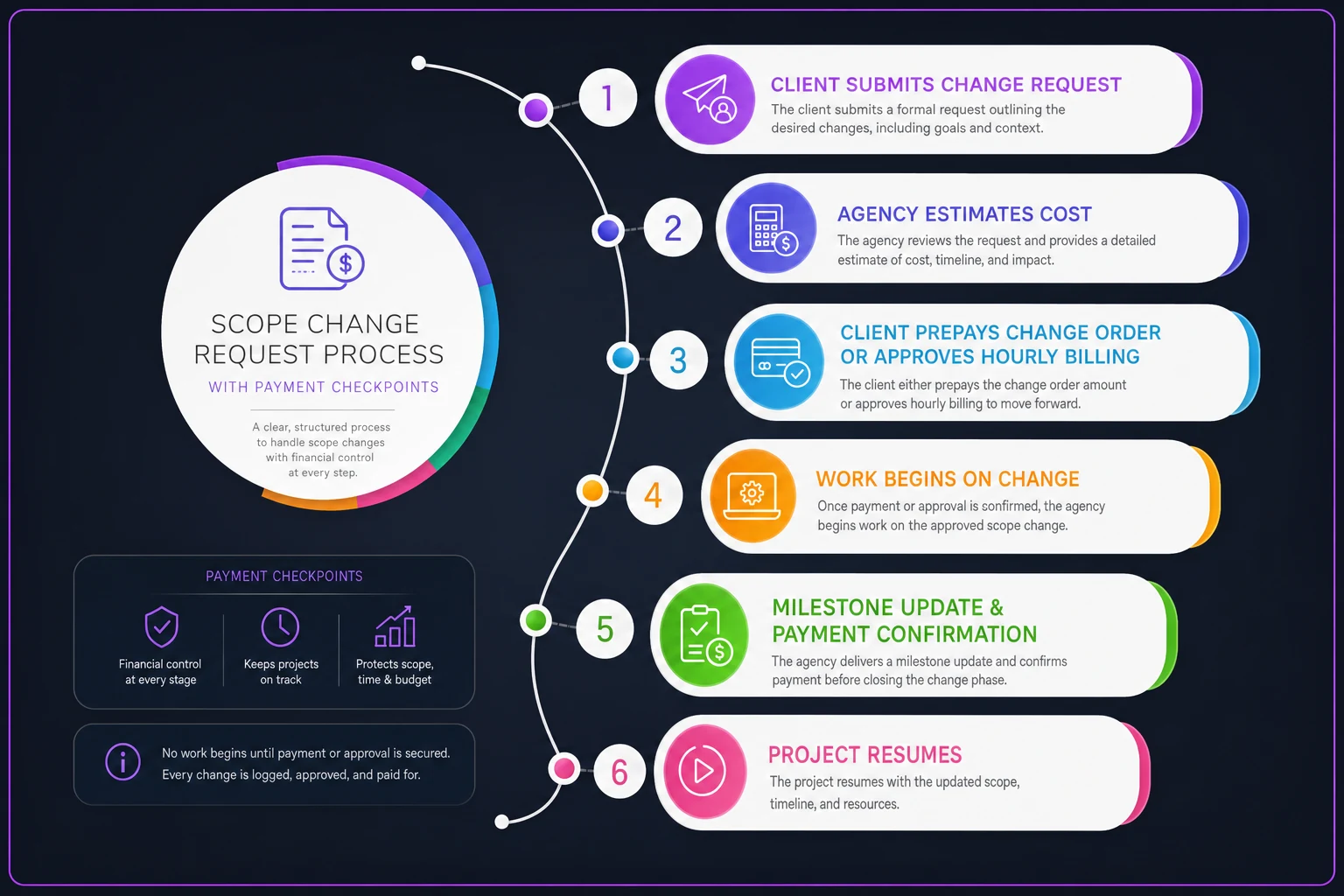
A design agency had a client who turned a "simple logo refresh" into a six-month brand overhaul. The original $8,000 project ballooned to easily $20,000 worth of work, but the payment stayed the same. They now use this approach.
Base project price covers specific deliverables listed in the contract. Any additions trigger either:
-
A change order with upfront payment
-
Moving to hourly billing for additions at $175/hour
-
Pushing additions to a "Phase 2" with its own payment schedule
The contract language: "Additional requests beyond specified deliverables will be estimated separately and require prepayment before work begins. Client may alternately defer additional requests to a future project phase."
This gives clients control—they can expand scope if they're willing to pay for it immediately. Most choose to stick with the original scope once they realize additions aren't free.
Require a small prepayment for change orders to discourage open-ended additions.
Deposits aren't just about reducing risk. They also filter out tire-kickers. Clients who won't pay $1,000 upfront for a $10,000 project probably weren't serious buyers anyway. They were shopping, not buying.
When Deposits Make Sense (And When They Don't)
Deposits protect you from two risks: clients who disappear after you've started work, and the opportunity cost of reserving time for a project that never happens. But demanding deposits for everything can hurt conversion rates.
Always require deposits for:
-
First-time clients (no exception, regardless of company size)
-
Projects requiring upfront purchases (domains, stock photos, software licenses)
-
Rush projects that displace other work
-
Clients who've been slow payers in the past
Consider skipping deposits for:
-
Established clients with perfect payment history
-
Small projects under $2,000 with quick turnaround
-
Retainer clients already on automatic payment
A web developer shared an interesting model: they waive deposits for clients who agree to weekly automatic payments throughout the project. Instead of $3,000 upfront for a $12,000 project, the client pays $1,500 every Monday for 8 weeks. This actually improves cash flow compared to traditional milestone billing while feeling less daunting to the client.
Deposits aren't just about reducing risk. They also filter out tire-kickers. Clients who won't pay $1,000 upfront for a $10,000 project probably weren't serious buyers anyway. They were shopping, not buying.
The Operational Reality of Payment Enforcement
Having solid payment terms means nothing if you don't enforce them. The businesses with the healthiest cash flow are ruthless about enforcement, but they make it feel routine rather than confrontational.
Payment enforcement follows a predictable pattern. Day 1 is the due date with automated reminder email. Day 3 gets a personal email checking if invoice was received. Day 5 gets a phone call or text about payment status. Day 6 means work stops and client gets notified. Day 10 brings final notice before sending to collections.
The critical moment is day 6 when work actually stops. Many businesses threaten to pause work but keep delivering anyway. Clients quickly learn these are empty threats. The first time you actually stop work, word spreads that you're serious about payment terms.
A freelance copywriter lost two clients the first month she started enforcing work stoppage for late payment. But the remaining clients suddenly started paying on time. Her average payment delay dropped from 22 days to 4 days. The short-term pain of losing problem clients led to long-term cash flow stability.
You need systems that make enforcement automatic. When payment hits day 6 overdue, your project management platform should automatically pause client access to work-in-progress. Your email system should send the standard work stoppage notice. This removes the awkward personal conversations while maintaining professional boundaries.
Automation and Payment Tracking
Manual payment tracking breaks down as soon as you have more than a handful of active projects. You forget to send invoices. You miss late payments. You lose track of which milestone comes next.
This is where operational software becomes essential. Modern invoicing platforms can automatically trigger milestone invoices when you mark project phases complete. They send payment reminders without you having to remember. They pause project access when payments are late.
The key is connecting your payment terms to your project workflow. When you mark the design phase complete in your project management system, it should automatically generate the corresponding milestone invoice. When payment clears, it should automatically unlock the next project phase.
AI-powered platforms take this further by analyzing payment patterns and flagging at-risk accounts before they become problems. If a usually prompt client suddenly takes 15 days to pay instead of their normal 3, the system alerts you to check in before the next milestone.
Some newer platforms integrate directly with accounting software, automatically reconciling payments and updating cash flow projections. This eliminates the manual data entry that creates gaps between what you've invoiced and what you've actually collected.
The goal isn't to automate the relationship away. It's to automate the administrative pieces so you can focus on delivering great work and having real conversations when problems arise.
Real Implementation: Marketing Agency Case Study
A boutique marketing agency restructured their payment terms and saw immediate cash flow improvement.
Before: They ran on net-30 terms for everything. Average invoice was $7,500. Average payment came in around day 42. They constantly struggled to make payroll despite having $80,000+ in outstanding invoices.
After implementing milestone-based billing, everything changed. All new clients require 25% deposit. Projects get broken into 2-week sprints with payment due at each sprint. Retainer clients move to autopay on the 1st. Work stops automatically at day 5 for late payments.
-
Average payment time
8 days
-
Cash on hand increased by roughly $35,000
-
Zero payroll delays
-
Lost two chronic late-payers, gained five new clients attracted to clear structure
Clients actually preferred the new structure. Smaller, frequent payments felt more manageable than massive invoices. Clear milestones reduced anxiety about project progress. The agency's confidence in enforcing terms made them seem more professional, not less flexible.
They also discovered that clients who pushed back hardest on the new payment structure were generally the ones who caused other problems too—scope creep, endless revisions, unreasonable timelines. The payment structure acted as an early warning system for difficult clients.
Common Mistakes to Avoid
Mixing payment models within the same client relationship. If someone starts as hourly, don't switch to project-based halfway through. If they're on retainer, don't suddenly start billing milestones for special projects. Consistency builds trust and reduces confusion.
Making deposits too small to matter. A $500 deposit on a $15,000 project doesn't protect you from much. It should cover at least your first week of costs plus the opportunity cost of turning down other work.
Vague milestone definitions. "When the client likes the design" isn't a milestone. "Upon delivery of three homepage concepts in PDF format" is measurable. Subjective milestones lead to payment disputes.
Ignoring the relationship between payment terms and pricing. If you offer net-30 terms, you're essentially providing a month of free financing. Build that cost into your pricing or offer cash discounts for immediate payment.
The Path Forward
Payment structure directly determines cash flow health. Generic net-30 terms and vague project pricing create unnecessary financial stress. The businesses that thrive use specific contract language, milestone-based payment schedules, and automated enforcement to maintain steady cash flow.
Start by auditing your current payment terms. Where are the gaps that let payments slide? Which clients consistently pay late? What project types create the longest payment delays?
Then implement one change at a time. Add deposit requirements for new clients first. Move existing retainer clients to prepayment. Break your next large project into milestones. Test different invoice templates to see what gets paid fastest.
The goal isn't to be harsh with clients. It's to create clear, predictable payment structures that work for everyone. Clients appreciate knowing exactly when payments are due and what they're paying for. You appreciate not having to chase payments or stress about making payroll.
Clients who balk at reasonable payment terms usually become problem clients anyway. The right payment structure acts as a filter, attracting professional clients who value your work enough to pay for it properly. That's when cash flow stress disappears and you can focus on actually delivering great work.
Ready to streamline your billing process?
Join 5,000+ businesses using Billoly to reduce billing delays, automate payments, and grow revenue efficiently.