


You've got $47,000 in outstanding invoices. Three of those clients represent 60% of your monthly revenue. One owes you $8,400 from a project completed eleven weeks ago.
Standard collections advice says to send increasingly firm emails, add late fees, then threaten legal action. Follow that playbook and you'll collect maybe 40% of what you're owed while torching relationships worth ten times that amount.
The operational reality of small business collections is completely different from corporate accounts receivable. When your biggest client owes you money, the power dynamic shifts. When a long-term customer hits cash flow problems, the calculation changes. When someone who refers you business goes silent on an invoice, the stakes multiply.
Why aggressive collections destroy small business economics
Most collections advice comes from people who've never depended on a handful of clients for survival. They'll tell you to be firm, set boundaries, enforce terms. They're not wrong about the principles — they're wrong about the context.
A marketing agency with twelve clients can't treat collections like a bank with twelve thousand accounts. A freelance designer who gets 70% of work through referrals can't burn bridges over a late payment. A consulting firm where each client represents $30k–45k annually can't follow a collections template designed for utility companies.
The math breaks down like this: recovering $3,000 from a client worth $18,000 annually through aggressive tactics means losing $15,000 in future revenue. Add the referral value — maybe another $25,000 over two years — and you've traded $40,000 for $3,000.
Small businesses face a collections paradox. The clients who owe you the most money are often the ones you can least afford to lose. Relationships you've invested years building can evaporate over one badly handled payment conversation. The referral networks that sustain your business judge you by how you handle conflict.
Reading payment delays before they become collection problems
Payment problems rarely start as payment problems. They start as operational breakdowns, cash flow crunches, or communication failures that show up weeks later as unpaid invoices.
Stop chasing payments and start automating your billing.
Billoly empowers you to create, send, and track invoices effortlessly while maintaining professional client relationships.
- Customizable invoice templates
- Automated payment reminders
- Real-time payment tracking
No credit card required
A client who's about to struggle with payment usually shows signs first. Email response times stretch from hours to days. Quick approvals turn into lengthy review processes. They start asking about payment terms they've never questioned before. They mention "waiting on a big payment" or "sorting out some banking stuff."
These aren't just warning signs — they're intervention opportunities. A client mentioning cash flow concerns in passing needs a different approach than one who's already 60 days late. Someone asking about payment flexibility before the invoice arrives will respond better than someone you're chasing after the fact.
The timing window for preserving relationships while recovering payment is narrow. Once a client feels embarrassed about owing money, they start avoiding you. Once they feel attacked, they get defensive. Once they feel cornered, they either pay grudgingly or disappear entirely.
The three-touch recovery framework that keeps clients paying
Traditional collections escalate pressure. Relationship-preserving recovery reduces friction. The difference shows up in every interaction.
First touch (Day 3-5 after due date):
"Hey Sarah, touching base on invoice #2847 from October — just making sure it didn't get lost in your inbox. I know month-end gets crazy. Here's the quick link if you need it: [invoice link]. Let me know if you need anything adjusted or have questions about any line items."
This message does three things standard collections templates miss. It assumes good intent. It acknowledges their reality (month-end chaos). It offers an easy out if something's actually wrong with the invoice.
Second touch (Day 10-12):
"Hi Sarah, following up on the October invoice — wanted to check if there's anything on your end I should know about? If cash flow timing is tight, we can look at splitting this into two payments. Would that help? Just let me know what works for your situation."
Now you're offering a solution before they have to ask for one. About 35% of late payers take the partial payment option when offered proactively. Almost none ask for it themselves.
Third touch (Day 18-20):
"Sarah, I haven't heard back about the October invoice and I'm getting concerned. The amount is now affecting my ability to cover operational expenses. Can we set up a quick call today or tomorrow to figure out a path forward? Even partial payment would help me manage things on my end. Available at 2pm, 3:30pm, or 4pm today — which works?"
This shifts from email to phone, acknowledges impact without attacking, and provides specific options. The phrase "path forward" frames this as problem-solving, not confrontation.
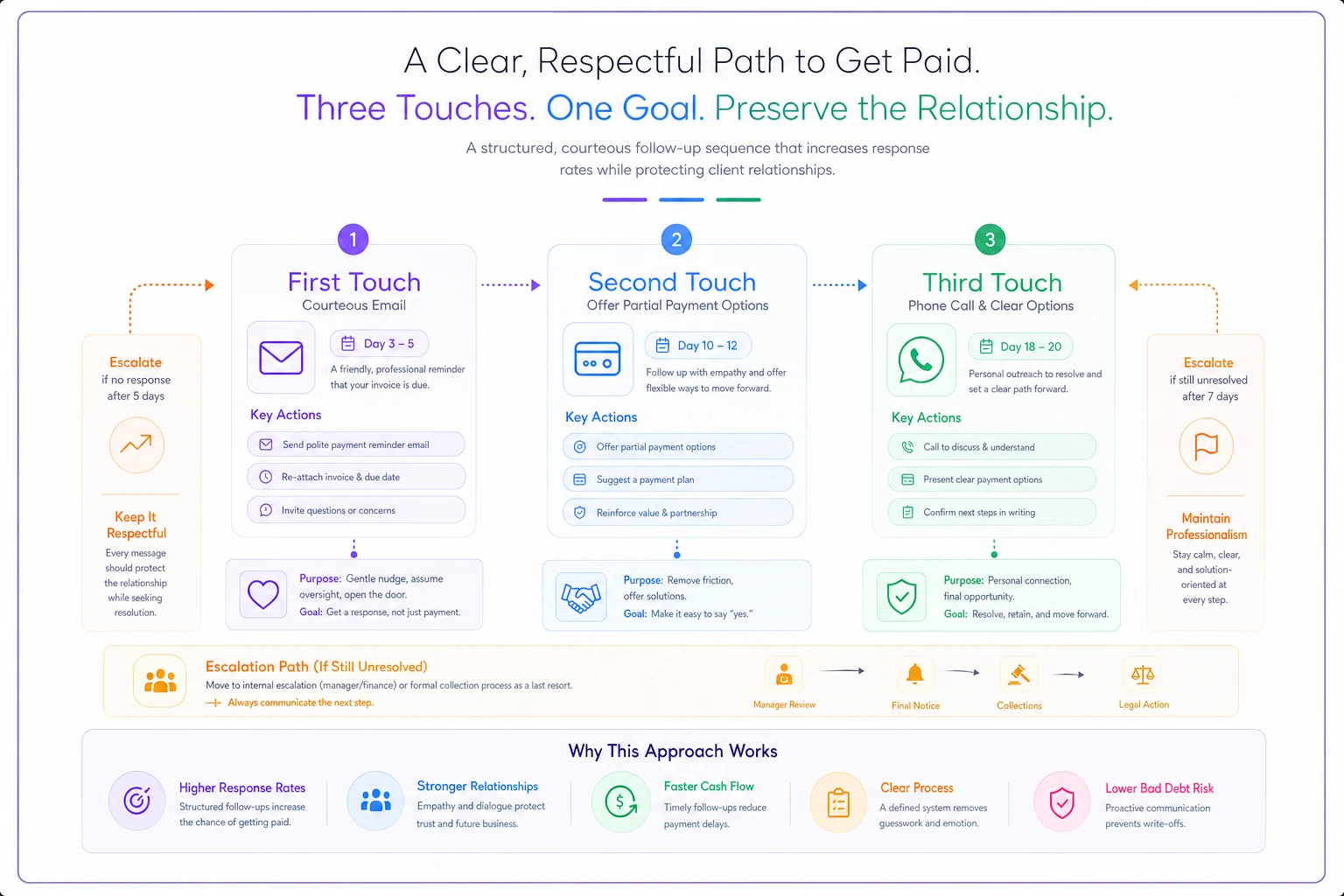
Here's a simple visual flow of the three-touch approach and timing to use when training your team or automating reminders.
Partial payment plans that actually get completed
Offering partial payments sounds simple. Getting them completed requires structure most businesses miss.
The worst partial payment offer: "Pay what you can when you can." This leads nowhere. No commitment, no timeline, no accountability.
| Option | Details |
|---|---|
| Option A: Three payments of $2,800 | - First payment: By this Friday (Nov 15) - Second payment: Dec 1 - Third payment: Dec 15 - No late fees if all three payments made on schedule |
| Option B: Four payments of $2,100 | - First payment: Within 48 hours - Remaining payments: Weekly starting Nov 22 - Includes 3% administrative fee for extended terms |
Clear amounts, specific dates, mild incentive for faster payment, consequence for slower payment. Most importantly — the first payment happens immediately. Once someone makes that first payment, completion rates jump to around 80%.
Require the first payment immediately as part of the plan — that initial payment greatly increases final completion rates.
The psychology matters more than the math. A client who owes $8,400 feels overwhelmed. A client who just paid $2,800 and owes $5,600 feels progress. That emotional shift from "I owe everything" to "I'm handling this" changes everything.
Concession templates that preserve dignity and revenue
Sometimes recovery means accepting less than full payment. The trick is structuring concessions that feel like solutions, not surrender.
"For genuine hardship cases: \"I understand the situation with [specific issue they mentioned]. Here's what I can offer: We'll close out this invoice at $6,000 (from $8,400) if payment arrives by Friday. This one-time adjustment helps us both move forward. After Friday, the full amount remains due.\""
This gives them a win while creating urgency. The discount only applies with immediate action.
"For disputed amounts: \"Looking at your concerns about the project scope, I see where the confusion happened. Rather than debate details from three months ago, I'm willing to remove the consultation hours (lines 4-7, totaling $1,400) if we can settle the remaining $7,000 this week. This feels fair given the miscommunication on both sides.\""
You're not admitting fault. You're acknowledging grey area and moving toward resolution.
"For relationship preservation: \"Given our four-year working relationship and the $hundred-twenty-something thousand in projects we've done together, I want to find something that works. If the full $8,400 is genuinely problematic, I can accept $7,000 as payment in full — but I need it by month-end to close my books. This is about maintaining our relationship, not maximizing this invoice.\""
The specific callback to history and future value reframes the conversation from transaction to relationship.
Scripts for different client personality types
The defensive client needs different handling than the embarrassed client. The disorganized client needs different structure than the struggling client.
For the defensive client:
"I'm not calling to create conflict. Something's obviously not working in our invoicing process, and I want to understand what that is. Walk me through what's happening on your end so we can figure this out together."
For the embarrassed client:
"Listen, I've been in business long enough to know cash flow gets weird sometimes. No judgment here. Let's just figure out what works for both of us and move forward. What timeline makes sense for your situation?"
For the disorganized client:
"I'm going to make this super simple. One payment, automatic charge to your card on file, we'll call it 10% less than the full amount if you authorize it right now while we're on the phone. Should I process that?"
For the genuinely struggling client:
"I can see you're in a tough spot. Here's what I need: some payment now to show good faith, then we'll work out the rest. Can you do $500 today? Then we'll figure out a plan for the balance that doesn't stress either of us out."
Starting small and building momentum works better than demanding large commitments from someone already overwhelmed.
Warning signs you're about to lose both money and client
Certain responses signal you're about to lose everything — the payment and the relationship. Recognizing these moments lets you pivot before it's too late.
When a normally responsive client goes completely silent after your second payment request, you're at a crossroads. One more email in the same tone and they'll ghost permanently. Time to completely change approach:
"Sarah, the silence is actually worrying me more than the late payment. Have I done something to damage our relationship? If there's an issue with the work or invoice, I'd rather know so we can fix it."
When someone starts disputing work quality only after you ask for payment, you're dealing with retroactive justification. They're building a case for non-payment. Standard response is to defend your work. Better response:
"I'm surprised to hear concerns about the project now, two months after delivery and multiple rounds of positive feedback. But let's separate two issues: if there are genuine problems with the work, I want to fix them regardless. The invoice is for work completed per our agreement. How do we handle both?"
When payment promises keep sliding — "definitely by Friday" becomes "early next week" becomes "waiting on one thing" — you're watching someone manage multiple crisis situations, and you're not the priority. Traditional escalation just adds to their stress. Instead:
"It seems like you're juggling a lot right now. Rather than keep adjusting dates, let's set something realistic even if it's further out. What date can you absolutely commit to, even if it's 30 days from now?"
Building payment recovery into your operational flow
The best payment recovery happens before anyone owes you money. Not through better contracts or terms — though those matter — but through operational practices that prevent payment problems from developing.
Start conversations about upcoming invoices before sending them. A simple "heads up, invoice for October coming Tuesday, should be around $8,400" prevents surprise and surfaces issues early.
Build payment checkins into project flow. "Now that we're at the halfway point, I'll be sending the second invoice tomorrow as discussed" reminds without demanding.
Create easy payment momentum. Instead of one $12,000 invoice, send three $4,000 invoices. Smaller amounts get paid faster, and partial collection beats zero collection.
Notice payment behavior patterns. A client who usually pays within 5 days but takes 15 days on one invoice might be signaling problems. That's when you have a casual conversation, not when they're 30 days late.
Most small businesses lose money not because clients won't pay — it's that by the time you're actively trying to recover payment, the relationship damage has already started. Every day past due adds awkwardness. Every follow-up email adds tension.
Automation opportunities in payment recovery
While the actual recovery conversations need human touch, the tracking and triggering can be systematized. Most businesses lose money not because clients refuse to pay, but because invoices fall through operational cracks.
AI-powered operational software can monitor payment patterns and flag changes before they become problems. When a typically prompt payer misses a due date, that's valuable signal. When multiple clients from the same industry start paying slower, that's market intelligence.
The automation doesn't replace relationship management — it enhances it. Instead of manually tracking who owes what and when to follow up, you focus on having the right conversation at the right time. The system reminds you that Sarah's payment is five days late and she usually pays within three. That context shapes how you approach the conversation.
Operational software can also track which recovery approaches work with which clients. Some respond to email, others need phone calls. Some pay immediately when offered splits, others need firm deadlines. Building this intelligence into your workflow means each recovery attempt gets more effective.
Relationship math most businesses never calculate
The true cost of aggressive collections isn't the client you lose — it's the compound effect on your business ecosystem.
-
Lose a client over payment
-$30,000 annual revenue
-
Lose their referrals
-$40,000 potential revenue
-
Damage to reputation in your industry
-$unknown
-
Time spent finding replacement client
40-60 hours
-
Stress and distraction from other work
unmeasurable
Compare that to accepting an 85% payment that preserves everything else. The 15% you "lose" costs far less than the relationship you keep.
This doesn't mean becoming a doormat. Clients who repeatedly pay late despite accommodation need different handling. Serial non-payers should be fired. But most payment problems aren't character problems — they're situation problems. Solving for the situation preserves the relationship.
Businesses that thrive long-term understand this distinction. They build recovery processes that acknowledge human complexity. They create payment solutions that work for both parties. They protect revenue while preserving relationships.
The next time you face an overdue invoice from a valuable client, resist the urge to follow generic collections advice. Look at the full relationship value. Consider the referral network. Calculate the replacement cost. Then craft a recovery approach that solves for the long term, not just the immediate invoice.
Because in small business, the money you recover matters less than the relationships you preserve while recovering it.
Ready to streamline your billing process?
Join 5,000+ businesses using Billoly to reduce billing delays, automate payments, and grow revenue efficiently.