


A marketing consultant lost their $42,000 annual retainer last quarter because their client's CFO couldn't understand recurring "production expenses" of $8,000 monthly. The consultant had receipts for everything—photographer fees, stock footage, paid ads—but lumping them into one vague line item triggered a six-week audit. Trust evaporated before they could provide the breakdown.
Why unclear expense breakdowns kill professional service relationships
This happens constantly. You bill for your time, add legitimate reimbursables, include taxes, and somehow end up in disputes. Not because you're doing anything wrong, but because your invoice structure creates confusion where clarity should exist.
Accountants make it worse. They need specific categorization for taxes, expense tracking, and audits. Vague descriptions get flagged. Now you're in email chains, providing documentation, watching payments delay while everyone tries to figure out what should have been obvious.
Standard invoice templates fail at mixed billing
Basic invoicing software gives you description, quantity, rate, amount. That works for straight hourly billing. Add reimbursables, taxes, and mixed services, and it becomes chaos.
Stop chasing payments and start automating your billing.
Billoly empowers you to create, send, and track invoices effortlessly while maintaining professional client relationships.
- Customizable invoice templates
- Automated payment reminders
- Real-time payment tracking
No credit card required
A web developer billing for a site rebuild might have development hours at $150/hour, hosting fees at cost, marked-up stock photos, state sales tax on deliverables, local tax on services, plus travel expenses. Dump that into standard line items and you get confusion.
The real damage scales. One confusing invoice might trigger a call. But 20-30 monthly invoices with mixed expenses and varying taxes guarantees disputes. A consultant billing $180,000 annually can lose 15-20 hours monthly just clarifying invoices—nearly $4,000 in billable time wasted on poor structure.
Three-section structure that eliminates confusion
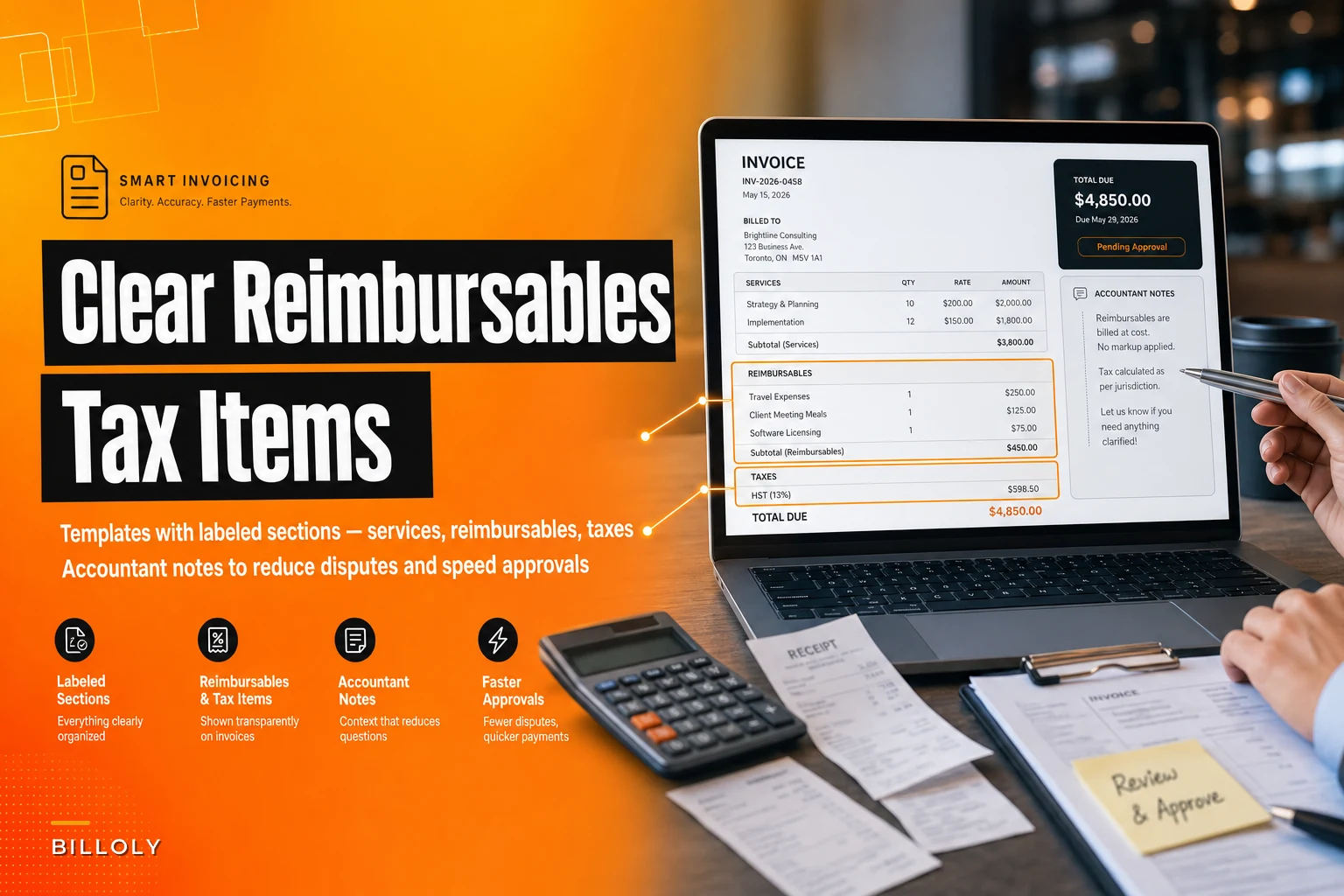
Physical separation on the invoice itself. Not just different line items, but distinct visual sections that make breakdowns impossible to misinterpret.
Section 1: Core Services Your actual work. Hourly rates, project fees, retainers. Each line specifies service provided, time period, rate basis, and services-only subtotal.
Section 2: Reimbursable Expenses Completely separated with its own header and subtotal. Include expense category, receipt date, markup if applicable, and documentation status.
Section 3: Taxes and Fees Again, physically separated with clear labeling of tax type, applicable rate, what it applies to, and registration numbers if required.
Visual separation matters more than you'd think. When people can scan an invoice and immediately understand what they're paying for, disputes drop dramatically.
Templates that actually work
Consultant Invoice Template
PROFESSIONAL SERVICES Strategic Planning Sessions (March 2024)
-
3 sessions × 4 hours @ $200/hour = $2,400
-
Email consultation and follow-up
8 hours @ $200/hour = $1,600
Services Subtotal: $4,000
--- REIMBURSABLE EXPENSES Research & Materials
-
Industry reports (3 purchased) = $450
-
Travel to client site (2 trips, 186 miles @ $0.67/mile) = $124.62
-
Printing/binding for presentation materials = $87.40
Note: Original receipts attached as PDF. No markup applied. Reimbursables Subtotal: $662.02
--- TAXES & FEES
-
State Service Tax (6.5% on services only)
$260.00
-
Payment processing fee (2.9% if paying by card)
$135.00
Tax/Fee Subtotal: $395.00 INVOICE TOTAL: $5,057.02
Creative Agency Invoice Template
CREATIVE SERVICES - MARCH 2024 Brand Development Project - Phase 2
-
Design concepts and iterations
$8,500
-
Copy development
$3,200
-
Creative direction
$2,800
Services Subtotal: $14,500
--- PASS-THROUGH EXPENSES All items billed at cost - receipts available in client portal
-
Stock photography licenses (12 images)
$1,840
-
Font licensing (2 families)
$299
-
Printing samples from approved vendor
$567
Pass-Through Subtotal: $2,706
--- THIRD-PARTY SERVICES 15% project management fee applied
-
Photographer (Johnson Studios)
$3,200 + $480 fee
-
Video editing contractor
$1,800 + $270 fee
Third-Party Subtotal: $5,750
--- APPLICABLE TAXES
-
State Sales Tax (7% on services)
$1,015
-
Digital goods tax (3% on licenses)
$64.77
Tax Total: $1,079.77 TOTAL DUE: $24,035.77
Both templates maintain clear structure while addressing different business models. The separation prevents confusion about what's being charged and why.
Strategic accounting notes that prevent delays
Clear categorization is half the battle. The secret weapon is strategic placement of accounting notes that answer questions before they're asked. These aren't lengthy explanations—they're brief, specific clarifications placed exactly where accountants look for them.
For reimbursables:
-
"Travel expenses follow IRS Publication 463 guidelines"
-
"Materials purchases include backup documentation per Client Expense Policy section 3.2"
-
"Third-party costs passed through at actual amount—no markup"
For tax items:
-
"Sales tax calculated on tangible deliverables only per state code 48.2-1001"
-
"Service tax ID
ST-789456-2024"
-
"Exempt items marked with reference to exemption certificate EC-2024-55"
For service descriptions:
-
"Hours tracked via [timesheet system] with daily detail available"
-
"Fixed fee per SOW dated 01/15/2024, section 4.1"
-
"Change order #3 approved via email 03/12/2024"
One graphic designer added these notes after their largest client's accounting kept holding payments for "invoice review." The notes turned 10-day holds into same-day approvals. The accountant sent a thank-you email calling it the clearest vendor invoice they'd processed.
Add a single-line reference next to each tax line with the statute or policy it references to cut review time.
The notes turned 10-day holds into same-day approvals. The accountant sent a thank-you email calling it the clearest vendor invoice they'd processed.
Categorization mistakes that guarantee disputes
Mixing reimbursables with service fees. A consultant bills "Project Phase 2: $12,000 including expenses." The accountant requests a breakdown to properly categorize, delaying payment by weeks.
Vague expense descriptions. "Miscellaneous costs: $800" or "Project materials: $1,200" tells reviewers nothing. They can't approve what they don't understand. Better: "Printing - 500 brochures from FastPrint: $800."
Inconsistent tax application. Charging tax on services one month but not the next, with no explanation, triggers reviews every time. If tax rules vary by service type or location, note it clearly.
Hidden markups. Adding margin to reimbursables without disclosure creates massive trust issues when discovered. If you mark up expenses (completely legitimate), state it explicitly: "Third-party services include 15% coordination fee."
Missing reference numbers. When expenses relate to specific purchase orders, contracts, or approvals, include those references. It's the difference between instant approval and a week-long documentation hunt.
Recurring templates for consistent clients
For regular clients, create templates that become familiar and expected. Accounts payable teams should glance at your invoice and immediately know where to find what they need.
Start with a master template for each regular client including their specific expense codes (if provided), standard notes they've requested, their preferred breakdown structure, and consistent placement of reference numbers.
Then create variations for different scenarios: monthly retainer with no reimbursables, project work with heavy third-party costs, travel-intensive engagements, mixed services with different tax rates.
A PR agency working with enterprise clients developed five standard templates based on project type. Payment time dropped from 42 days to 18 days because accounting teams knew exactly what to expect.
Consistency helps you catch problems faster. When every invoice follows the same pattern, anomalies stand out. Unexpected tax charges or unusual expense categories get questioned internally before becoming client issues.
Software automation for complex categorization
AI-powered operational software can change the game here. Instead of manually organizing expenses and calculating tax variations, these platforms automatically categorize items based on your rules and specific client requirements.
The automation handles tedious work: pulling expense data from receipts, applying correct tax rates based on service type and location, generating accountant-friendly notes based on included items. You set rules once—which expenses get marked up, which services are taxable, what documentation to attach—and the system handles it consistently across every invoice.
| Automation Feature | Manual Process | AI-Powered Process | Time Saved |
|---|---|---|---|
| Expense Categorization | 15-20 min per invoice | 2-3 min review | 85% reduction |
| Tax Calculations | 10-15 min per invoice | Automatic | 90% reduction |
| Documentation Notes | 5-10 min per invoice | Auto-generated | 80% reduction |
| Client Preferences | Check notes each time | Applied automatically | 70% reduction |
These platforms learn from your corrections. When an accountant requests specific categorization changes, you update it once and the system remembers for all future invoices to that client. Over time, you build a library of client-specific preferences that eliminate most disputes before they start.
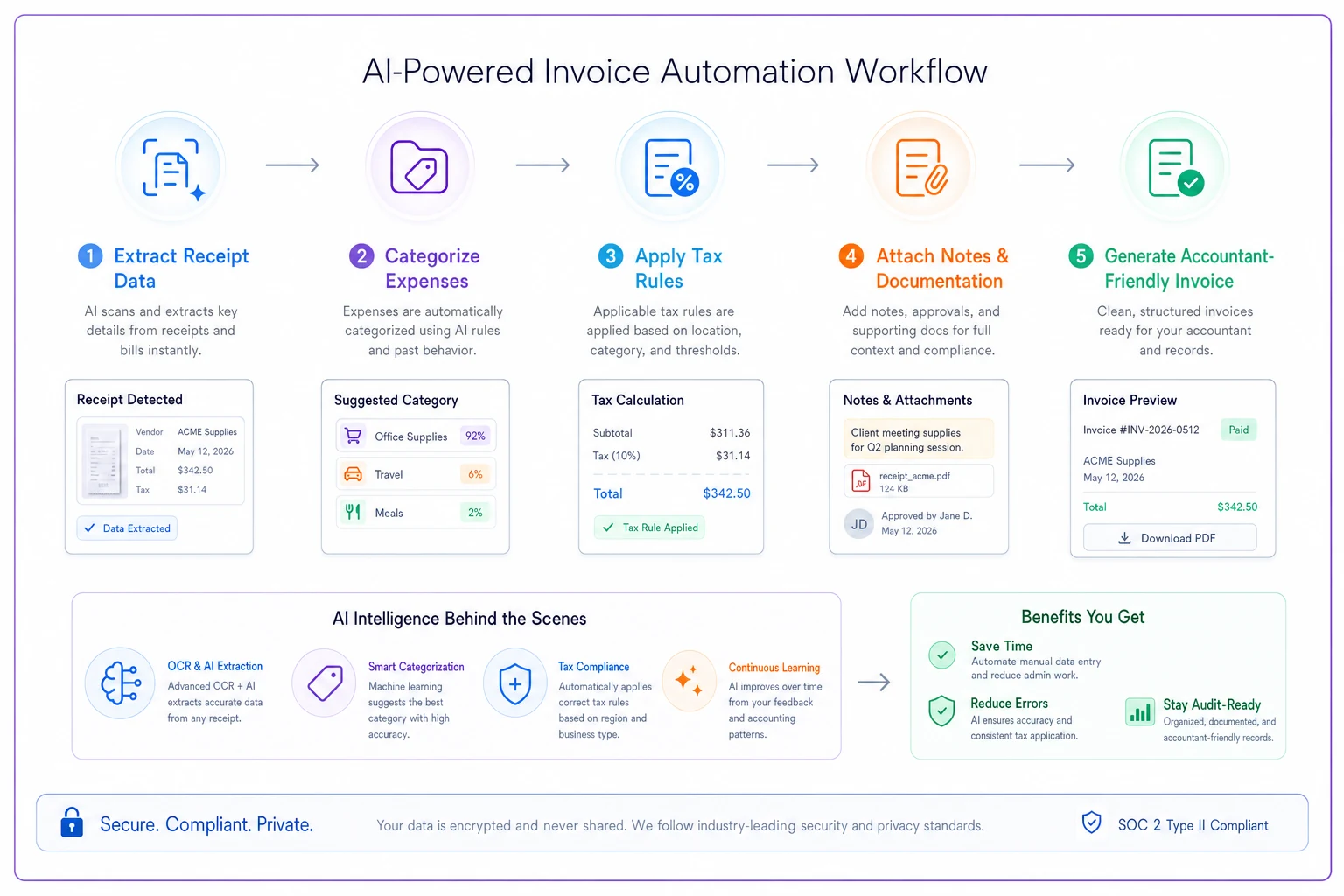
This simple workflow shows how data flows from receipt capture to a categorized, tax-calculated, note-attached invoice ready for accountant review.
The real value isn't just cleaner invoices—it's data collection. When every expense is properly categorized and tracked, you see patterns: which project types generate the most reimbursables, which clients consistently dispute certain charges, where markup strategies actually make sense. This visibility helps you adjust pricing, set better expectations, and identify operational inefficiencies you didn't know existed.
Preventing disputes through better structure
Clear invoice structure isn't about professionalism—it's about removing friction from your cash flow. Every dispute costs time and money. Every confused accountant delays payment. Every unclear expense line creates doubt about your billing practices.
These templates work because they address the core problem: humans trying to interpret financial documents quickly and accurately. When you present reimbursables and tax items clearly, separated from core services, with notes that anticipate questions, you're not just sending an invoice. You're providing a financial document that fits seamlessly into your client's accounting workflow.
Start with one client—preferably one who's been problematic about invoice approvals. Restructure their next invoice using the three-section approach. Add strategic notes. Watch what happens to approval time. Most businesses see dramatic improvement within one billing cycle.
Start with one client—preferably one who's been problematic about invoice approvals. Restructure their next invoice using the three-section approach. Add strategic notes. Watch what happens to approval time. Most businesses see dramatic improvement within one billing cycle.
The effort you put into invoice clarity pays dividends in reduced disputes, faster payments, and better client relationships. In professional services, where cash flow determines everything, that clarity might be the most valuable operational improvement you make.
Ready to streamline your billing process?
Join 5,000+ businesses using Billoly to reduce billing delays, automate payments, and grow revenue efficiently.