


The scariest number in any long project isn't the total contract value. It's the gap between work you've already delivered and money that's actually landed in your account. On a six-month build, that gap can quietly grow to five figures before anyone notices — and by the time you do, the client has usually already decided they're unhappy about something, which turns a payment conversation into a negotiation.
Most freelancers and small shops set up their payment schedule once, at kickoff, then never revisit it until a client goes quiet. That initial schedule basically decides how much financial risk you're carrying for the entire engagement. This post is about choosing it deliberately — with real milestone examples, escrow and interim-invoicing options, and the specific contract language that keeps clients feeling protected without leaving you funding their operation for free.
The real problem: work-in-progress exposure
Everyone talks about "getting paid on time." That's not the actual risk on long projects. The real risk is your exposure — the value of finished-but-unbilled or billed-but-unpaid work sitting on the table at any given moment.
Here's how it sneaks up on people. A web developer signs a five-month project for around $42k. They take a 20% deposit ($8.4k), then agree to bill "at the end" for the rest. Feels clean. But by month three, they've delivered maybe 60% of the work — roughly $25k of value — and collected $8.4k. That's about $17k of exposure, all riding on a client relationship that hasn't been tested yet.
If the client's business hits a rough patch in month four, or a new stakeholder shows up with opinions, that $17k is what's at stake. And you have almost no leverage, because you've already handed over most of the value.
The insight most people miss: your exposure should never exceed what you're willing to lose. Everything about a payment schedule — milestones, escrow, interim billing — is really just a mechanism to keep that exposure number small enough that you can walk away from a bad situation without it wrecking your year.
Three ways to structure it (and when each one fits)
There's no single right schedule. It depends on project length, how much you trust the client, and how much of the cost is your labor versus pass-through expenses.
Stop chasing payments and start automating your billing.
Billoly empowers you to create, send, and track invoices effortlessly while maintaining professional client relationships.
- Customizable invoice templates
- Automated payment reminders
- Real-time payment tracking
No credit card required
| Structure | Best for | Your exposure | Client trust required | Overhead |
|---|---|---|---|---|
| Milestone billing | Defined deliverables, 2-6 month projects | Low-medium | Medium | Low |
| Interim (progress) invoicing | Long, evolving scope, hourly-ish work | Medium | Medium-high | Medium |
| Escrow / staged release | New clients, high dollar value, low trust | Very low | Low (that's the point) | High |
Milestone billing ties money to outcomes. Interim invoicing ties money to time or percentage complete. Escrow ties money to a neutral third party holding funds until you both agree the milestone's done.
The mistake people make is defaulting to whatever felt normal on their last project. A $12k logo-and-brand project and a $90k platform rebuild should not use the same payment logic. The bigger the number and the newer the client, the more you should lean toward escrow or tight milestones.
Concrete milestone examples that actually work
Vague milestones are worse than no milestones. "Phase 1 complete" invites arguments about whether Phase 1 is really complete. Good milestones are binary — either the thing exists or it doesn't.
-
Kickoff / mobilization — 15% ($9k). Due on signing. Covers discovery, ramp-up, and the cost of turning down other work to reserve your time.
-
Approved architecture + technical spec — 15% ($9k). Tied to a signed-off document, not a vibe. The client's approval email is the trigger.
-
Core feature set functional in staging — 25% ($15k). Demonstrable in a shared environment. Either they can log in and use it or they can't.
-
Full feature complete + UAT begins — 25% ($15k). Triggered when you hand over for user acceptance testing.
-
Launch + 2-week stabilization — 20% ($12k). Final payment, released after the post-launch window.
Notice the front-loading. By the halfway point (through milestone 3), you've collected 55%. Your maximum exposure between any two milestones stays around $12k-$15k instead of the $17k+ from the "bill at the end" approach — and it's tied to something concrete, so disputes are rare.
The pattern worth stealing: never let a single milestone represent more than about 25% of the contract. If one payment is 40% of the deal, that's 40% of your revenue hanging on one approval conversation. Break it up.
Interim invoicing for projects that won't sit still
Milestones assume you can define deliverables in advance. Plenty of long projects can't — ongoing development, evolving marketing programs, work where scope genuinely shifts month to month. For those, interim invoicing works better.
The cleanest version: bill on a fixed cadence for actual progress. Every two weeks or monthly, you invoice for percentage-complete or hours logged, with a running summary so the client sees what they've paid against total budget.
A typical setup for a $48k, four-month project might be: roughly $12k/month, structured as "50% of the month's estimated work invoiced at the start of the period, remainder invoiced at the end against actual progress." That keeps you from ever fronting more than a couple weeks of labor.
The trap here is scope creep hiding inside interim billing. When there's no milestone gate, extra requests slide in and you keep working, assuming it all nets out. It doesn't. Interim invoices need a budget-remaining line on every invoice — "$48k contract, $31k billed to date, $17k remaining" — so both sides can see when you're approaching the ceiling before you blow through it. This matters more the longer the project runs, especially on engagements where you're mixing fixed and hourly fee types.
Escrow: when giving up control actually protects you
Escrow feels like overkill until you're staring at a $75k contract with a client you met eight weeks ago. The logic flips on big-dollar, low-trust situations: instead of you carrying the exposure, a neutral party holds the funds and releases them as milestones clear.
When escrow actually makes sense:
-
New client, no track record, contract north of ~$40k-$50k
-
International clients where collections would be a nightmare
-
Projects where the client is also nervous about you delivering
-
Situations where a broken deal would genuinely hurt your finances
When escrow is a bad idea:
-
Repeat clients you've been paid by before — it signals distrust and adds unnecessary friction
-
Small projects where escrow fees (often 1-3%) eat into your margin
-
Fast-moving work where waiting on release approvals kills momentum
Who should skip it entirely: if your projects are under about $15k or you work mostly with referred, repeat clients, escrow adds cost and awkwardness for a risk you're not really carrying.
The underrated benefit is that escrow depersonalizes payment. When the client knows the money is already sitting with a third party, released automatically on milestone sign-off, the emotional temperature of every payment conversation drops. Nobody's writing a check while annoyed. They're just approving a release.
The contract clauses that make any of this enforceable
A payment schedule is only as strong as the clauses around it. These are the ones that consistently matter on long projects:
-
Suspension clause. "Work pauses if any invoice remains unpaid more than 10 business days past due, and timelines extend accordingly." This is your leverage. Without it, an unpaid invoice just means you keep working for free while the deadline stays fixed.
-
Milestone acceptance window. "Client has 5 business days to review and accept a milestone; absent written objection, the milestone is deemed accepted and invoiced." Kills the "we never approved that" limbo.
-
Interest / late fee. A modest late fee (1.5% monthly is common) that you'll actually enforce. The number matters less than the fact it exists.
-
Materials/expense pass-through terms. Who fronts pass-through costs, and when they're reimbursed. On long projects these add up faster than people expect.
-
Kill fee / early termination. If the client walks, you're owed for work completed plus a percentage of the next milestone. Protects you from being dropped right after finishing an expensive phase.
Enforce the suspension clause — it's only protection if you actually stop work when payments slip.
The clause people skip most often is the suspension clause, and it's the one that ends up mattering most. A milestone schedule with no right to stop work is a wish, not a protection.
A real scenario
A three-person branding studio took on a rebrand-plus-website project for a regional retail client — roughly $54k over five months. Their old habit: 30% deposit, 70% on completion. They'd been burned once when a client restructured mid-project and dragged final payment out for four months, leaving them about $30k exposed.
They restructured the schedule for this engagement: 20% mobilization, then four milestones of roughly $10k-$11k each tied to concrete deliverables (brand direction approved, full identity system, site design signed off, site launched), with a 5-day acceptance window and a suspension clause.
The difference wasn't dramatic on paper, but it changed how the project felt. Their peak exposure dropped from around $30k to under $12k. When the client went quiet for two weeks in month three, the studio paused at the milestone gate instead of pushing ahead on faith. Payment landed within a week of the reminder. The whole thing wrapped roughly on schedule, and the final invoice — usually the painful one — was only about 20% of the total instead of 70%.
Keeping track of all this without losing your mind
The operational headache with staged payments is that they create more moving parts. On a "bill at the end" project you send two invoices. On a proper milestone schedule you might send six, each tied to an acceptance trigger, each with its own due date and follow-up.
Miss one trigger and you've quietly re-created the exposure problem you were trying to avoid. A completed milestone that sits un-invoiced for three weeks because you were heads-down on the next phase is just as bad as not having a schedule at all.
This is where a workflow — not just a template — matters. Whether you run it in a spreadsheet or an operational billing platform that tracks milestone triggers and flags when a deliverable's been accepted but not yet invoiced, something has to watch the gap between delivered and billed for you.
Use a simple workflow to watch the gap between delivered and billed:
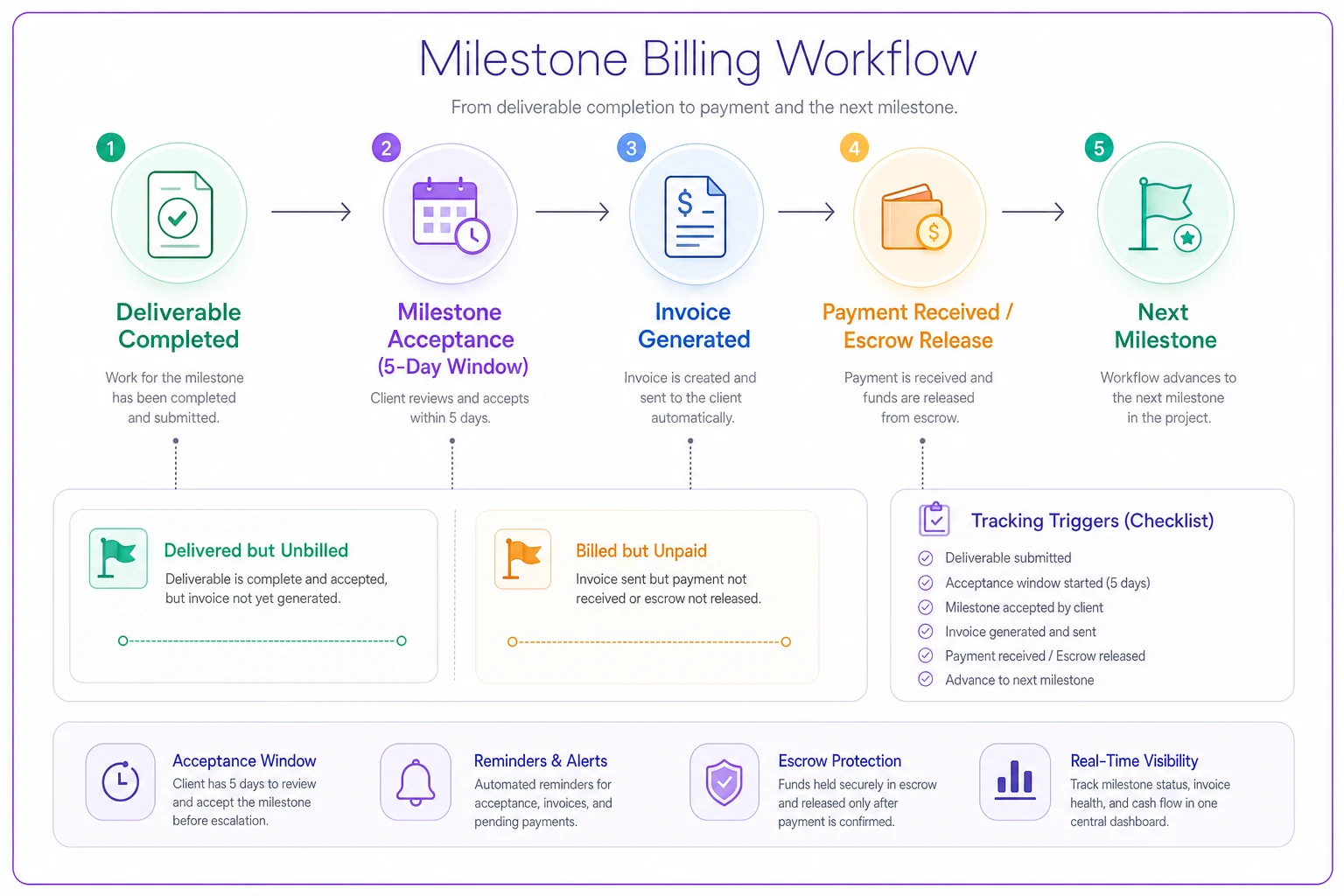
The tools that handle this well don't replace judgment; they just make sure nothing slips through while you're actually doing the work.
Pick the schedule before you pick the price
The order people usually go in: agree on price, then figure out payment terms as an afterthought. Flip it. Decide how much exposure you're willing to carry first, then let that shape the milestones, the cadence, and whether escrow is worth the friction.
For a two-month project with a known client, tight milestones and a suspension clause are plenty. For a six-month build with someone new and a big number attached, front-load the schedule, keep individual milestones small, and don't be shy about escrow. The goal isn't to squeeze the client — it's to make sure that on your longest, highest-stakes projects, the money and the work stay roughly in step the whole way through, so no single bad month can put you underwater.
The goal isn't to squeeze the client — it's to make sure that on your longest, highest-stakes projects, the money and the work stay roughly in step the whole way through, so no single bad month can put you underwater.
Ready to streamline your billing process?
Join 5,000+ businesses using Billoly to reduce billing delays, automate payments, and grow revenue efficiently.