
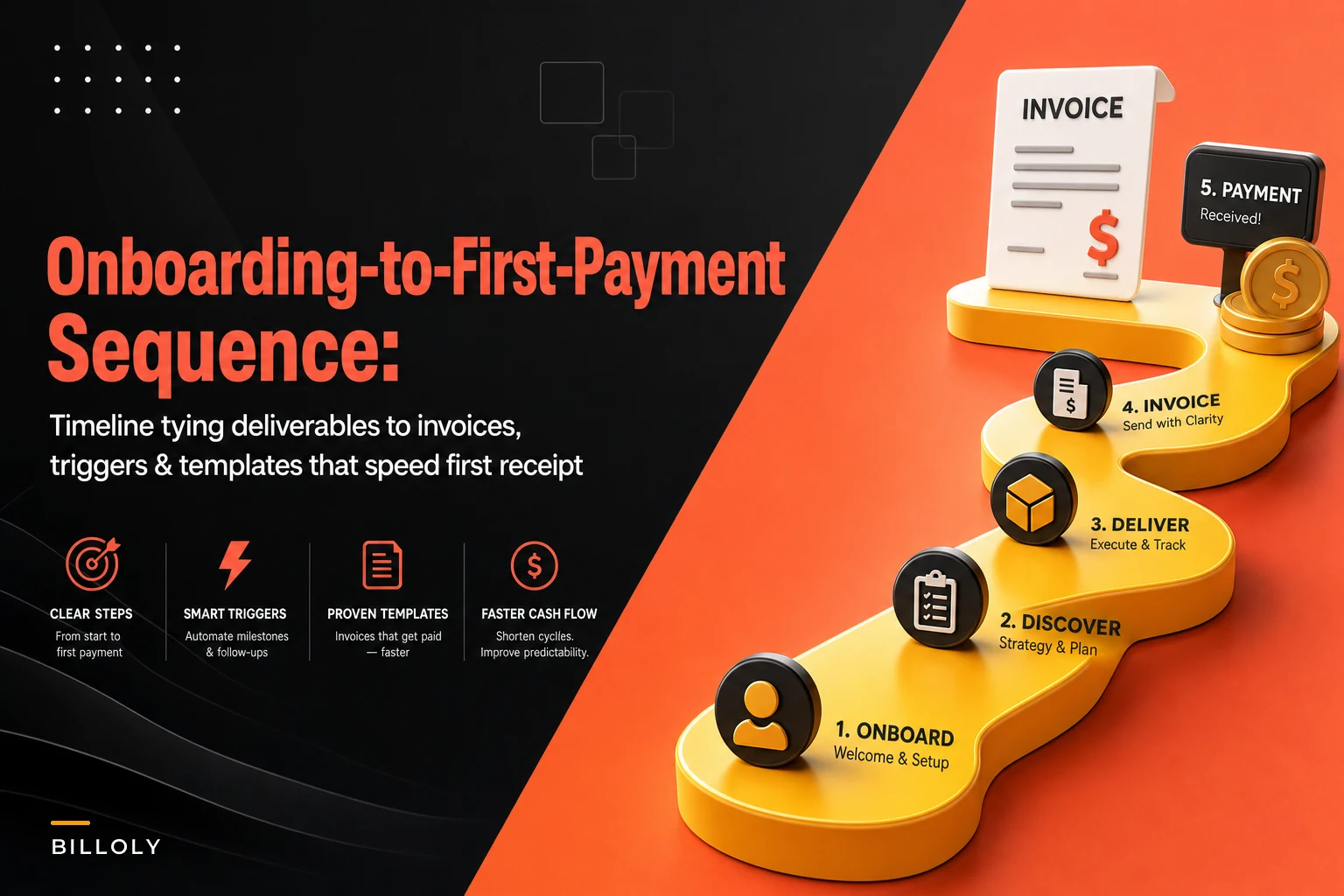

The gap between "you signed the client" and "the client paid you something" is where most freelancers quietly bleed cash. Not the big unpaid invoices later — those get attention. The early gap. The one where a project starts, work begins, and three weeks in you realize no money has moved because nobody set up the trigger that turns effort into an invoice.
This post is about that specific window: the sequence from onboarding to first payment. Not collections. Not late invoices. The very first receipt, and how to make it arrive faster by tying deliverables, communication, and billing triggers together instead of leaving them scattered across your inbox.
Where the first payment actually gets stuck
The delay almost never happens because a client refuses to pay. It happens because the first invoice was never triggered — there was no clear moment where someone said "this deliverable is done, so this bill goes out."
-
The kickoff happens, work starts, but the deposit invoice was never sent because everyone assumed the contract signing "counted."
-
A first milestone gets delivered buried in a long email, and the invoice follows days later — after the momentum and the client's attention have faded.
-
The freelancer waits until they feel they've "done enough" before invoicing, which is a subjective bar that keeps moving.
A designer building a brand identity might spend two weeks on discovery and moodboards before sending a single invoice, purely because it "didn't feel finished." Meanwhile their rent is due and the client hasn't been asked for a cent.
The core issue: onboarding and billing get treated as two separate tracks. One is about relationship and setup. The other is about money. When they run on separate timelines, the money one always loses.
The principle: every onboarding step should carry a payment consequence
The fastest onboarding-to-first-payment sequences share one trait — the billing trigger is attached to an onboarding event, not floating on its own.
Stop chasing payments and start automating your billing.
Billoly empowers you to create, send, and track invoices effortlessly while maintaining professional client relationships.
- Customizable invoice templates
- Automated payment reminders
- Real-time payment tracking
No credit card required
-
Contract signed → deposit invoice fires automatically.
-
Kickoff call completed → onboarding fee or first milestone invoice goes out same day.
-
First deliverable shared → matching invoice attached to the same message.
When the trigger lives inside the onboarding flow, there's no decision to make later. The awkward "is now the right time to ask for money" moment disappears because you decided the timing up front, before the relationship had any emotional weight.
A realistic 14-day onboarding-to-first-payment timeline
Here's a sequence that works well for project-based freelancers and small service teams. Adjust the days to your cycle, but keep the trigger logic intact.
| Day | Onboarding event | Communication | Payment trigger |
|---|---|---|---|
| 0 | Proposal accepted | "Great — sending your agreement + deposit invoice now" | Deposit invoice (25–40%) issued immediately |
| 0–2 | Client signs + pays deposit | Auto-confirmation of receipt | Deposit marks project as "active" |
| 3 | Kickoff call | Recap email with scope + next deliverable date | None (deposit already covers this) |
| 5–7 | First working deliverable shared | Deliverable + short review request in same message | If deposit didn't cover milestone 1, invoice attached here |
| 8–10 | Client feedback | "Thanks — here's what's next and the timeline" | None |
| 12–14 | Milestone 1 approved | Approval confirmation + invoice | Milestone 1 invoice fires on approval |
What makes this fast isn't the calendar. It's that no invoice in this sequence waits on you remembering to send it. Each one hangs off an event that's already going to happen.
A common mistake: people put the deposit invoice on Day 3 or Day 5, "after the kickoff call, once we're sure it's a fit." That single choice adds a week of delay and hands the client an early exit. The deposit belongs on Day 0. If they won't pay a deposit to start, that's information you want before you invest the kickoff hour.
The communication templates that make triggers work
Triggers only speed things up if the message around them is short enough that the client acts immediately. Long emails create lag. Here are the three that matter most in the early window.
1. Proposal-accepted → deposit (Day 0) > Hi [Name] — excited to get started. Two quick things to lock in your start date: > 1. Sign the agreement (link) > 2. Deposit invoice for [amount] is attached — start date holds once it's paid. > As soon as both are in, I'll send your kickoff scheduling link.
The deposit is framed as what holds the start date, not as a hurdle. That reframing alone gets deposits paid faster because it ties payment to something the client wants.
2. First deliverable → soft billing context (Day 5–7) > Here's the first [deliverable]. Take a look and let me know your thoughts by [date]. > For reference, this completes the first milestone — invoice attached, due [terms]. Happy to walk through anything.
The deliverable and the invoice live in one message. Splitting them into two emails is one of the quiet killers of early cash flow — the client sees the work, feels good, closes the tab, and the invoice arrives later into a colder inbox.
3. Milestone approved → invoice fires (Day 12–14) > Glad you're happy with [milestone]. That wraps this phase — invoice attached, [terms]. Next phase kicks off once it's cleared, targeting [date].
Payment becomes the gate to the next phase. Not a threat, just the natural rhythm of the project.
Why "send the invoice later" quietly costs you the most
The real damage isn't a single late first payment. It's what the delay does to the whole cash position.
A typical example: a freelance developer runs three new client onboardings in a month, each with a project fee around $6k–$8k. If each deposit invoice slips by an average of eight to ten days because it's not tied to a trigger, that's roughly three weeks of combined deposit money sitting uncollected across the month — money that was already earned the moment the client said yes.
Multiply that across a year of new clients and the "we'll invoice soon" habit becomes a permanent hole in working capital. You're essentially financing your own clients' starts for free.
There's a second, subtler cost. The longer the first payment takes, the weaker your position on every later invoice. A client who took 20 days to pay a deposit has already learned that your payment terms are flexible. The first receipt sets the tone. Fast first payment usually means faster payments all the way through the engagement.
Running the sequence without babysitting it
Once you've got the trigger logic mapped, the manual version works fine for one or two projects. The problem is scale — the moment you're onboarding three or four clients at once, tracking which deposit is out, which milestone is approved, and which invoice hasn't fired becomes its own part-time job.
-
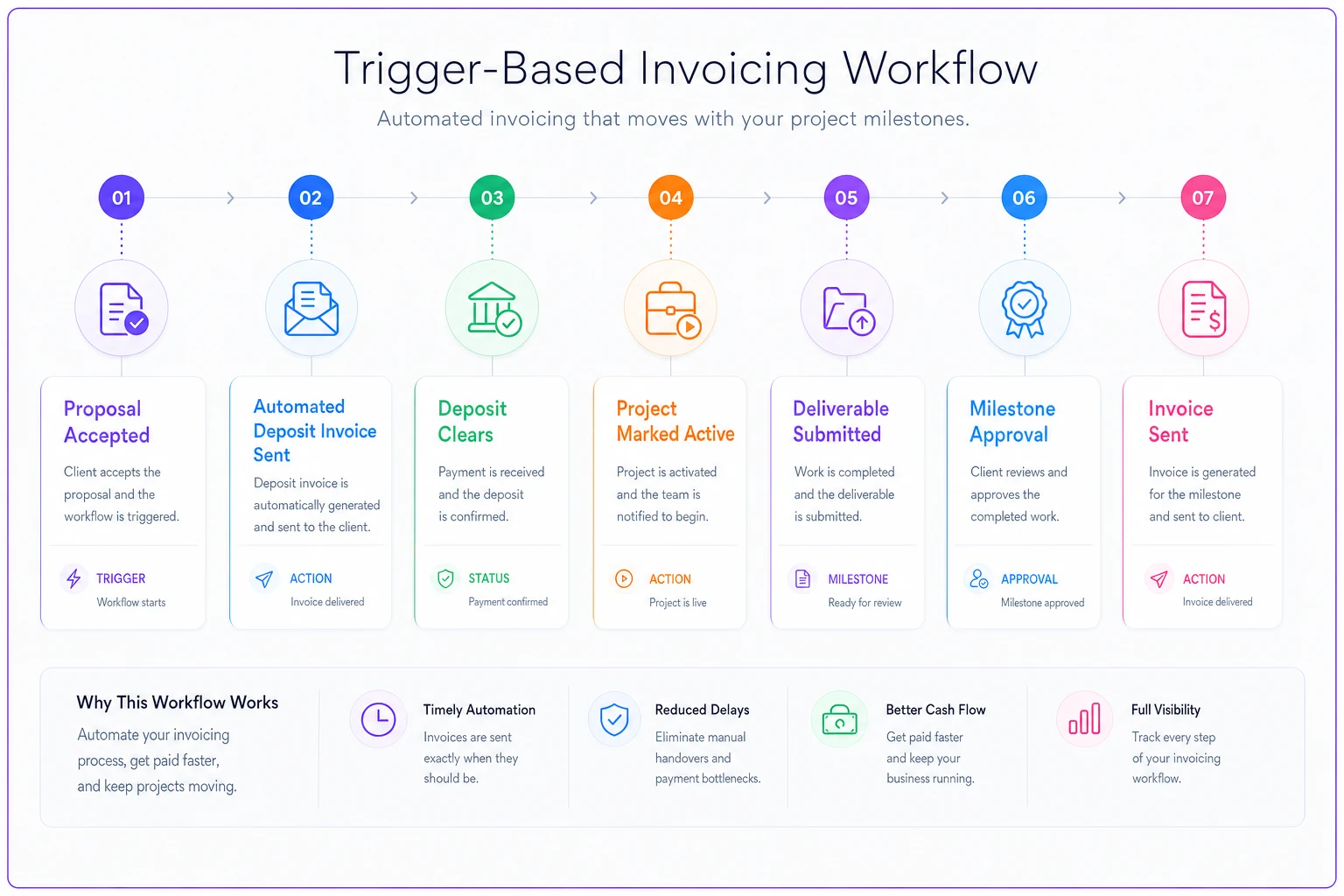
Trigger-based invoicing — when a proposal is marked accepted or a milestone is marked approved, the matching invoice generates and sends without you touching it.
-
Deposit-gated start dates — the project doesn't move to "active" until the deposit clears, so nothing slips through as unpaid work.
-
Linked deliverable + invoice records — so the deliverable, the approval, and the invoice all sit against the same milestone instead of scattered across email.
The point isn't to remove yourself from client communication — that part should stay human. It's to remove the remembering. Good operational software handles "the deposit was paid three days ago, here's your reminder to schedule kickoff" and "milestone 1 was approved, invoice sent" without you chasing it. You stay focused on the work; the sequence keeps moving.
Configure your proposal workflow so the deposit invoice automatically sends the moment the proposal is marked accepted.
Here’s a simple visual of the trigger-based flow.
The point isn't to remove yourself from client communication — that part should stay human. It's to remove the remembering. Good operational software handles "the deposit was paid three days ago, here's your reminder to schedule kickoff" and "milestone 1 was approved, invoice sent" without you chasing it. You stay focused on the work; the sequence keeps moving.
When a fast first-payment sequence makes sense — and when it doesn't
When it works well:
-
Project-based work with clear phases (design, dev, consulting, content).
-
Clients you don't have years of trust with yet.
-
Any engagement over roughly $2k–$3k, where a deposit is standard and expected.
When to loosen it:
-
Long-standing clients on repeat work who pay reliably — forcing a rigid deposit-gate on a five-year relationship can feel like distrust.
-
Very small one-off jobs where a deposit invoice creates more admin than it protects.
Who should skip the deposit-gate entirely:
-
Freelancers working through platforms that already hold funds in escrow — the platform is your trigger.
-
Anyone on retainer or subscription billing, where the cadence is already handled up front rather than deliverable-by-deliverable.
Match the aggressiveness of the sequence to the risk. New client, big project, no track record — full sequence, deposit on Day 0. Trusted client, small job — a simple invoice on delivery is plenty.
A short real scenario
A two-person branding studio kept starting projects on a handshake and a signed proposal, then invoicing the deposit "once the kickoff was scheduled." Their first payment on a typical $9k–$11k project was landing somewhere around 18–22 days after the client said yes.
They changed one thing: the deposit invoice now fires the same hour the proposal is accepted, framed as what locks the start date. Kickoff scheduling only unlocks after the deposit clears. First-payment timing dropped to roughly 3–5 days. No new clients lost, no pushback worth mentioning. The bigger effect was on the rest of the pipeline — because the first payment came fast, milestone invoices behind it tightened up too, and the studio stopped starting months in a cash hole.
Your onboarding-to-first-payment checklist
Before your next client starts, make sure each of these has a defined trigger:
-
[ ] Deposit invoice is attached to proposal acceptance, not to the kickoff call
-
[ ] Deposit is framed as what secures the start date
-
[ ] Kickoff scheduling only unlocks after deposit clears
-
[ ] First deliverable and its invoice ship in the same message
-
[ ] Each milestone approval automatically fires the matching invoice
-
[ ] Next phase is gated on the current invoice clearing
-
[ ] No invoice in the sequence depends on you remembering to send it
Stop treating billing as something that happens after onboarding and start treating it as part of onboarding. The client's first payment shouldn't be a moment you build up courage for — it should be a scheduled consequence of a step they were already going to take. Get the triggers right at the front, and the first receipt stops being the slowest part of every project.
Stop treating billing as something that happens after onboarding and start treating it as part of onboarding. The client's first payment shouldn't be a moment you build up courage for — it should be a scheduled consequence of a step they were already going to take. Get the triggers right at the front, and the first receipt stops being the slowest part of every project.
Ready to streamline your billing process?
Join 5,000+ businesses using Billoly to reduce billing delays, automate payments, and grow revenue efficiently.