



Most small businesses don't get burned on worker classification because they were trying to cheat the system. They get burned because their billing accidentally paints a picture that looks like employment. A recurring monthly retainer that never changes. Expenses paid the same way you'd cover a staff member's mileage. A contractor who invoices you and only you, at set intervals, with no separate business identity anywhere in the paper trail.
Auditors don't watch how you feel about the relationship. They read the documents. And your invoices, retainer agreements, and expense reimbursements are some of the loudest documents in the file.
This is a tight, operational look at how contractor invoicing compliance actually breaks down in the money flow — retainers, expense pass-throughs, and a handful of simple checks that keep you out of trouble. Not tax law. Not a lecture on the ABC test. Just the payment mechanics that quietly increase or decrease your risk.
The three payment patterns that trigger classification questions
Classification risk rarely comes from one giant red flag. It builds from small, repeated payment behaviors that, stacked together, look like an employment relationship.
These three show up most often in real books:
1. The frozen retainer. A contractor gets the exact same amount every month, on the same day, for some vague "ongoing support" scope. No deliverable variation, no project reference, nothing tying the payment to specific output. It reads exactly like salary. This starts innocently enough — a designer or bookkeeper on a flat monthly arrangement — and nobody thinks about how it looks two years later when the relationship is being scrutinized.
2. Expense reimbursement that mirrors payroll. When you reimburse a contractor for their phone bill, home internet, or a slice of their software subscription the same way you'd cover an employee's tools, you're signaling that you control their means of doing work. Contractors are supposed to carry their own overhead. Reimbursing operating costs — versus genuine project pass-throughs — is one of the quieter risk signals in the file.
3. Exclusive, indefinite, undifferentiated payments. One payer. No end date. No project structure. No sign the contractor bills anyone else or runs a real business. The money flow tells a story of dependence, and dependence is at the heart of most classification tests.
None of these is illegal on its own. But each one, embedded in your payment routine, is a data point. The fix isn't to stop using retainers or stop reimbursing project costs — it's to structure them so the paper trail actually matches a genuine contractor relationship.
Retainers: the difference between "salary in disguise" and a legitimate arrangement
A retainer is not the problem. A formless retainer is.
Stop chasing payments and start automating your billing.
Billoly empowers you to create, send, and track invoices effortlessly while maintaining professional client relationships.
- Customizable invoice templates
- Automated payment reminders
- Real-time payment tracking
No credit card required
The pattern that gets businesses in trouble: $2,500 a month, every month, for "consulting," no scope attached, paid on the 1st like clockwork for 18 months straight. When someone audits that relationship, there's nothing in the payment record to distinguish it from a part-time employee's paycheck.
A defensible retainer looks different in a few specific ways:
-
It references a scope or deliverable set — even a rolling one ("up to 20 hours of design work per month" or "monthly SEO reporting plus two content pieces").
-
Unused or overflow work is handled explicitly — rolls over, expires, or triggers additional billing.
-
The invoice comes from the contractor, on their letterhead or business identity, not generated by you and reimbursed.
-
There's a contract term with an end or renewal, not open-ended indefiniteness.
A practical example: a marketing consultant on a $3,000 monthly retainer. The weak version is a single line item — "Monthly consulting — $3,000." The strong version breaks out the retained scope, shows hours or deliverables consumed that month, and notes anything carried over. Same money. Completely different story on paper.
Deliverable-linked billing and low classification risk are basically the same document. If you're already using structured retainer documents, the invoicing side should match that structure — structured retainer documents that tie payment to specific deliverables serve double duty as your best classification defense.
When a flat retainer actually makes sense
-
The contractor clearly serves multiple clients and has an independent business identity.
-
The scope is genuinely fixed and the flat rate reflects a negotiated package, not a wage.
-
The engagement has defined boundaries — a term, a renewal decision, a real contract behind it.
When a flat retainer is a bad idea
-
The contractor works only for you, full-time hours, indefinitely.
-
You direct their daily schedule and methods.
-
The payment has quietly replaced what would otherwise be a role you'd hire for.
If most of those are true, you don't have a retainer problem — you have a hiring decision you've been avoiding.
Expense pass-throughs: the line that matters most
There's a real difference between a project pass-through and an operating cost reimbursement, and your books should keep them cleanly separate.
A pass-through is a cost you'd expect to change hands on a specific project — printing 500 brochures the contractor ordered for your campaign, a stock license bought for your specific deliverable, a subcontractor the contractor brought in for your job. These are billed to you, marked up or passed at cost, and tied to actual project work. Perfectly normal.
An operating cost reimbursement is you covering the contractor's cost of being in business — their laptop, their Adobe subscription, their portion of rent, their phone. That's overhead a real contractor absorbs. When you start covering it, you look like an employer providing tools and equipment.
| Item | Looks like a contractor pass-through | Looks like an employer providing tools |
|---|---|---|
| Materials bought for your specific project | ✅ Billed at cost, project-referenced | — |
| Subcontractor hired for your job | ✅ Line-itemed on their invoice | — |
| Their monthly software subscriptions | — | ⚠️ Reimbursing = risk signal |
| Their home internet / phone | — | ⚠️ Reimbursing = risk signal |
| Travel to a client site for your project | ✅ Documented, receipt-backed | ⚠️ Regular commute-style reimbursement |
| Their laptop or equipment | — | ⚠️ You buying = strong risk signal |
The operational rule: pass-throughs belong on the contractor's invoice as their line items; operating costs belong nowhere in your reimbursement flow. If a contractor's software is expensive, that's baked into their rate — not a separate reimbursement you process.
The same clean separation that speeds invoice approvals also keeps your classification story straight. Project costs only, receipt-backed, itemized on their invoice. Anything that looks like overhead stays off the reimbursement entirely.
A real scenario: the design studio that reimbursed the wrong things
A small branding studio — three full-timers, a rotating bench of five or six freelance designers — was reimbursing its regulars for a chunk of their Adobe Creative Cloud and, in two cases, splitting the cost of a new monitor. Felt generous. Felt like taking care of the team.
The problem surfaced during a state review of a former contractor's unemployment claim. The reimbursement pattern, combined with same-amount monthly retainers and no evidence the designers worked for anyone else, added up to a classification challenge on two of the five. The studio ended up on the hook for back employment taxes and penalties — somewhere in the $9k–$13k range once everything settled, plus a lot of accountant time nobody formally billed for.
The fix afterward was almost boring. They stopped reimbursing any software or equipment — freelancers priced their own overhead into their rates. Retainers got rebuilt around monthly deliverable ranges instead of flat "design support." Each contractor was required to invoice from their own business name, and the studio confirmed a couple of them actually worked for other clients.
Nothing about the money they paid changed much. The structure of how it was paid changed everything about how the relationship read on paper.
The simple compliance checks worth running
You don't need a compliance department. You need a short, repeatable check that runs before you onboard a contractor and periodically after. A pre-flight for the payment relationship.
Here's a practical sequence:
-
Collect the tax form before the first payment. W-9 (or the international equivalent) on file, no exceptions. Payment doesn't release until it's in. This single gate prevents most year-end scrambling.
-
Confirm business identity. Does the contractor invoice from a business name, have an EIN or registered entity, or at minimum present as a real independent operation? Note it in the file.
-
Check the exclusivity signal. Ask, and record, whether they work for other clients. You're not policing them — you're documenting that the relationship isn't structurally exclusive.
-
Review the retainer scope. Is there a deliverable, hour cap, or defined output tied to the payment? If it's a flat "ongoing support" line with no scope, flag it.
-
Separate pass-throughs from overhead. Confirm you're not reimbursing operating costs. Project costs only, receipt-backed, on their invoice.
-
Set a review date. Long-running contractor relationships drift toward looking like employment. A light annual re-check catches the drift before it becomes a problem.
Run steps 1–5 before the first dollar moves. Step 6 is a calendar reminder, nothing more.
The onboarding gate that saves you at tax time
The most common failure isn't dramatic — it's a missing W-9 discovered in January when you're trying to issue 1099s. You paid someone $4,000 across the year, now you can't reach them, and you're stuck. Gating the first payment on the tax form eliminates this entirely. If your onboarding sequence already runs required steps before the first payment releases, form collection just becomes one more item in that gate — and it never gets skipped.
Where light automation genuinely helps (and where it doesn't)
The compliance checks above are simple, but they fail for a boring reason: nobody remembers to run them. The onboarding rush, the "we'll get the W-9 later," the retainer that quietly runs 24 months without anyone re-reading the scope. This is where a workflow platform earns its keep — not by making judgment calls, but by refusing to let a payment proceed until the boxes are checked and by flagging drift you'd otherwise miss.
Automate a 12-month reminder to review retainer scopes so they don't drift into flat salary-like payments.
In practice that looks like: a contractor record that won't release payment without a W-9 attached, a reminder that fires when a retainer has run flat for twelve months with no scope update, and expense entries that require a project reference so operating costs can't slip in unlabeled. The classification judgment stays with you and your accountant. The remembering — the part humans reliably drop — is what's worth automating.
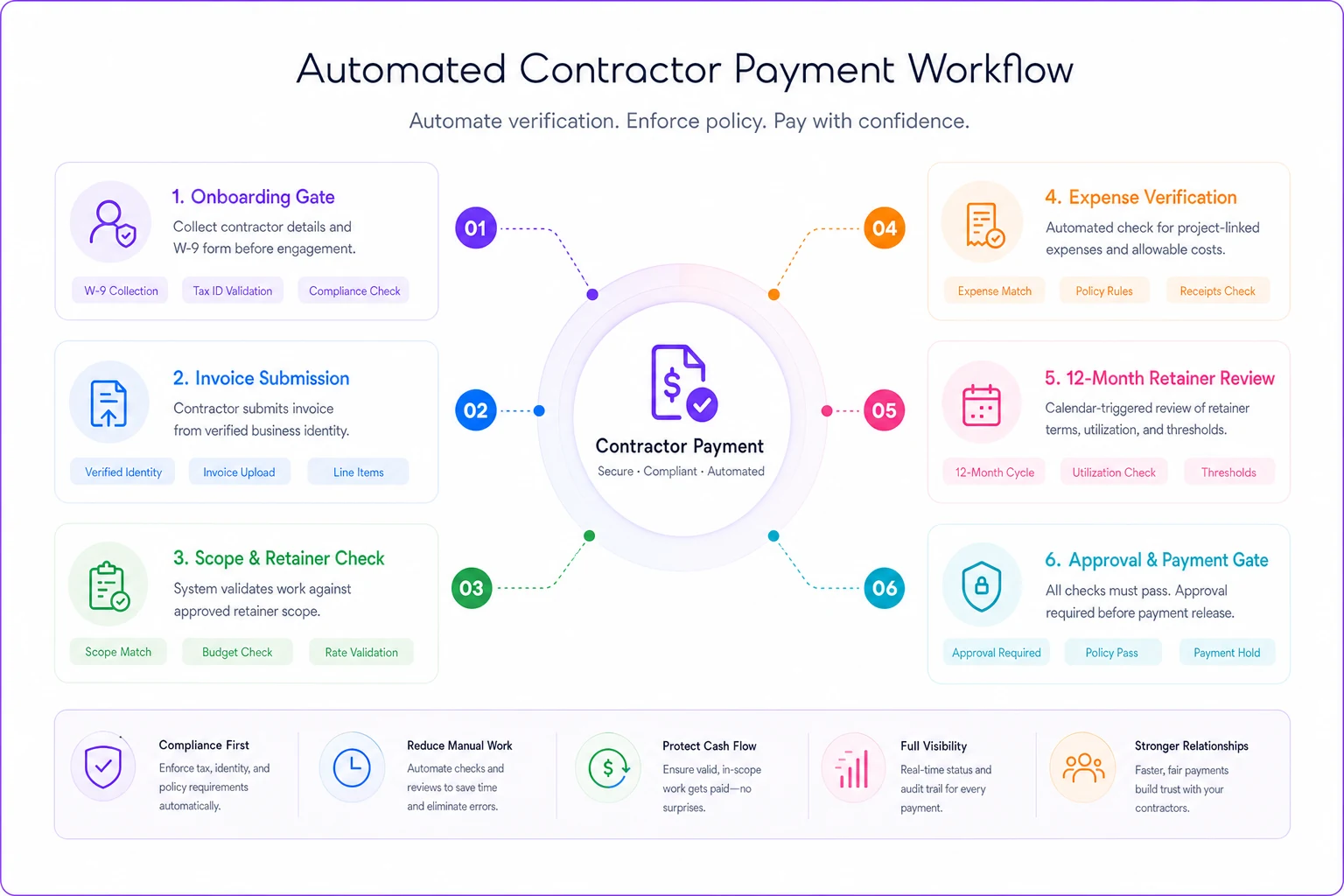
The point isn't to hand off compliance. It's to make sure the simple checks you already agree with actually happen every time, instead of being the thing you meant to do.
Who should be paying closest attention
If you use one or two freelancers occasionally on clearly-scoped projects, this is relatively low-stakes — keep W-9s on file and move on. The risk climbs fast when:
-
You have long-running contractors paid on flat retainers for a year or more.
-
You reimburse anything that looks like their overhead.
-
A contractor works substantially or exclusively for you at near-full-time hours.
-
You're in a state with aggressive classification enforcement — the standards vary a lot, and some are far stricter than the federal baseline.
If several of those describe your setup, the cheapest move you'll make this quarter is spending an afternoon restructuring how those payments are documented — before anyone else does it for you.
Bringing it together
Worker classification risk hides in the plumbing of how you pay people, not in your intentions. A retainer with no scope, an expense flow that covers a contractor's overhead, a payment relationship with no independent-business signals anywhere — each is a normal, well-meaning choice that quietly builds the wrong picture.
The correction is almost entirely structural. Tie retainers to deliverables. Keep project pass-throughs strictly separate from operating-cost reimbursements. Gate first payments on a W-9. Note whether contractors serve other clients. Re-check the long-running relationships once a year. None of it changes the economics of what you're paying — it just makes the documents tell the truth about a relationship that already is what it is. Get the paper trail to match the reality, and classification stops being something you lose sleep over.
Get the paper trail to match the reality, and classification stops being something you lose sleep over.
Ready to streamline your billing process?
Join 5,000+ businesses using Billoly to reduce billing delays, automate payments, and grow revenue efficiently.