


Most designers, illustrators, video editors, and copywriters don't lose money on their rates. They lose it in the fuzzy space between "the work" and "what the client actually does with the work." A logo gets used on a national billboard. A photo shoot ends up in a paid ad campaign. "Just a couple tweaks" turns into round nine. None of it was priced, because none of it was written down on the invoice or the contract that fed it.
This is the specific gap I want to close here: how to write billing for creative freelancers that protects revisions, licensing, and usage — with actual clause language and line-item examples you can lift. Not payment terms, not collections, not reminders. Just the sector-specific parts of a creative invoice that generic templates completely ignore.
Why creative invoices leak in three predictable places
Standard invoicing tools were built for people who sell hours or units. A creative deliverable isn't either of those. It's a piece of intellectual property with a scope of use attached to it, and the value often has nothing to do with how long it took to make.
-
Revisions. No cap, or a cap that lives in an email nobody re-reads. The client assumes "unlimited until you're happy." You assumed "two or three."
-
Licensing. You hand over a file. The client assumes buying the file means buying every possible use, forever, everywhere. You assumed you were licensing a specific use.
-
Usage / media buyout. A social post rate and a national TV rate are wildly different, but the deliverable looks identical. Without a usage line, you get paid the social rate for TV exposure.
The leak almost never happens at the moment of sale. It happens three weeks later when scope quietly expands and there's no clause to point back to. If it's not on the estimate and echoed on the invoice, it doesn't exist.
Revision caps: the clause that saves the most relationships
Revisions are where creatives bleed hours without noticing, because each individual request feels small. "Can you make the logo a touch bigger?" isn't worth invoicing. But eleven of those across a month absolutely is.
Stop chasing payments and start automating your billing.
Billoly empowers you to create, send, and track invoices effortlessly while maintaining professional client relationships.
- Customizable invoice templates
- Automated payment reminders
- Real-time payment tracking
No credit card required
The fix isn't to be stingy. It's to define what one "round" means and what happens after the included rounds run out.
> Revisions. This project includes two (2) rounds of revisions. A "round" is a single consolidated set of feedback delivered in one document or message. Requests submitted after a round has begun will be held for the next round. Additional rounds beyond those included are billed at $95/hour, in 30-minute increments, with an estimate provided before work begins.
Two things in there do the heavy lifting. First, defining a round as one consolidated set of feedback stops the drip of ten separate emails from eating you alive. Second, the "held for the next round" line trains clients to batch their notes, which genuinely makes the work better, not just cheaper for you.
| Description | Qty | Rate | Amount |
|---|---|---|---|
| Brand mark design — concept + 2 revision rounds (included) | 1 | $2,400 | $2,400 |
| Additional revision round (round 3) | 1.5 hrs | $95 | $142.50 |
Showing the included rounds as a zero-cost-but-visible item does something subtle: it reminds the client they already got two rounds before they ever see a charge for the third. The extra fee stops feeling like a surprise and starts feeling like the natural continuation of a deal they already agreed to.
A common mistake is billing the overage silently and hoping nobody notices. They notice. Send the estimate before the third round, get a one-line "go ahead," and the charge becomes uncontroversial.
Licensing: you're selling a use, not a file
This is the section most freelancers skip entirely, and it's where the biggest single checks live.
When you deliver a design or a photo, you're licensing specific rights. The default under copyright law in most jurisdictions is that you, the creator, own the work unless you explicitly transfer it. Clients rarely know this, so silence gets interpreted as "I own everything now." You have to spell out the boundary.
-
Scope of use — where and how it can be used (web only? print? paid ads? merchandise?)
-
Duration — one year, three years, perpetual
-
Territory — local, national, worldwide
A photographer shooting product images for a small e-commerce brand's website is a completely different deal than the same photos ending up on a Times Square screen. Same shoot, radically different value.
> License Grant. Upon receipt of full payment, Creator grants Client a non-exclusive license to use the deliverables for [website and organic social media], in [North America], for a period of [two (2) years]. Uses beyond this scope — including paid advertising, print, packaging, or resale — require a separate written license and additional fee. Creator retains ownership of all copyrights and underlying files not expressly licensed.
Notice "upon receipt of full payment." That clause means the license doesn't legally transfer until you're paid, which quietly gives you leverage that has nothing to do with chasing anyone.
> Buyout Option. Client may acquire a full, perpetual, worldwide, exclusive assignment of the deliverables for an additional fee of $[amount], payable in addition to the project fee. Upon payment, all rights transfer to Client.
Freelancers hand over full rights for the base project fee because "the client asked nicely" more often than you'd think. Exclusivity means you can never reuse or relicense that work again — that's worth something, and pricing it at zero trains the whole market to expect free.
Usage fees: pricing exposure, not effort
Usage sits next to licensing but answers a different question: not can they use it but how much reach are they getting. Ad agencies have priced this way for decades. Freelancers usually don't, and leave the difference on the table.
A typical example: an illustrator quotes $1,800 for a set of spot illustrations, assuming they'll live in a blog and a newsletter. The client loves them and runs them as the hero visuals across a six-week paid campaign. The creation fee was fair. The usage — national paid media for a limited window — was never priced. Depending on the client's size, that could reasonably have been another $2k–$5k.
You handle this with a usage line and a tiered structure agreed up front:
-
Digital paid (social/display), 90 days
+$[amount]
-
Out-of-home / print, per campaign
+$[amount]
-
Broadcast / streaming
quoted per placement
Client agrees to notify Creator before extending deliverables to paid channels.
That last notification line matters more than the numbers. It creates an obligation to tell you before the exposure expands, which is the whole game.
When usage fees actually make sense
Charging separate usage fees makes sense when the work is going into advertising, when the client is a mid-size or larger brand, or when exclusivity and reach genuinely affect what the work is worth. It's overkill for a tiny local business getting a one-off logo. A solo bakery doesn't need a broadcast usage tier, and pushing one just makes you look like you're inventing fees.
Schedules that keep licensing straight over time
For anyone doing repeat or ongoing creative work, the problem isn't one contract — it's tracking who licensed what, for how long, and when it expires. A photographer with forty past clients has no realistic way to remember that Client #17's two-year license lapses next spring.
Attach the rights schedule to the invoice file so the license terms travel with the payment record.
A simple rights schedule attached to each invoice solves the memory problem. It's just a structured record:
| Deliverable | License type | Territory | Term | Expires | Renewal fee |
|---|---|---|---|---|---|
| Product photo set A (12 images) | Non-exclusive, web + social | North America | 2 years | 2027-04 | $600 |
| Hero banner illustration | Non-exclusive, paid digital | Worldwide | 90 days | 2026-02 | Re-quote |
Keeping this attached to the invoice — not buried in a separate contract folder — means the terms travel with the money record. When a client circles back a year later wanting to keep using something, the renewal fee and expiry are right there.
This is one place where invoicing software with custom fields and structured line items per client earns its keep. Instead of digging through old PDFs, license terms, expiry dates, and renewal fees live alongside the payment history. Reviewing what's expiring next quarter becomes a two-minute task instead of an afternoon.
A five-step workflow to put this in place
You don't need to rewrite every contract tonight. Sequence it:
-
Set your revision default. Pick a standard included-rounds number and an hourly overage rate. Same for every project unless you deliberately change it.
-
Build a licensing menu. Write out your three or four standard license tiers (owned-channel, paid digital, broadcast, buyout) with real prices. This becomes your reusable reference.
-
Put the clauses on the estimate and the invoice. The estimate sets expectations; the invoice creates the paper trail. If they only appear in one, the other becomes the loophole.
-
Add a rights schedule to every deliverable. Even a two-row table. Future-you will thank present-you.
-
Flag expiries. Whether it's a spreadsheet reminder or a field in your billing tool, know what lapses in the next 90 days.
Running through this sequence once, properly, takes maybe half a day. After that it's maintenance.
Here's a quick visual of the sequence:
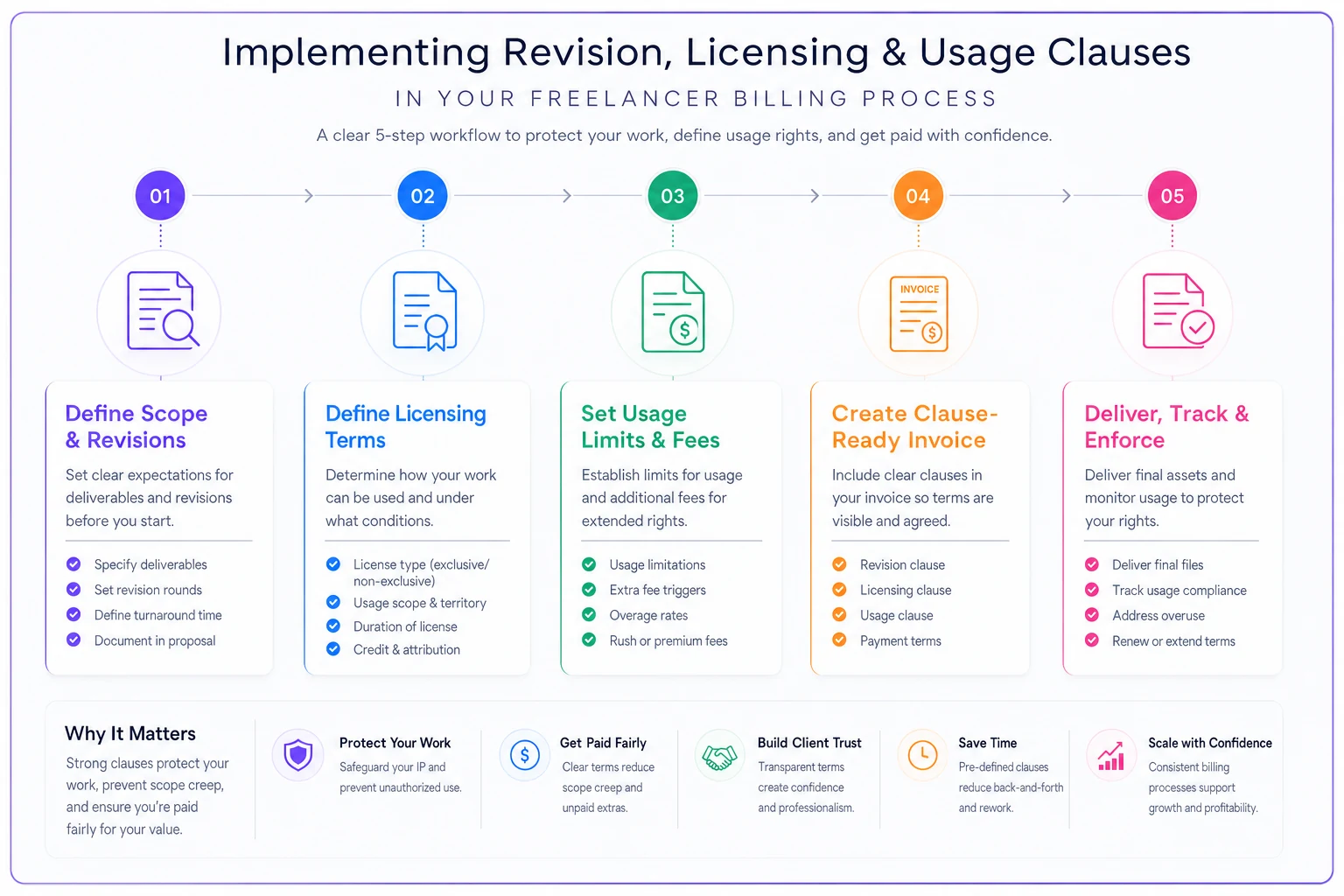
Use the visual as a checklist when you update your templates.
Pre-send checklist for creative invoices
Before any creative invoice goes out, confirm:
-
[ ] Included revision rounds are stated and visible (even at $0)
-
[ ] Overage rate and increment are named
-
[ ] License scope, term, and territory are spelled out
-
[ ] "Upon full payment" language ties the license to getting paid
-
[ ] Usage/paid-media terms included if the work could run in ads
-
[ ] Buyout price listed if full-rights transfer is on the table
-
[ ] Rights schedule attached with expiry dates
-
[ ] Ownership-of-files line clarifies what the client is not buying
Print it out and tape it next to your monitor if you have to. The ten seconds it takes to scan this list before hitting send has saved more awkward client conversations than any contract clause alone.
Real scenario: the freelance brand designer
A solo brand designer doing mostly logo-and-identity work — roughly $4k–$6k per project, maybe two projects a month — kept running into the same two problems. Revision rounds routinely stretched to five or six with no extra charge, and a handful of past clients had scaled up and were using her work in paid campaigns she'd originally priced as small local jobs.
She made two changes. First, a hard two-round default with a $90/hour overage, stated on both the estimate and the invoice. Second, a basic licensing menu separating owned-channel use from paid-media use, plus a buyout option.
Nothing dramatic happened overnight. Within a few months, revision creep basically stopped — clients started batching feedback once they saw a round-three line could appear. Two clients who'd expanded into paid ads paid usage fees they'd previously gotten for free, adding somewhere around $3k across that stretch. No relationships broke. The terms were just clear enough that the conversation happened before the work, not after.
When this is overkill
Not every freelancer needs the full apparatus. Occasional favors for friends' businesses, or one-off small jobs where the total fee is a couple hundred dollars — a heavy licensing structure just adds friction and makes you look more corporate than the job warrants. Match the paperwork to the stakes.
The moment it becomes worth doing is when your work starts reaching real audiences: paid ads, retail, anything where the client's use of the work is generating money. That's where a missing usage clause stops being a minor omission and starts being the difference between a fair deal and a giveaway.
Closing thought
The rate you charge is the easy part. The harder, more valuable skill in creative billing is defining the edges of what you're selling — how many rounds, what use, for how long, over what territory — and getting those edges onto the same document that asks for money. Do that consistently, and the awkward "wait, that's extra?" conversations mostly disappear, because the answer was already written down before anyone started arguing about it.
Ready to streamline your billing process?
Join 5,000+ businesses using Billoly to reduce billing delays, automate payments, and grow revenue efficiently.